x



Storm surge in Hamburg - fish market under water
Storm surge in Hamburg - fish market under water
"Sabine" rages in Europe under the name "Ciara". At least five people died. In Hamburg the fish market was under water.
The storm "Sabine" hit rail and air traffic particularly hard in Germany, but the damage was limited overall.
Further storms cannot be ruled out in the next few days.
Deutsche Bahn had its long-distance traffic started again on Monday, but recommended that trips planned for Tuesday be postponed.
In Berlin there are further restrictions on the S-Bahn. Parks should not be entered for the time being.
In many countries in Europe, flights were canceled and schools were closed.
Hamburg fish market under water
In Hamburg-St. On Monday the fish market was under water for Pauli. The apex was more than 2.70 meters above the medium flood in the early evening, so that the flood gate at the fish market was closed for safety. By 5.45 a.m. on Tuesday morning, a level of over 1.50 meters above the medium flood was expected, according to the Federal Maritime and Hydrographic Agency.
A death in a traffic accident in Switzerland
In Switzerland, a man died in a traffic accident that, according to the police, was probably caused by strong winds. As the cantonal police in Freiburg announced, the trailer of a 35-year-old got into the oncoming lane and crashed there with the car of a 36-year-old. The emergency services could only determine the death of the 36-year-old. After initial investigations, the police assume that the trailer was pushed onto the oncoming lane by the storm
Railway problems are still ongoing in Bavaria
After the hurricane "Sabine", Deutsche Bahn (DB) is also expecting train cancellations and delays on Tuesday. Especially in the Werdenfelser Land around Garmisch-Partenkirchen and in the Allgäu, railway lines are still blocked, the DB said late Monday afternoon. "Elsewhere, train traffic is starting up again." Damages have been remedied at more than 100 locations. "In particular, fallen trees on overhead lines and tracks blocked the routes."
First of all, the DB and the private railway companies shut down almost all regional rail traffic in Bavaria on Monday morning due to the storm lows. No long-distance trains had run on long-distance traffic before
Man blown from the roof and seriously injured
Blown into a man from the roof of his house in Thuringia. He was injured in a hospital in Erfurt, said a spokeswoman for the district office of the Ilm district on Monday. In view of the storm's low "Sabine", the man tried on Sunday evening to secure the roof of his house in Bechstedt-Wagd, a district of the Wachsenburg district
Britain hit particularly hard
In the UK, which had been hit particularly hard by the hurricane on Sunday, the clean-up began on Monday. However, a spokesman for the weather authority warned that pulling out "Ciaras" does not necessarily mean easing the situation. Now icy winds and up to 20 centimeters of snow threatened. "The risk of violent snowstorms cannot be ruled out," said Alex Burkill.
Flights and train connections across the country were canceled or delayed. In some parts of the country, as much rain fell in 24 hours as in a month and a half. There were still 180 flood warnings in effect on Monday.
The West Yorkshire region was hit hardest by the storms. Cars were flooded in the cities of Hebden Bridge and Mytholmroyd, tens of thousands of households were without electricity. The ferry service between Dover and Calais, which was discontinued on Sunday, was resumed on Monday morning.
British Airways and Virgin Atlantic passengers, however, gave "Ciara" an unexpected drive. The hurricane low shortened the flight time from New York to London to new record values: three machines covered the 5554 km route in under five hours, as reported by the portal Flightradar24
Power and flight outages in Europe
The French network operator Enedis announced that about 130,000 households were without electricity due to "Ciara". The north and east of France were hit the hardest. Train traffic in France was "badly disrupted", as the railway company SNCF said. Around 50 flights were canceled at the two Paris airports.
The fire brigade deployed hundreds of times, particularly in eastern France. Electricity pylons buckled there, roofs were covered and fallen trees blocked roads. Wind gusts of up to 200 kilometers per hour were measured.
In the Netherlands, morning rush hour traffic, according to police, spilled over a total length of more than 600 kilometers. Around 220 flights were canceled in the morning at Amsterdam Schiphol Airport. As early as Sunday, 240 pilots were unable to take off there.
School lessons in Luxembourg were canceled due to the storm on Monday, while in Belgium morning rush hour came to a standstill due to road closures and floods. For safety reasons, an entire offshore wind farm shut down off the Belgian coast
At least four dead across Europe
The storm "Ciara", which is raging in Germany as "Sabine", has hit other parts of Europe with full force. At least four people died, and traffic chaos and blackouts occurred in many countries. Hundreds of planes had to remain on the ground on Monday at wind speeds of up to 200 kilometers an hour, including in Great Britain and the Netherlands. The storm also affects traffic in France and Belgium.
According to British police, a man died on a freeway in southwestern London when his car was hit by an uprooted tree. In Poland, a woman and her daughter died from a falling roof torn from the building by gusts of wind nearly a hundred kilometers an hour. A man died in southern Sweden when his boat capsized. After the boat accident, a person was also missing.
In other deaths, the connection to the storm was not entirely clear or indirect. In Paris, a man fell off a scooter and died from the consequences of his head injury. The police did not rule out that a wind gust was the cause of the accident.
In Germany, a truck driver had died who collided with his truck on Autobahn 67 in the south of Hesse on a barrier trailer from the Autobahnmeisterei stationed in the right lane, the police said. According to this, clearing work took place in the lane due to the storm when the accident occurred.
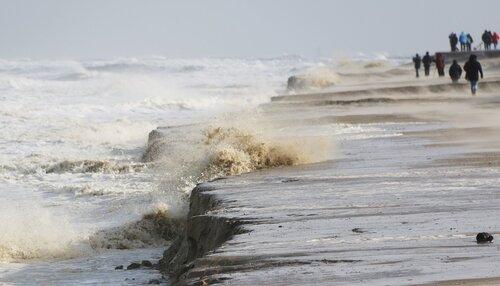
Sturm tears large pieces off the beach on Wangerooge
Storm "Sabine" badly damaged the beach on Wangerooge. The demolition edge is sometimes up to two meters high and extends on the main beach for a length of about one kilometer, said the island's deputy chairman of the island, Peter Kuchenbuch-Hanken (Greens).
Wangerooges Mayor Marcel Fangohr (non-party) said the peak of the tide was higher than predicted. "If that lasts for three days, then maybe we won't have a beach afterwards."
A spokesman for the Lower Saxony State Agency for Water Management, Coastal Protection and Nature Conservation said four more are expected by Wednesday after the light storm surge on Monday afternoon. Then you will assess the damage.
Stop at the train - what was the strategy behind it?
For the second time in just over two years, Deutsche Bahn has completely stopped long-distance traffic - even though the storm went out comparatively lightly. Was it cautious to leave the ICE and Intercity trains completely in the stations? Or did it even help to keep the damage to a minimum?
"We were able to largely prevent trains from being left on the open route and passengers from there having to be evacuated," a spokesman said on Monday why the train stopped. "We want to supply our passengers in train stations in extreme weather conditions."
A few years ago, trains ran much longer in the face of a storm. Before the Friederike storm hit in early 2018, there had been no complete blockage in long-distance transport for eleven years. But in the meantime, the train is giving the stop signal much earlier, sometimes also regionally limited, for example in 2019 in northern Germany in September and in North Rhine-Westphalia in March.
The company headquarters says that the handling of major disruptions such as storms has been comprehensively revised. The railway speaks of good experiences and sees itself confirmed. Because the stronger the storm rages, the greater the risk of accidents and the likelihood of train evacuations on the open route. "Safety has absolute priority - the safety of both passengers and our employees," stressed the train on Monday. If the trains are in the station, according to the company, operations can be started again better after the storm.
"The focus is on the ability to plan travel and rail operations despite considerable restrictions," emphasized the railways. She had advised to postpone travel days before the storm. Many passengers had informed train employees that they could reschedule. The railroad scolding on social media was limited during “Sabine”, thanks also to passengers
"Sabine" would have had more consequences in the summer
"Sabine" would have had more consequences in the summer
The storm depression "Sabine" could have had significantly more serious consequences in the summer months. Guido Wolz from the German Weather Service (DWD) in Munich said that it is known that summer storms uproot the trees more easily. "If the trees don't have foliage, they're less vulnerable," he said. A storm similar to that on Monday would probably have knocked down significantly more trees in summer
Fatal accident when cleaning up
A fatal accident occurred on highway 67 in the south of Hesse during cleanup work due to the storm "Sabine". A truck driver was killed on Monday morning when his truck collided with a motorway service department's trailer in the right lane, the police said.
Accordingly, clearing work took place on the lane between Lorsch and Viernheim because of the storm when the accident occurred. It is unclear why the truck hit the barrier trailer. The driver was caught in his vehicle and died at the scene of the accident. The police were unable to provide precise information about the man's identity
"Hurricane that occurs every two to three years in Germany"
According to the German Meteorological Service, Sabine is not a top-class urbane like "Kyrill" or "Lothar". A storm like "Sabine" occurs in Germany every two to three years.
The highest wind speeds
It was the stormiest on Monday in Feldberg in the Black Forest. There wind speeds of 177 kilometers per hour were measured. This is announced by the German Weather Service. But even in the lowlands like in the Bavarian Fürstenzell, gusts were up to 154 kilometers per hour. The hurricane swept up to 161 kilometers an hour on the Großer Arber, the highest mountain in the Bavarian Forest at 1456 meters. According to the DWD, “Sabine” is approaching the “Kyrill” storm in Bavaria, which caused severe damage in January 2007.