x



Suicide of a democracy
Benin has long been considered a model for Africa. However, the recent elections are evidence of the democratic decline.
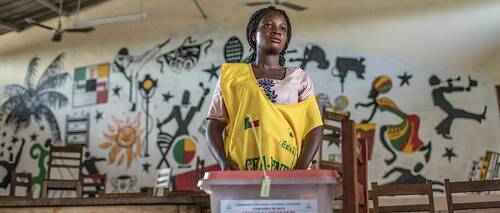
Sparse selection at the ballot box - polling station in Cotonou on April 28, 2019
Read this article also in English.
Elections to the exclusion of the opposition - a novelty in Benin since the end of the dictatorship and the subsequent "renouveau démocratique". Benin was considered a model that, despite the low geopolitical and economic importance of the country with only 11 million inhabitants, radiated to many other countries in Africa. The country was used as a regional example for democratic change, regular and orderly elections and peaceful transfers of power. Is this model now at the end? Democracy: "en panne"? Social peace: at risk?
On April 28, five million voters were called to designate MPs for the National Assembly, the Beninese Parliament. Even before the final count, it is clear that the 83 future representatives will only belong to two parties, the "Bloc Républicain" and the "Union Progressiste". Both groups are close to the current President Patrice Talon and have supported the incumbent government since taking office.
Excluded from the elections were five other, mostly opposition parties, which - according to the verdict of the state electoral authority - had not qualified enough to participate. This sparked a passionate public debate ahead of the poll. If Beninese intellectuals are believed, there has been no comparable democratic crisis since the overcoming of the self-defining Marxist-Leninist one-party state 30 years ago and the introduction of democratic institutions. They fear that, with the support of the political groups that support him, the president can (have) all constitutional changes decided in the future in order to secure more presidential rights and thus greater power to implement the reforms he is striving for. In the past, attempts by the opposition in Parliament and the Constitutional Court had failed because they feared that the head of state would be too powerful.
Both sides remained adamant; “Gambled”, some think; "Perfidiously concocted," say the others.
How could it come to this? It all started with a change in the charter of political parties that the National Assembly decided in July 2018. The aim of the reform was to anchor political parties more broadly throughout Benin and thus raise the threshold for ethnic and / or regionally oriented associations. Above all, this was to be achieved by recruiting 15 “founding members” in each community, 1155 “membres fondateurs” per party nationwide. In September 2018, the MPs then introduced a new electoral law. The aim was to end the fragmentation of the party landscape (currently around 200) and to promote the formation of larger political blocs. Each party must now collect at least 10 percent of all votes to secure seats in the National Assembly. On the other hand, the deposit of the equivalent of around 380,000 euros is required as a prerequisite for admission to the election. Finally, in February 2019, the national constitutional court ruled that the parties must also submit a “certificate of conformity” to the electoral authority, which is to be issued by the Ministry of the Interior.
As a result of the election authority's review of the candidatures, only two parties were admitted, whose documents were allegedly only noticed by "minor irregularities". All other competitors' documents appeared to have unacceptable deficits that led to their disqualification.
Attempts to resolve the situation were carried out on many levels. However, neither the President nor the Constitutional Court saw themselves able to contribute to making the election process more representative through their own interventions. The National Assembly was also no longer able to do anything: the opposition and the "Bloc Majoritaire", who held the president, did not want to agree on a flexible interpretation of the right to vote or to change existing laws in favor of an "inclusive election". A consensus-based exegesis of the laws and ordinances by the parliament would - constitutionally - still have allowed modifications in the admission of the parties. Both sides remained adamant; “Gambled”, some think; "Perfidiously concocted," say the others.
The opposition has used pithy words to call for powerful demonstrations against the exclusion of its parties. This appeal only met with a moderate response.
It would be premature to make any predictions about the further development of democracy. Nevertheless, signs of a decline in democratic achievements can be observed in the current domestic political development in Benin. In Benin, the right to strike has been curtailed for a year and the release of officials and state employees has also been made easier. With the ban on the print edition of "La Nouvelle Tribune", the most read critical newspaper in the country, the press has lost a renowned voice. In the 2019 Reporters sans Frontières annual report, Benin fell by twelve places. A Beninese specialty is the targeted reduction of leeway for political opponents and uncomfortable sections of society through finely chased bureaucratic guidelines, the legitimacy of which cannot be fundamentally questioned, but whose strict compliance is hardly possible due to limited capacities, a lack of competence and the insufficient equipment of the Beninese authorities. This corset can be tightened as required.
The opposition has used pithy words to call the Beninese people for powerful demonstrations against the exclusion of their parties. This appeal only met with a moderate response. There were isolated isolated actions of dissatisfaction, which could quickly be dispersed by the security forces who rushed to the province. The armored cars procured last year are visible expression of the attentive state power across the country. The arrests of prominent opposition figures and journalists were intimidating, but were released after a few days in custody.
In order to prevent an impending boycott of large parts of the population, the government-friendly newspaper “La Nation” published a precautionary measure two days before the election, threatening prison terms and fines that incite others to abstain, possibly using “wrong information”. On the day of the election itself, the Internet was turned off without giving a reason. After all, the "exclusive" election and the negative position of many well-known public figures seems to have prevented many citizens from voting.
Less than half of the population is convinced that democracy works.
The confidence of the Beninese population in their elected representatives is not very high and has decreased in recent years: less than half of the population is convinced that democracy works. In fact, during the past legislative periods, parliamentarians have largely dealt with power games; After their election to the National Assembly, many endeavored to integrate themselves very quickly into the current majority block, free of any political program, which the respective presidents knew how to organize after taking office. The contribution of Parliament - like that of previous governments - to a structural transformation of their country is hardly noticeable.
The lack of reaction of the population in the face of the loss of the external signs of democratic structures is understandable, because a "democratic return" has not yet reached a large number of people, especially the poor. The country remains in one of the last places in international social and economic indices. The effects of a partially dynamic economic development have been partially offset by population growth; the rest of the surplus is distributed to members of a growing middle class, especially in the urban centers in southern Benin. Inequality in the country has continued to increase in recent decades.
Not a good starting point for the preservation and further development of democratic achievements. No great support is expected from outside, because the Beninese development, apart from some lip service to democracy, will not allow the international community to get any noticeable reactions. In this respect, it remains a challenge that national actors - politicians, scientists, activists, civil society - have to accept, to form alliances and coalitions in order to stop a creeping autocratization. Attractive alternatives to the existing system that promise inclusive economic, social and political progress are still lacking. Social movements and political parties that can rely on a population base are still in short supply. Perhaps the current political crisis also has the potential to promote such initiatives.