x





Devil population crashes caused by contagious tumours have knock-on effects elsewhere in the food chain.
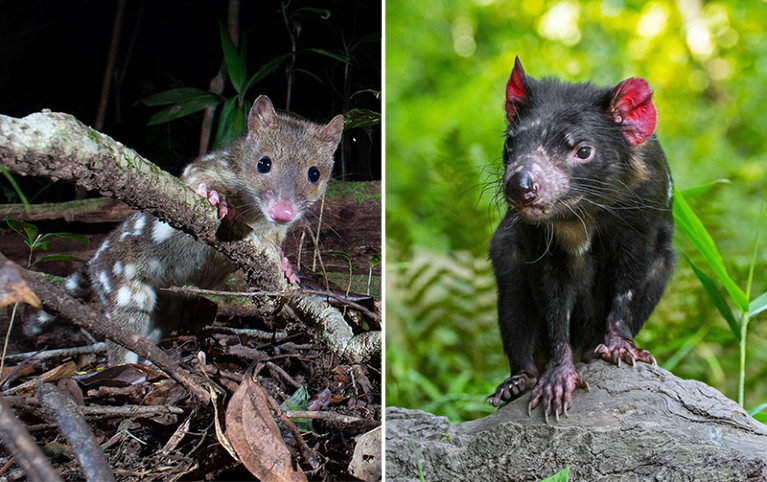
Spotted-tailed quolls (left) and Tasmanian devils (right) have similar diets and are both active at night.Credit: Bruce Thomson/NPL; Arterra Picture Library/Alamy
Declining numbers of the endangered Tasmanian devil (Sarcophilus harrisii) are affecting the evolutionary genetics of a small predator, the spotted-tailed quoll (Dasyurus maculatus), according to a study published today in Nature Ecology & Evolution1.
The findings fit with what scientists would expect — typically, when a top predator’s population dwindles, smaller predators increase in number because there are more resources available and less competition.
But little is known about what the effect of a top predator’s decline is on the evolutionary genetics of other species in the food web, says study co-author Andrew Storfer, an evolutionary geneticist at Washington State University in Pullman. “This is one of the first studies to demonstrate that.”
For the past three decades, Tasmanian devils — carnivorous marsupials native to the island of Tasmania in Australia — have been affected by an infectious type of lethal cancer known as devil facial tumour disease (DFTD). The devil population has declined by nearly 70%, from 53,000 in 1996 to 16,900 in 2020, mainly because of DFTD, which is passed on through biting2.
Storfer and his PhD student Marc Beer wanted to study how this decline in devil numbers is affecting another marsupial, the spotted-tailed quoll. Devils and quolls have similar diets and are both active at night, scavenging for food. But devils are larger and more aggressive, so quolls tend to avoid them.
The researchers analysed 3,431 genetic variants in the genomes of 345 quolls across 15 generations. They searched for evidence of changes in the variation and selection of genes in quolls that could be associated with the prevalence of DFTD in devils and with the devils’ population density.
They found that quolls in regions with similar spreading rates of DFTD were genetically more similar to each other compared with those in areas that had different DFTD prevalence and devil population densities. They also found evidence of genetic selection in response to changes in devil numbers, and identified 12 gene variants in quolls that are linked to devil population density and 10 associated with the number of years DFTD has been prevalent for in devils. Among these genes are ones important for movement and muscle development, as well as some linked to feeding behaviour.
The study showed that the distribution of genetic variation in quolls is increasing, but that genetic exchange — the movement of genes into or out of populations — is decreasing. This might be because, when few devils are present, quolls do not need to move around as much as they do in areas with a high devil density, thus reducing the chance of animals from different populations encountering each other. “Less genetic exchange among populations will eventually lead to lower genetic diversity within populations. And there are evolutionary consequences of that,” says Storfer. “We really don’t know what they are.”