x




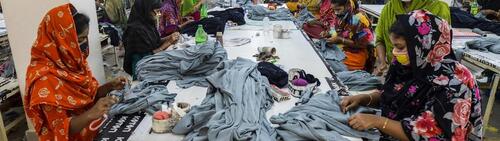
Fashion chains make no sales in the corona crisis - according to human rights organizations, this brings textile workers in Asia into distress: textile factories no longer pay wages or dismiss their seamstresses.
In light of the expected slump in sales in the Corona crisis, international retail companies have canceled their orders from suppliers. Hundreds of thousands of factory workers in Asia are threatened, according to the human rights organization Human Rights Watch (HRW).
According to the organization, the most affected are seamstresses who manufacture clothing for so-called fast fashion chains such as C&A or H&M. "Workers still got their March wages in many cases, but I think there will be total chaos in April," HRW legal advisor Aruna Kashyap told dpa. Many companies have even canceled the order for finished goods. For the seamstresses in Cambodia, Myanmar and Bangladesh, this means that they do not receive any wages for the work they do because their employers do not have the contract payments.
International companies took advantage of existing, unfair purchasing practices to protect themselves against losses - at the expense of workers, added Kashyap. In Cambodia alone, according to the Ministry of Labor there, more than 110 clothing factories, which together employ almost 100,000 workers, have suspended their production due to the pandemic.
In Bangladesh, more than 1,000 factories are closed, according to the women's rights organization Femnet. The organization also highlighted the extremely difficult situation for hundreds of thousands of migrant workers, who would normally be precariously employed as day laborers in factories in the Indian state of Tamil Nadu, and who no longer received wages from their agents. From one day to the next, they would no longer have any money for food or rent.
According to Human Rights Watch, it has been estimated that a million workers have already been laid off or sent on unpaid leave - the organization reports similarly high numbers for Myanmar and Cambodia.
The German company C&A is one of the dealers who have canceled their orders. In a letter dated March 23 from a dpa to a supplier in Cambodia, the company stated that "all orders" for the period up to the end of June would be "canceled with immediate effect". It was consensus that the corona pandemic is considered an event of force majeure, it said. In such cases, it is justified if the company does not feel bound by its contractual obligations.
Miriam Saage-Maaß of the human rights organization ECCHR contradicts this: "Force majeure cannot be cited if the contract is simply not practical or economically difficult," she said. In addition, a company had to prove that the problem was unpredictable - and the company was aware of the risk of a pandemic.
The C&A spokesman Jens Voelmicke said on request that the letter was initially "an immediate measure". Since then, the company has been striving for "individual, flexible solutions" with its suppliers. C&A intends to "accept all goods that have left the factory", so many orders "as commercially reasonable" should be accepted.

In this textile factory in Indonesia's capital Jakarta, employees produce protective clothing. For most textile factories, a change in production in the corona crisis would not be the solution, my human rights activist.
In Myanmar's capital Yangon, more than 680 workers at a sewing factory that manufactures clothing for H&M and Next have recently been fired because orders have been canceled. According to a spokesman, Next committed in March to accept the orders, which should be completed by April 10. According to Human Rights Watch, the H&M Group, the clothing group Inditex and the US department store chain Target have undertaken to accept goods that have already been completed or are in production and to pay as agreed.
However, HRW criticized that only a few fashion companies took part in the business risks for the textile factories where they have their goods produced. The organization warned that switching production to goods in the corona pandemic, such as protective clothing, "would not be sufficient as alternative employment."
Legal advisor Kashyap asked fashion companies to help workers through this crisis: "The least you can do is stick to your original contracts."
International companies took advantage of existing, unfair purchasing practices to protect themselves against losses - at the expense of workers, added Kashyap. In Cambodia alone, according to the Ministry of Labor there, more than 110 clothing factories, which together employ almost 100,000 workers, have suspended their production due to the pandemic.
In Bangladesh, more than 1,000 factories are closed, according to the women's rights organization Femnet. The organization also highlighted the extremely difficult situation for hundreds of thousands of migrant workers, who would normally be precariously employed as day laborers in factories in the Indian state of Tamil Nadu, and who no longer received wages from their agents. From one day to the next, they would no longer have any money for food or rent.
According to Human Rights Watch, it has been estimated that a million workers have already been laid off or sent on unpaid leave - the organization reports similarly high numbers for Myanmar and Cambodia.
The German company C&A is one of the dealers who have canceled their orders. In a letter dated March 23 from a dpa to a supplier in Cambodia, the company stated that "all orders" for the period up to the end of June would be "canceled with immediate effect". It was consensus that the corona pandemic is considered an event of force majeure, it said. In such cases, it is justified if the company does not feel bound by its contractual obligations.
Miriam Saage-Maaß of the human rights organization ECCHR contradicts this: "Force majeure cannot be cited if the contract is simply not practical or economically difficult," she said. In addition, a company had to prove that the problem was unpredictable - and the company was aware of the risk of a pandemic.
The C&A spokesman Jens Voelmicke said on request that the letter was initially "an immediate measure". Since then, the company has been striving for "individual, flexible solutions" with its suppliers. C&A intends to "accept all goods that have left the factory", so many orders "as commercially reasonable" should be accepted.
In this textile factory in Indonesia's capital Jakarta, employees produce protective clothing. For most textile factories, a change in production in the corona crisis would not be the solution, my human rights activist.
In Myanmar's capital Yangon, more than 680 workers at a sewing factory that manufactures clothing for H&M and Next have recently been fired because orders have been canceled. According to a spokesman, Next committed in March to accept the orders, which should be completed by April 10. According to Human Rights Watch, the H&M Group, the clothing group Inditex and the US department store chain Target have undertaken to accept goods that have already been completed or are in production and to pay as agreed.
However, HRW criticized that only a few fashion companies took part in the business risks for the textile factories where they have their goods produced. The organization warned that switching production to goods in the corona pandemic, such as protective clothing, "would not be sufficient as alternative employment."
Legal advisor Kashyap asked fashion companies to help workers through this crisis: "The least you can do is stick to your original contracts."