x





Generally thought to have begun in about 750 AD, about a century after the birth of Islam, the Islamic Golden Age was a time of cultural, scientific and economic prosperity in the region.
While western Europe was going through the Dark Ages – a period of major decline in culture and science – the Arab world was flourishing, with scholars and thinkers flocking to Baghdad's House of Wisdom to exchange ideas and make discoveries.
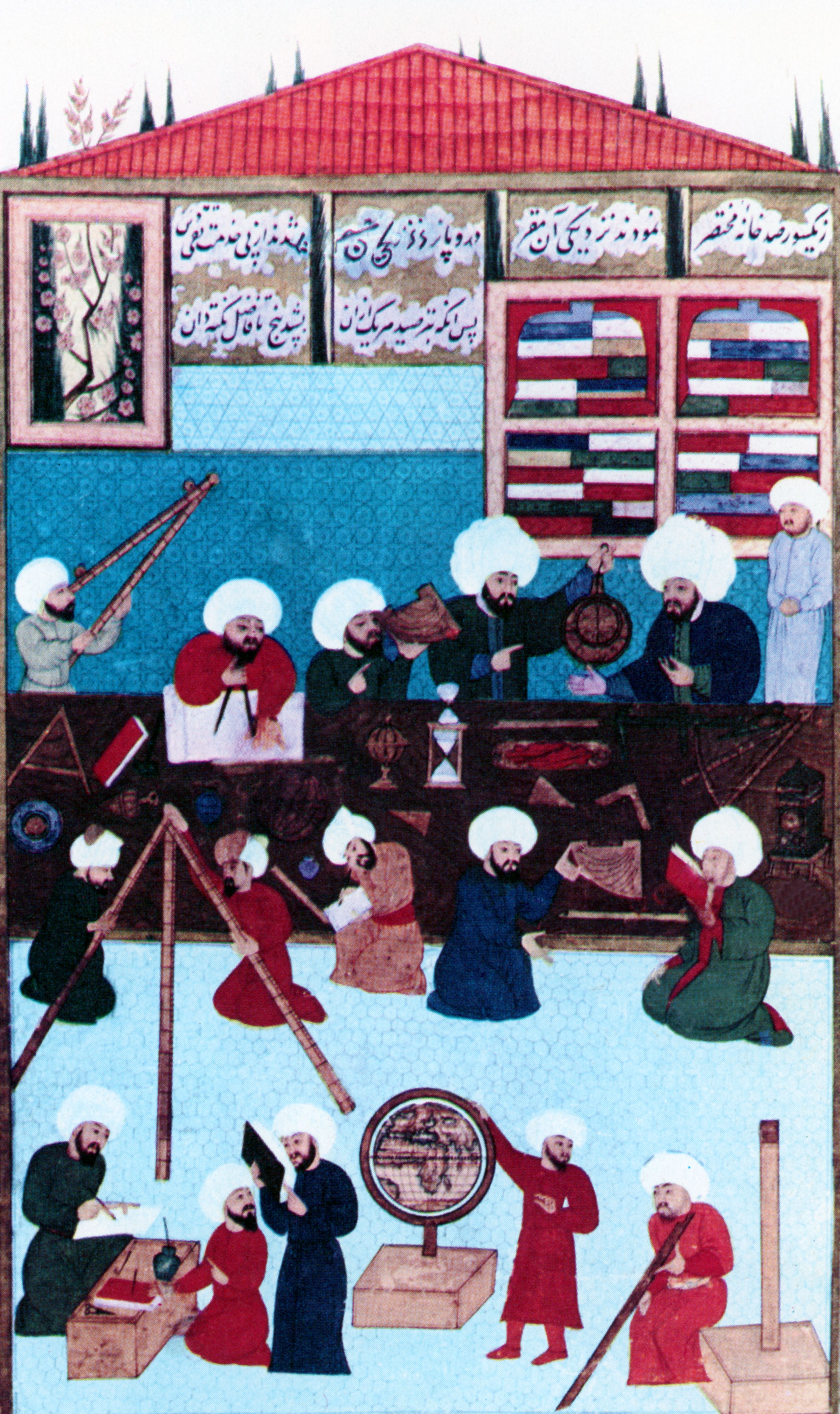
During the Islamic Golden Age, Arabs and Muslims made great strides in a variety of fields, including astronomy. Getty
After learning to make paper from the Chinese, a great translation movement began, allowing Arab scholars to build on knowledge written in manuscripts from around the world.
Major advancements were made in maths, medicine and other sciences, including astronomy.
Part of the motivation for looking to the skies was to advance tools so Muslims could better carry out their Islamic duties. They had to be able to tell time more accurately to perform the five daily prayers.
They also upgraded tools to determine the direction of the Kaaba – which Muslims must face while praying – and improved lunar calendars to mark religious events, including Ramadan, Hajj and Eid Al Fitr, by monitoring Moon phases.
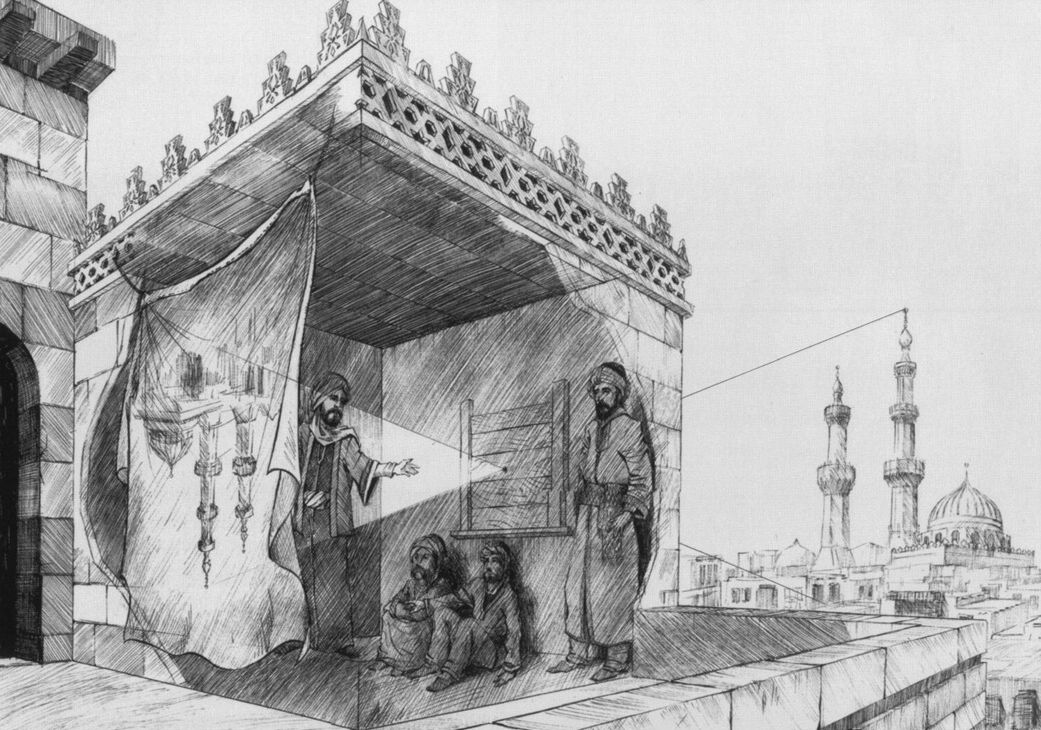
A drawing of Ibn Al Haitham and his camera obscura invention in Cairo, Egypt.
The research also helped with other activities, including navigation and farming.
Thousands of stars and several Moon craters still have their Arabic names, while others were translated into Latin.
Some historians say the knowledge of the Arabs influenced the start of the European Renaissance era – a period of cultural, artistic and scientific advancements that began in the 14th century.
The period of great discovery in the Middle East was brought to an abrupt end in 1258, when the Mongol army of Genghis Khan invaded and captured Iraq, destroying the House of Wisdom and the knowledge it contained. It is said that so many books and manuscripts were thrown into the Tigris River that it ran black with ink.
Dr Nidhal Guessoum, an astrophysicist and professor at the American University of Sharjah, said pioneering work was done during the Islamic Golden Age.
Dr Nidhal Guessoum, astrophysicist at the American University of Sharjah. Leslie Pableo for The National
“Pioneering and huge observatories were built, starting around 828 in Baghdad and Damascus, all the way to mid-18th century in Delhi and Jaipur, with one instrument built into the ground in the Samarkand observatory having a radius of 40 metres,” he said.
“In parallel to that, optics were greatly developed, with Ibn Sahl [in the 10th century] establishing the law of refraction [currently named after either Willebrord Snell or Rene Descartes, both from the early 17th century].
“Ibn Al Haytham produced seminal works on mirrors and lenses and invented the camera obscura, or pinhole camera.”
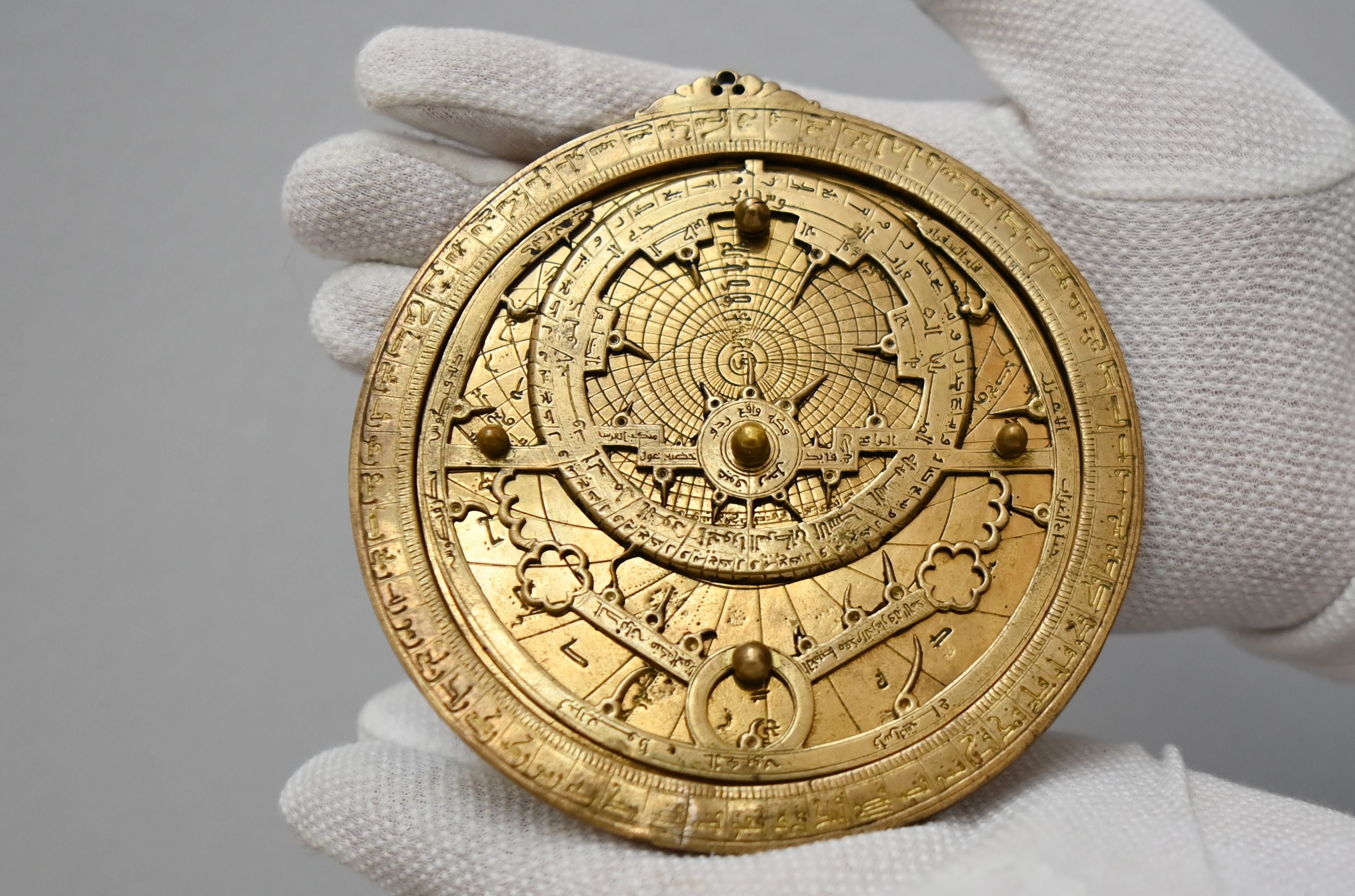
A 14th century astrolabe. Photo: Sotheby’s
The astrolabe, an invention by the ancient Greeks used to tell time and for navigation, was upgraded by Arab scientists during the Islamic Golden Age.
The device was popular among Europeans in the 12th century before being replaced with instruments including pendulum clocks and telescopes.
Thabet Al Qaissieh, founder of Al Sadeem Observatory in Abu Dhabi, said space continued to play a significant role in Arab culture.
“Since ancient times, Arabs have always used the night sky as a reference, whether for seasons, navigation, or literature, which to this day continues to influence our psyche in many ways,” he said.
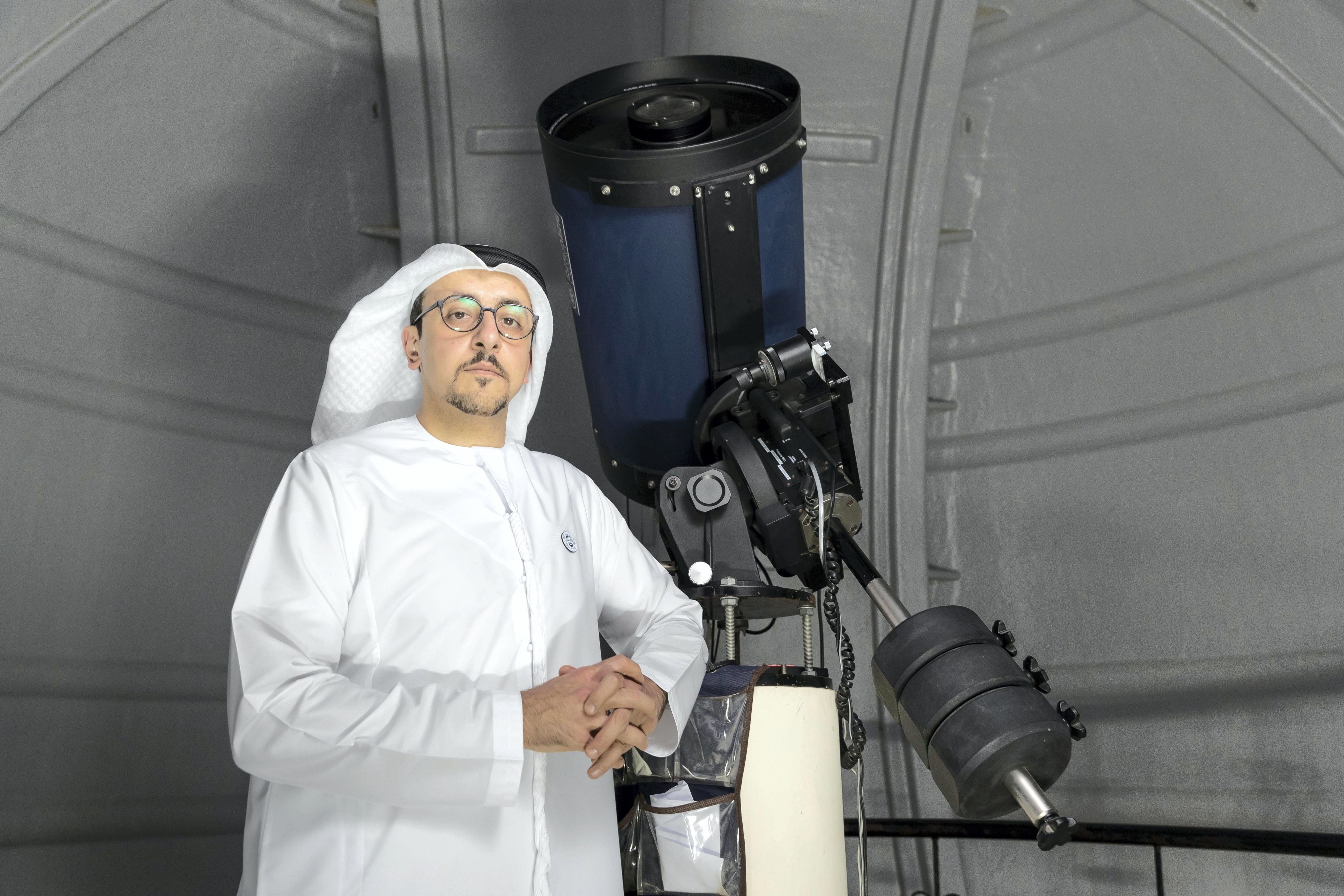
Emirati astronomer Thabet Al Qaissieh at Al Sadeem Observatory. Antonie Robertson / The National
“For example, we use the Moon to determine the start of Ramadan, or Hijri month, but also to describe the beauty of a person.
“All this can, similar to others, promote a scientific revolution in our region that can have a collective benefit for the wellbeing of everyone in the region.
“As with many of the technologies we enjoy every day, most of its origins can be traced back to space exploration technologies, but due to the spill over effect, the vast majority of humans benefit.”