x




China needs a stable Middle East. In the long term, Washington's erratic appearance will strengthen the People's Republic's influence.
The USA's assassination of Quasem Soleimani, head of the Quds unit in the Iranian Revolutionary Guard, will have a long-term impact throughout the Middle East and beyond. With China's growing influence in the Gulf region, it is all the more important to consider Beijing's response.
Sino-Iranian relations have received a lot of attention recently. Iranian Foreign Minister Mohammed Javad Sarif had visited Beijing four times in 2019 before returning to the city on December 31 after a flying visit to Moscow. This last voyage followed a trilateral Chinese-Russian-Iranian naval exercise in the Gulf of Oman and in the northern Indian Ocean. Sarif's meeting with Chinese Foreign Minister Wang Yi centered on the maneuver and gave him the opportunity to inform his colleague about the Iranian nuclear issue.
As an expression of poor Sino-American relations, Wang unusually frankly stated that China would side with Iran against "unilateralism and harassment" and that "the United States' unilateral withdrawal from the nuclear deal, with which it is canceling international commitments and [thereupon aim] to exert maximum pressure on Iran, which is the cause of the current tensions surrounding the Iranian nuclear issue ”.
Chinese leaders persistently reject the use of violence in international politics and always emphasize their preference for development-oriented solutions to political crises and security problems.
When Soleimani was killed three days later, it only increased Chinese reservations about US policy in the Middle East. The State Department spokesman initially called for restraint, as usual, but snappily picked out the United States when he expressed hope that all parties would abide by the "basic norms of international relations." In the event that this was not clear enough, Wang continued in a phone call with Sarif that the "dangerous US military operation would violate the basic norms of international relations and increase tension and unrest in the region."
This emphasis on standards is relevant. Chinese leaders persistently reject the use of violence in international politics and always emphasize their preference for development-oriented solutions to political crises and security problems. When it comes to the Middle East, representatives of China regularly put forward this argument, said the Chinese ambassador to the China-Arab States Cooperation Forum Li Chengwen, who said: “The basic problems in the Middle East are in development, and the only solution is development. “Given this orientation, it is not surprising that the Chinese are offended by what they consider to be an irresponsible and impulsive political murder. Regardless of the reasons for the crime, Soleimani's death will make the region less secure in the short term.
Beijing is concerned about this uncertainty because the stability of the Gulf is important to the Chinese. A key factor is, of course, energy. China is the world's largest oil and gas importer, and the Gulf States are its main suppliers. Anything that prevents the Gulf States from putting energy on the market is harming China's economy, which in turn weakens the Communist Party's performance-based legitimacy model. China has also invested heavily in the Middle East away from energy supply, since 2013 with investments and construction projects worth over $ 123 billion. The fact that China has a large overseas community in the United Arab Emirates increases the risks of a possible conflict.
Both Russia and China supported Iran’s coalition of hope initiative for shipping and energy security, but no other regional or other power.
Beijing is therefore concerned with stability in the Middle East, and it has long been considered likely that the Chinese would eventually commit to security in the region. Numerous decisions by the Trump administration have made the Middle East even more explosive, which in turn should accelerate China's military engagement.
The four-day naval exercise by China, Russia and Iran was the first such cooperation between the three countries. All three had carried out bilateral maneuvers at different times, but never a trilateral one. It was announced in September, shortly after the drone strikes on Saudi Aramco facilities in Abqaiq and Churais. Against the background of the tense situation in the Gulf at the time, it seems strange that China agreed to participate.
Chinese naval expert Li Jie said: “Scheduling the joint maneuver may be a bit delicate, and some see it as an announcement of Chinese support for Iran should military conflicts arise with other countries. But the maneuver can just as well be a normal military cooperation between the countries, as long as it takes place in international waters and does not target another country. ”There could also be a connection with the" Coalition of Hope "initiative announced by Iran in September for the safety of shipping and energy supply. Both Russia and China supported the plan, but no other regional or other power except them.
The trilateral maneuver, according to Sarif an expression of the joint “commitment to securing important waterways”, comprised exercises for combating piracy and terrorism as well as for rescue operations. Iran makes a fuss about the maneuver, speaks of a “new triangle of power on the high seas” that could have great international impact. Chinese officials described it more cautiously as "normal military cooperation".
China is not a revisionist state. It does not want to reorganize the Middle East to take responsibility for security afterwards. The Chinese want a predictable, stable region.
This should not be confused with Beijing's distancing itself; Sino-Iranian relations are, by definition, asymmetrical. The Iranian leadership is happy to exaggerate the comprehensive strategic partnership as evidence of China's commitment to Iran without admitting that China has signed many such partnership agreements, including with Saudi Arabia and the United Arab Emirates. China does not place its relations with Tehran above its Gulf rivals. In economic terms, the members of the Gulf Cooperation Council are even more attractive as partners for China than revisionist Iran and can certainly contribute more to the plans for interregional networking as part of the Belt and Road Initiative. So Iran needs China much more than China needs Iran.
It is also important to note that the joint naval exercises with Iran were nothing new. China and Saudi Arabia had carried out a three-week naval exercise just a month earlier. The “Blue Sword 2019” of the Royal Saudi Navy and the Chinese Navy served to “build mutual trust, improve cooperation, exchange experiences, develop the skills of those involved in the fight against terrorism and piracy on the high seas, and improve training and readiness to fight ". And it was not the first joint military exercise by China and Saudi Arabia to hold a maneuver in China in 2016.
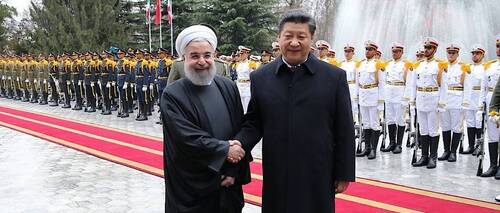
The fact that the Saudi and Iranian military exercises followed each other so closely was not a planning error. With the close proximity, China is signaling that it wants to continue its balanced strategy in the region, which can also be seen in the successive state visits to Xi Jinping in Riyadh and Tehran in January 2016, during which it signed comprehensive agreements for a strategic partnership with both countries.
China is not a revisionist state. It does not want to reorganize the Middle East to take responsibility for security afterwards. As far as possible, the Chinese want a predictable, stable region in which to trade and invest. Trump made this much more difficult with the killing of Soleimani. In the short term, this will increase the cost of economic operations and most likely put many people at risk. In the long term, however, China's power and influence in the Middle East could grow if it took greater responsibility to safeguard its regional interests.