x





A European bat has been captured on film engaging in what appears to be an unusual reproductive strategy.
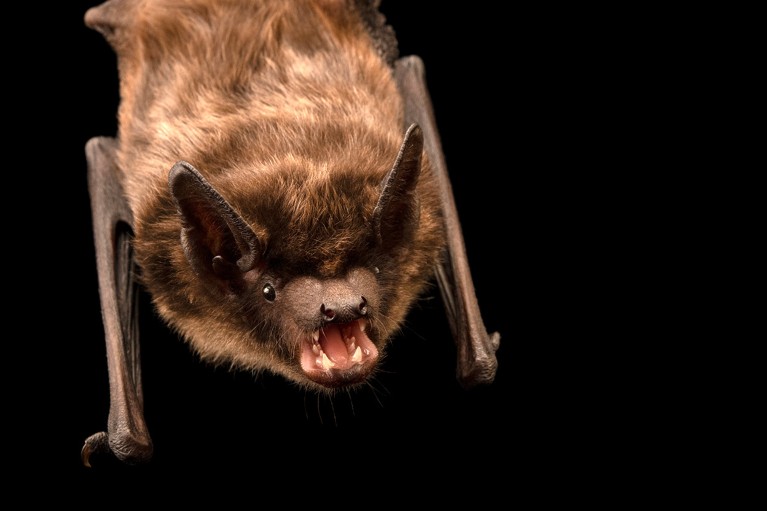
The male serotine bat (Eptesicus serotinus) has a penis that, when erect, is around 22% of its body length.Credit: Joel Sartore/Photo Ark via NaturePL
Scientists have filmed what appear to be the first known instances of non-penetrative reproductive sex in mammals, in bats living in a church attic in the Netherlands and at a Ukrainian bat-rehabilitation centre. They wrote about their discovery this week in Current Biology1.
In most mammals — the group that includes bats and humans — fertilization of eggs happens internally and gestation also takes place internally. Males are thought to have evolved penises to deliver sperm close to the eggs during sex.
Other animals use alternative methods of reproduction. For example, songbirds mate by means of a specialized opening called the cloaca, which is also used for excreting waste. Sperm is transferred from the male birds to the females when they touch their cloacas together in a ‘cloacal kiss’.
“I am not aware of a mammalian species that transfers sperm” without penetration, says Mihaela Pavličev, an evolutionary biologist at the University of Vienna, “so this report describes a unique characteristic”.
The study began when Nicolas Fasel, an evolutionary biologist at the University of Lausanne in Switzerland, and his colleagues noticed that the serotine bat (Eptesicus serotinus) has a rather large and unusual penis. When erect, it is 22% of the bat’s head–body length and has a bulbous, heart-shaped tip. “We were thinking it would be really difficult for it to enter anything,” he says.
The scientists would have left it at that, if not for serendipity. One day, Fasel received an email with the subject line “Eptesicus penis” and a film attached. He nearly trashed it as spam before reconsidering given the Latin species name. The email was from Jan Jeucken, a bat enthusiast who is closely monitoring a population of bats that live in a church attic near his house in the Netherlands. Jeucken had made videos of bats having sex in the church from an angle that made the entire act visible. It’s rare to see bat sex in the wild, let alone from directly underneath. The authors analysed 93 putative mating events that took place in this church attic, and 4 further instances at a bat-rehabilitation centre in Ukraine.
During sex, the male grasps the back of the female and bites the nape of her neck, presumably to hold on. Then he moves his erect penis around the female’s tail membrane, searching for the vulva. Once this has been located, the male stays still, with the penis held firmly against the vulva. There is no penetration, but it is likely that the sperm find their way into the vagina. The longest sex act continued for 12.7 hours, but half of the recorded copulations lasted for 53 minutes or less. After mating, the fur on the female’s belly appeared wet, which the researchers suggested indicates the presence of semen.
The scientists did not sample the females’ wet fur to confirm whether semen had been transferred. But Pavličev says that despite this, the evidence strongly suggests that the scientists’ interpretation of the behaviour is correct.