x





First truly single aperiodic tile discovered that can cover an infinite surface without repeating itself.
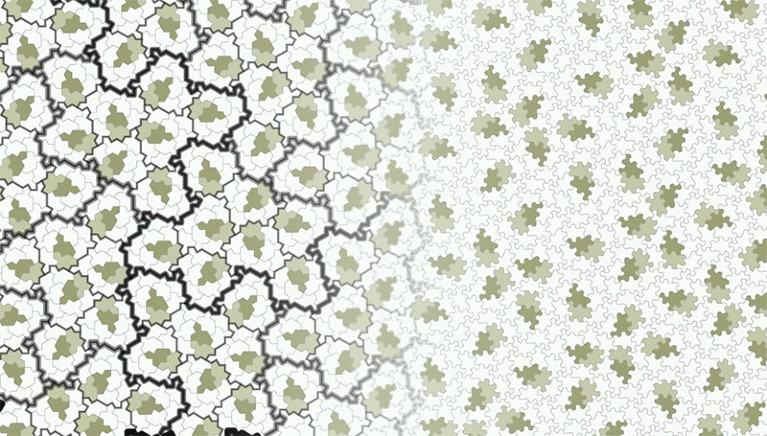
A shape (highlighted in green) that can endlessly tile an area without making a repeating pattern has been discovered.Credit: D. Smith et al./arXiv
After 60 years of searching, mathematicians might have finally found a true single ‘aperiodic’ tile — a shape that can cover an infinite plane, but never make a repeating pattern.
Periodic tilings have translational symmetry: a honeycomb pattern, for example, can be repeated forever and looks identical after being shifted in any of six directions by any number of cells. But in aperiodic tilings any such shift is impossible.
In March, a team announced an important breakthrough in the search for an aperiodic tile. David Smith, a hobbyist mathematician based in Bridlington, UK, discovered a shape that he suspected could be an aperiodic tile and, together with three professional mathematicians, Smith wrote up a proof that his tile — together with its mirror, or flipped, image — could be used to build infinite aperiodic tilings of the plane1. (The proof has not yet been peer reviewed, although mathematicians have reportedly said that it seems to be rigorous.)
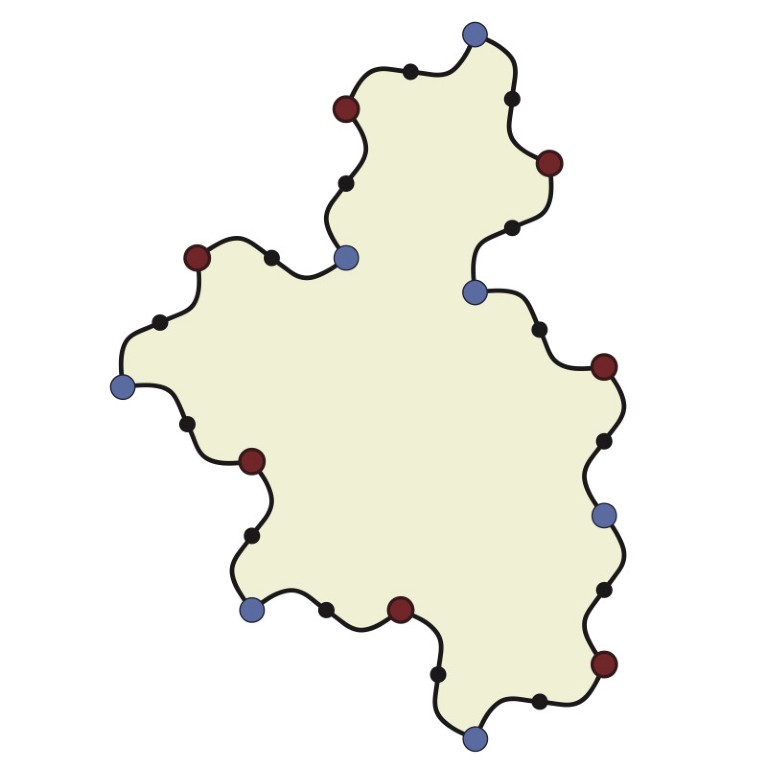
The pattern is made up of single tiles such as this wavy one.Credit: D. Smith et al./arXiv
Smith’s shape was not a single aperiodic tile, because it and its mirror image are effectively two separate tiles — and both versions were required for tiling the entire plane. But now the same group of mathematicians has reported a modified version of their original tile that can build aperiodic tilings without being flipped2.This proof was posted on the preprint server arXiv and has not yet been peer reviewed.
The first aperiodic tilings were discovered in the 1960s, and they involved 20,426 tile types. After various improvements, Roger Penrose, a mathematician at the University of Oxford, UK — who won a Nobel Prize in Physics in 2020 for his foundational work on the theory of black holes — discovered the first aperiodic tiling made of only two tile types that were not merely mirror images of each other. Penrose’s tilings now adorn the patio of Oxford’s mathematics department.