x





The four-legged miniature machine is powered by tiny explosions.
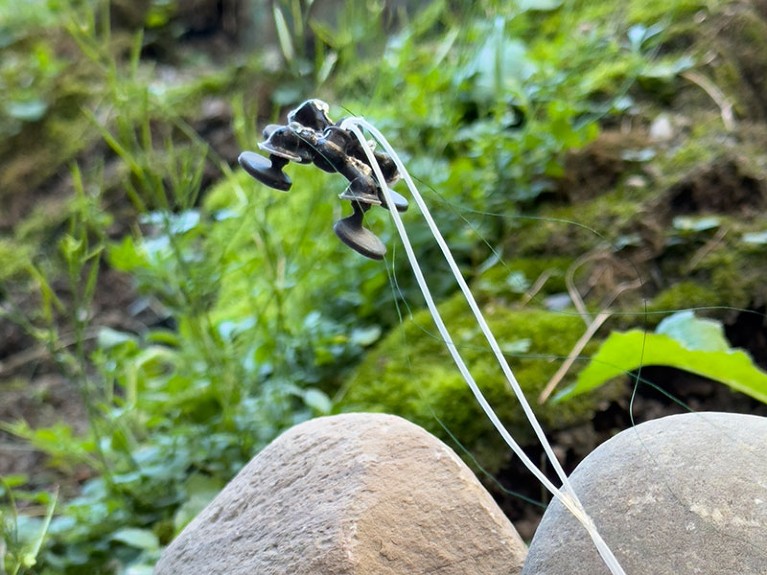
Small explosions in each of its four feet propel the robot.Credit: Cameron Aubin
An insect-sized robot powered by tiny explosions can crawl, leap and carry a load many times its own weight.
The robot, developed by materials engineer Robert Shepherd at Cornell University in Ithaca, New York, his PhD student Cameron Aubin and their colleagues, is powered by tiny actuators. “The actuator kind of looks like a drum. It’s a hollow cylinder with an elastomeric silicone rubber on the top,” says Aubin.
The researchers used four actuators to drive the robot’s feet. To make the robot jump or crawl, a stream of methane and oxygen is fed into each foot and sparked with electricity from a battery. The resulting reaction between the gases to form water and carbon dioxide releases energy as a small explosion, causing the rubber layer to deform. “That acts sort of like a piston,” Aubin says.
The tiny explosions happen so quickly, Shepherd says, that there are no flames to burn or damage the rubber. But they provide considerable propulsion: the robot could jump to a height of 56 centimetres and carry a load 22 times its own weight.
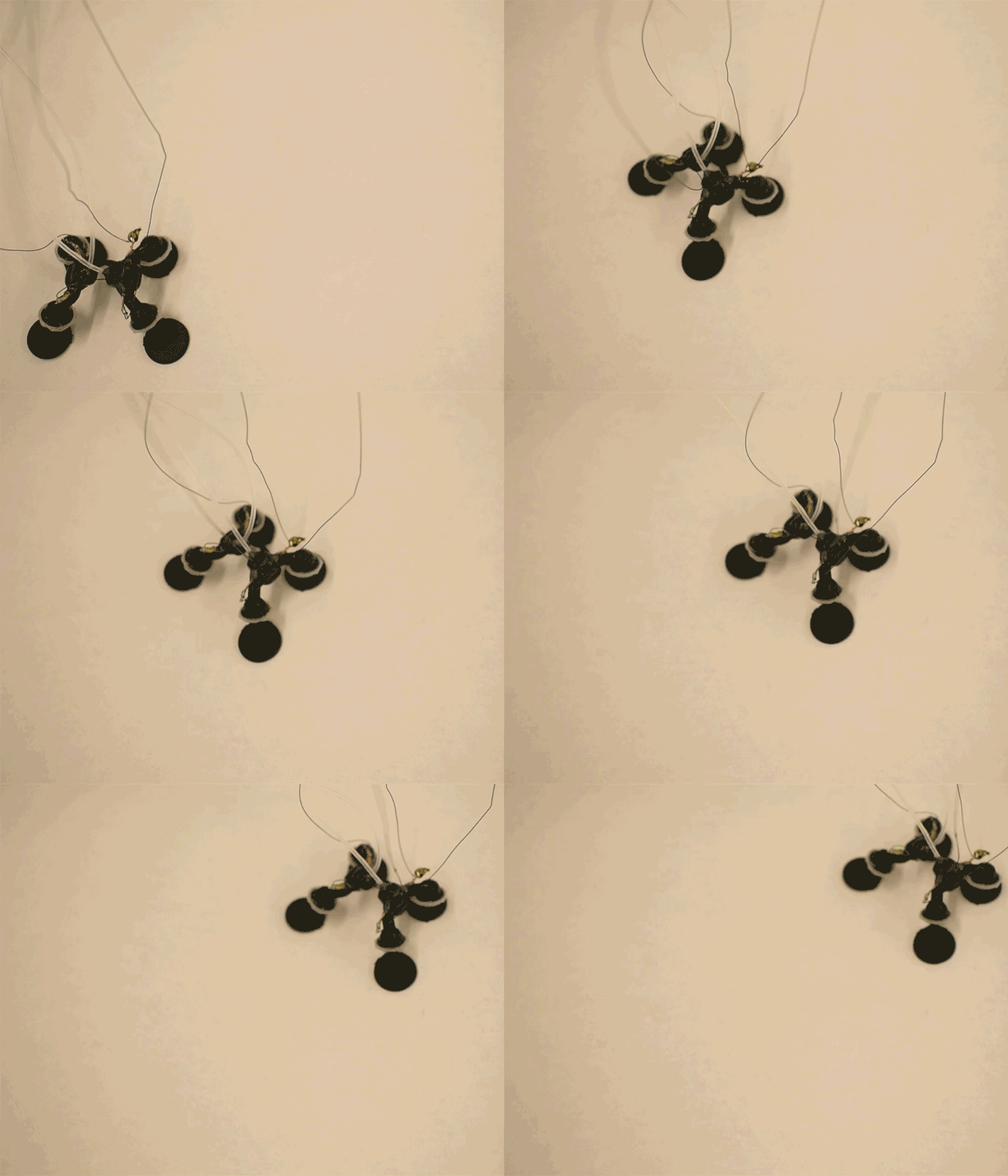
The robot can crawl along, but must remain tethered to its battery and gas supply.Credit: C. A. Aubin et al./Science
“This team has brought chemically powered actuation to impressive length scales for robotics while also demonstrating impressive capabilities for insect-scale machines,” says Ryan Truby, a materials scientist at Northwestern University in Evanston, Illinois.
Robots that are small and light but strong and able to cover large distances could one day be utilized in environmental monitoring or search-and-rescue applications. The robot Aubin and Shepherd built, described in a paper published on 14 September in Science1, will need further development for use in the field. At the moment, it must be tethered to a panel that contains the gas supply and a battery, a restriction that presents a challenge, says Truby. “Devising ways of combusting fuels on board an untethered robot is not trivial,” he says. “This is the next big hurdle to address.”