x



Tokio : Auf Schatzsuche Die Mega-Metropole verbirgt Überraschendes. E
The mega-metropolis hides something surprising. A journey of discovery through the art world of the Japanese capital.
The entrance to the Sato Sakura Museum is on the Meguro Canal, just a few subway stations away from the hustle and bustle of the city center. It is entirely dedicated to the sakura, the heyday of cherry trees. For the Japanese, these few days are a time of intense joie de vivre and a symbol of the transience of beauty; the museum is not mentioned in any guidebook, maybe because you cannot imagine that tourists are interested in it too? The canal lined with cherry trees turns into a place of reflection in spring. When darkness falls, residents huddle on the banks to get a view of the illuminated trees. The small three-story museum is just a stone's throw away.
Here you can see the most beautiful contemporary paintings of the sakura. And also to watch how many Japanese meditate in front of the pictures. Creative people meet in the nearby Nakameguro district with its historic streets. Inviting cafes and restaurants, trendy boutiques and the meguro art museum with excellent exhibitions make it a lively district. A visit to Tokyo's most famous cultural institutions (Tokyo National Museum, National Art Center, Mori, Suntory, Complex 665) is a must, no doubt. But trips to unknown places are also worthwhile. The SCAI The Bathhouse Gallery is located in a 200-year-old public bath house in the original artist district of Yanaka, which was able to retain its character despite the gentrification.
Works by the country's important and well-known artists are shown there. Toshikatsu Endo, who has a penchant for burnt wood, for example, or Mariko Mori, who is known for her performances in striking clothing. The gallery is behind one of Louise Bourgeois' giant spiders in the Roppongi Hills. “Mama”, the name of the monumental sculpture that once stood at Zurich's Bürkliplatz for a few days, borders the Roppongi Art Triangle, a new artists' quarter in which a lot is currently happening.
Another highlight in the Yanaka district is the Fumio Asakura Museum. The former studio of the sculptor, surrounded by a large garden, offers visitors the opportunity to view his works in peace. It is different in 3331 Arts Chiyoda. The art center with boutique, café and children's playground is hidden in a quiet neighborhood near Akihabara and exhibits residence artists. Interested parties can go from classroom to classroom in the former school and chat with the working artists. For a change, a visit to the galleries of luxury brands (Pola, Shiseido, Louis Vuitton) is recommended. They are housed in the magnificent buildings on the Japanese counterpart to the Champs Elysées in Ginza and show big names, such as Yayoi Kusama with their seemingly endless dot patterns, Yoko Ono with their avant-garde performances and Takashi Murakami with his manga-inspired sculptures.
_____ Sueo Mizuma opened his first gallery in 1994 in the French quarter opposite the Kagurazaka Canal. It was so successful that more galleries in Beijing, Singapore and Indonesian Yogyadarta were added in the past ten years. Mizuma is considered a pioneer of contemporary art in Tokyo because he keeps discovering interesting artists with potential. Because of his conviction that abstract expressionism, pop art and minimalism are all trends that were conceived in America and convey western ideas, Christian values and American culture, he prefers a regional style among his artists. His view of art represents the resentment that some people in Japan still have against America and its cultural exports today due to the occupation after World War II. Nevertheless, this influence cannot be overlooked in the vintage shops in the Koenji district, which offer GI uniforms or cowboy shirts, for example. Japanese folklore is completely absent here, and you might think you are in Brooklyn. Intellectuals judge this "cultural imperialism" rather strictly: America and European countries would maintain their hegemonic power by spreading their values around the world, according to a Japanese researcher living in Europe, for example.
_____ One of the greats of traditional Japanese culture is the writer and poet Sen no Rikyu. He co-founded the Japanese tea ceremony Chanoyu in the 16th century and is one of the most important figures of the Sengoku period. His clear, no-frills style was style-defining. How Duchamp wanted to give everyday objects an artistic dimension with his “readymade” has always expressed a preference for formal things in tea ceremonies in Japan. The Tokyo National Museum tried to draw this daring parallel in 2018 in its exhibition “Marcel Duchamp and Japanese Art”. One of the most important references in the Japanese cultural memory is the history of Genji from the 11th century. The novel tells the life of an imperial prince of exceptional beauty, who made a name for himself as a poet and womanizer. The plot spanned decades and became one of the favorite inspirations of Japanese painters.
Another figurehead of Japanese culture are Hokusai and his graphics (The Wave, the 36 views of Fuji), which are very popular in the pop scene. The work of the artist, born in 1760, had a great influence on Gauguin, van Gogh and Monet. Gallery owner Sueo Mizuma: «Japanese art draws on this heritage. Contemporary forms of popular culture can be found in mangas, comic books, and anime, cartoons. »A western observer mentions other distinguishing features of Japanese art. Florian Helmke-Becker, owner of the Humo Gallery in Zurich, says: «Japanese artists are characterized by care, precision and attention to detail. They have high expectations and work with dedication and a strong sense for a clear design. »As an example, the gallery owner Kouichi Tabata mentions that he made the same drawing of two birds on one branch 72 times and these sketches at high speed in different colors on one Screen projected. The result is surprising: the same bird is different every time.
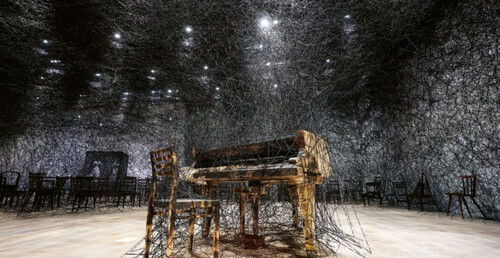
_____ Humo also represents Toshihiko Mitsuya in Switzerland, who uses organic foil to fold organic sculptures in the Japanese origami tradition. Shiota Chiharu goes into similar detail in her work; her works can be seen this fall at the Mori Art Museum in Tokyo. The artist uses old objects such as beds, shoes and suitcases as skeletons, which she spins with wool threads. Her work received attention in 2015 when she interwoven two fishing boats with a dense network of red threads and around 180,000 old keys for the Venice Biennale. This exhibition of the museum, which is always worth visiting, should not be missed if you are going to be in Tokyo soon.