x





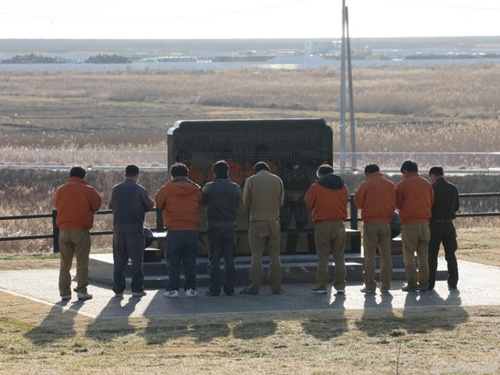
Twelve years after the meltdown in Fukushima, Japan, the country's government is back to nuclear power. The environmental organization Greenpeace spoke on Saturday, the 12th anniversary of the catastrophe caused by a severe earthquake and devastating tsunami, of "complete disregard for those who suffered and continue to suffer from the consequences of the 2011 nuclear disaster."
Twelve years of Fukushima disaster, Japan relies on nuclear power © Provided by APA
The government of Prime Minister Fumio Kishida not only wants to restart existing reactors, but also to develop and build new next-generation reactors. Meanwhile, in the summer at the latest, the state will begin the controversial draining of huge amounts of filtered cooling water from the destroyed reactors.




A gigantic tsunami hit the Pacific coast on March 11, 2011 and flattened everything: towns, villages and huge areas of cultivation sank under the water and mud masses. The flood killed around 20,000 people. In Fukushima, as a result, the Fukushima Daiichi nuclear plant suffered a super meltdown, which became a symbol of the triple catastrophe all over the world - even if none of the deaths was attributed to the radiation. More than a decade later, the state no longer holds national commemorations. Reconstruction has made great progress, but the catastrophe threatens to be forgotten.
Thanks to enormous decontamination work, the radiation levels in most areas of Fukushima Prefecture are now at practically the same level as in other countries, as Fukushima's governor Masao Uchibori emphasized to foreign journalists. Thanks to the strictest controls, food that comes onto the market is also safe. Around 27,000 of the initially 165,000 evacuees are still unable to return to their old residential areas.
The destroyed reactors must also continue to be cooled with water, the amount of which is increasing every day due to infiltrating rainwater and groundwater. It is stored in huge tanks, but now the space is running out, according to operator Tepco. Therefore, it should be filtered and diluted before being discharged into the sea. According to Tepco and the International Atomic Energy Agency, this does not pose a risk. However, the filter system cannot filter out the tritium isotope. However, Japan argues that tritium is harmless to humans in small amounts. However, local fishermen are against the dumping of more than a million cubic meters of water, which could take decades.
For Climate Protection Minister Leonore Gewessler (Greens), "nuclear power will never be a safe form of energy". "Our position has been clear for decades: Nuclear power has no future! It is highly risky and can cost us dearly. There is only one solution: the energy transition - that is the way out of dependence on dangerous nuclear power," says Gewessler in a broadcast on Saturday.