x





Former universities minister Michelle Donelan is appointed head of Department for Science, Innovation and Technology in mini-reshuffle.
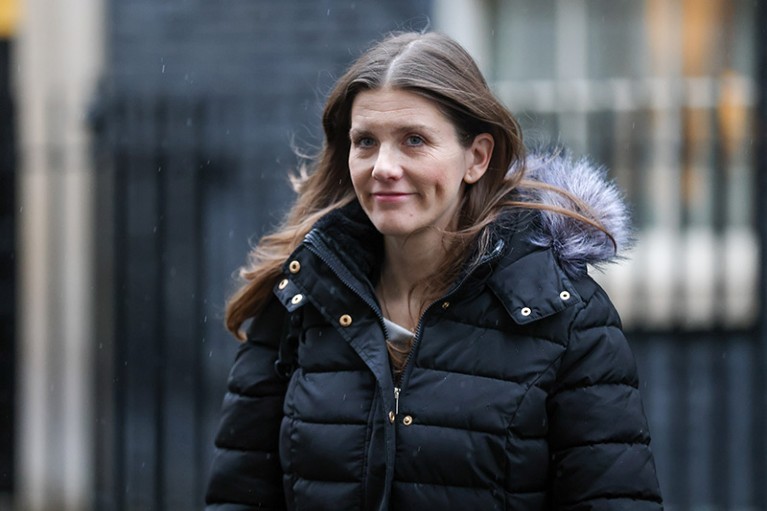
Michelle Donelan has been appointed UK secretary of state for science, innovation and technology.Credit: Hollie Adams/Bloomberg via Getty
The United Kingdom has a new government department dedicated to science and technology. On 7 February, Prime Minister Rishi Sunak split the Department for Business, Energy and Industrial Strategy (BEIS) into three, creating the Department for Science, Innovation and Technology, the Department for Energy Security and Net Zero, and the Department for Business and Trade.

UK universities report sharp post-Brexit drop in EU students
Michelle Donelan, a former universities minister, has been put in charge of the new science department as secretary of state, a cabinet-level position. George Freeman, who was minister of state with responsibility for science at BEIS, retains a minister of state position in the new department.
“A dedicated Department for Science, Innovation and Technology will drive the innovation that will deliver improved public services, create new and better-paid jobs and grow the economy,” the prime minister’s office said in a press release. “Having a single department focussed on turning scientific and technical innovations into practical, appliable solutions to the challenges we face will help make sure the UK is the most innovative economy in the world.”
The UK scientific community largely welcomed the move. “This is another sign of the importance government places on science and innovation,” says Daniel Rathbone, assistant director of the Campaign for Science and Engineering in London. “It is vital, however, that the practicalities of making changes in Whitehall aren’t allowed to take away from the time and resources needed to drive forward the promising agenda the government has previously set out.”
Rathbone highlighted reform of the tax-relief system for research and development and access to European research programmes as two big issues the new department needs to tackle.
Breaking up the BEIS “super-ministry” could mean that science and innovation gets more attention from the government, says Kieron Flanagan, who studies science and technology policy at the University of Manchester, UK.
“On the face of it, this structure makes sense,” says Flanagan. “But we still need to know more about what the department’s role and goals are.”
Although the UK scientific community’s top priority remains retaining access to the European Union’s Horizon Europe funding programme, Flanagan points out that the government reshuffle will probably have little effect on broader negotiations related to Brexit. “The expectation may be that having a higher-profile secretary of state for science will help solve this, but it is really a political issue, not a scientific one,” he says.
Surprise! The UK is spending way more on research than it thought
James Wilsdon, who studies science policy at University College London, says it seems strange to see such a big change in the machinery of government when the country is expecting a general election to be called relatively soon. “It does have a bit of a ‘deckchairs on the Titanic’ feel,” he says.
There is symbolic value in giving science more visibility and a seat at the cabinet table, but “I’m not sure tinkering with the name badges and furniture in Whitehall has any real relevance to the fundamental challenges in the real economy and the research economy”, says Wilsdon.