x




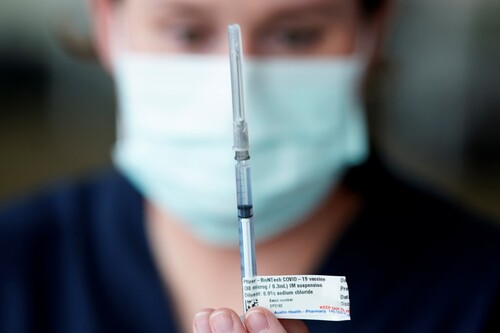
A special report outlines the challenges — from unleashing the power of mRNA vaccines, to the battle for temporary intellectual-property relief.
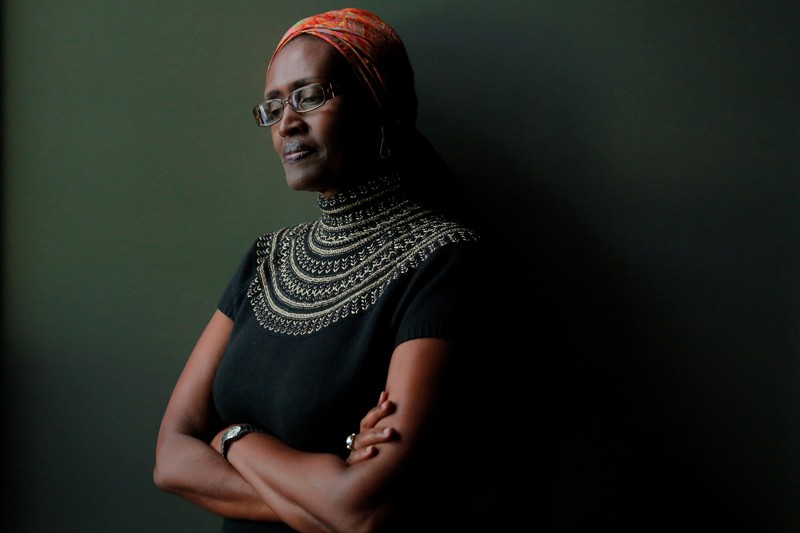
UNAIDS executive director Winnie Byanyima is one of the leaders of the campaign for temporary relief from COVID-related intellectual-property rights.Credit: Andrew Kelly/Reuters
Some 11 billion doses are required to vaccinate 70% of the world's population — assuming two doses are given per person. This is the proportion that might be needed to reach population-level, or herd, immunity.
According to researchers at Duke’s Global Health Innovation Center, high- and upper-middle-income countries, representing one-fifth of the world’s population, have bought around 6 billion doses; but low- and lower-middle-income countries, representing four-fifths of the population, have secured only around 2.6 billion. This includes 1.1 billion doses for COVAX, a scheme in which international funders have pledged to vaccinate one-fifth of the world’s population. By this measure, the researchers say, it could take two or more years for people in the lowest-income groups to be vaccinated.
Why a pioneering plan to distribute COVID vaccines equitably must succeed
That’s why India and South Africa are among the countries involved in a campaign to get COVID-19-related intellectual-property rights temporarily waived. This, the campaign's proponents argue, will unleash a cascade of production.
Last October, the two countries asked the World Trade Organization (WTO) for certain intellectual-property rights on COVID-19 medical tools and technologies to be temporarily suspended until herd immunity has been reached. The proposal has been gathering support, and is now backed by around 100 countries, and a diverse coalition of organizations called the People’s Vaccine Alliance, which includes the United Nations’ HIV/AIDS agency UNAIDS and human-rights group Amnesty International. It was discussed at a WTO meeting on 10 and 11 March, and talks are due to resume next month.
Proponents argue that the waiver will enable governments and manufacturers to jointly organize a ramping up of vaccine supply. Without a temporary waiver on intellectual-property rights, they say, poorer countries will remain dependent on the charity of richer countries and their pharmaceutical industries.
John Nkengasong, a virologist who heads the Africa Centres for Disease Control and Prevention in Addis Ababa, says the waiver campaign also comes from the experience of the AIDS epidemic. In the 1990s, he says, drugs to treat HIV had been developed and were available in high-income nations, even though most cases of HIV, and deaths, were in Africa. Then, as now, it took many years for AIDS drugs to get to Africa, he says.
“We cannot repeat the painful lessons from the early years of the AIDS response, when people in wealthier countries got back to health, while millions of people in developing countries were left behind,” Winnie Byanyima, executive director of UNAIDS, said earlier this month.
But the India–South Africa proposal is being opposed by the European Union, the United States, the United Kingdom and most of the larger pharma companies. They argue that intellectual-property-rights waivers are unnecessary, and even undesirable, for COVID-19 vaccines.
Jerome Kim, director-general of the International Vaccine Institute in Seoul, says: “The thing about vaccines is that, unlike a drug, you can’t just [follow instructions] and assume that you’ve got a vaccine. This is a complex biological process that has multiple quality-control steps.” For RNA technology, he says, “it’s really not that robust yet”.
Furthermore, for mRNA vaccines, at least, intellectual-property rights are scattered among many companies. Negotiating with everyone in the intellectual-property-rights chain would probably take a year, says Kim. “Would it actually get us vaccine faster? Or would you just be asking a company to give up something that in the end wouldn’t have an impact on global health?”
Instead, Kim proposes that companies license their intellectual-property rights to third parties. Such ‘technology transfer’ will speed up the manufacturing process because more companies will be making things. This is already happening, he points out. “Technology transfer has been one of the remarkable features, I think, of this particular pandemic,” Kim says.
Friede agrees. “We’ve seen partnerships where, if you’d asked me six months ago, ‘do you think those two could ever play together?’, I’d have said, ‘absolutely not, they are violent competitors’,” he says.
The WHO is advocating what it calls “coordinated technology transfer”, in which universities and manufacturers license their vaccines to other companies through a global mechanism coordinated by the WHO, which would also facilitate the training of staff at the recipient companies, and coordinate investments in infrastructure. It says this approach is more coherent and transparent than one-off tech-transfer deals such as that between AstraZeneca and Serum Institute.
Want to track pandemic variants faster? Fix the bioinformatics bottleneck
In another approach, the University of Pennsylvania, which owns sufficient intellectual-property rights relating to mRNA vaccines to strike out on its own, is helping Chulalongkorn University in Bangkok to develop a vaccine-making facility.
“If you look at vaccine roll-out right now, it’s going to be two years before Thailand and other lower-income countries get vaccine,” says Weissman, who is collaborating on the project. The country’s government wasn’t willing to wait, he says. “They were willing to put up the money … so that they’ll be ready to treat their people by the end of this year.”
In the long term, argues Friede, every region needs a facility that fully owns the production know-how and can produce vaccines. The gap is most egregious in Africa, a continent that imports 99% of its vaccines, says Nkengasong. It has only three big vaccine manufacturers.
“Can a continent of 1.2 billion — projected to be 2.4 billion in 30 years, where one in four people in the world will be African — continue to import 99% of its vaccines?” Nkengasong asks.
Messenger RNA (mRNA) vaccines are being used for the first time in this pandemic. According to Zoltán Kis, a chemical engineer at the Future Vaccine Manufacturing Hub at Imperial College London, there are broadly three reasons why mRNA vaccines are simpler to make than are conventional vaccines: mRNA technology doesn’t require living cells; there are fewer substances in the mix; and the process requires smaller volumes than does conventional-vaccine manufacturing.
From start to finish, it can take two days to make a batch of drug in a 30-litre reactor (currently thought to be the largest feasible), although quality control might add to the time needed.
The exercise begins with a two-hour process to make a long chain of RNA. This requires a DNA template, four different nucleotides and an enzyme to link the nucleotides together in the correct order.
Once that’s done, another enzyme is added to degrade the DNA template, which takes about 15 minutes. Purification is next — again, relatively easy, because the mRNA is the largest molecule in the mix, and there are no living cells or cell debris to eliminate.
The next stage is to stabilize the RNA by encapsulating it in lipid nanoparticles. By streaming the RNA and the nanoparticles together, the latter self-assemble around the former, in a process that takes about a day.
Next, glass vials are filled with the vaccine substance. One filling line can fill around 400 vials per minute, and can operate around 60% of the time on a yearly basis. The remaining 40% of the time is needed to prepare a line for future filling. One filling line could fill 126 million vials a year.
The technical challenge lies mostly in preventing the notoriously fragile RNA from degrading. Even once it is protected inside the lipid bubbles, very low temperatures are needed to keep it intact. “It’s a challenge, but once you have the people who know how to do this, it’s more like a standard procedure,” says Kis.
That's why drug manufacturers that have never made vaccines before are now considering getting into mRNA, and that could be game-changing for production capacity, says Martin Friede, head of vaccine development at the World Health Organization in Geneva, Switzerland. “Some people don’t realize what they are sitting on,” he adds.