
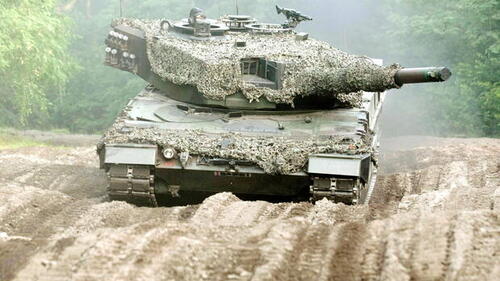

The public debate about further arms deliveries to Ukraine is currently very much focused on the Leopard 2 battle tank. Federal Defense Minister Christine Lambrecht (SPD) said on Friday that the federal government's position had not changed. Poland , on the other hand, wants to supply Leopard tanks as part of a coalition.
Thus, before the next meeting of the Ukraine-supporting countries in Ramstein on January 20, the pressure on Germany is increasing . Vice Chancellor Robert Habeck (Greens) had also said that the federal government should not stand in the way if other countries wanted to lead the way in supplying battle tanks.

Ukraine is running out of T-72 tanks
So far, Ukraine has mostly relied on Soviet-era T-72 tanks. She also captured many of them from retreating Russian troops. But as the war progressed, the number continued to decrease. So Ukraine needs a replacement - it can only come from the West.
Why does Ukraine want the Leopard 2?
The tank is considered one of the best in the west. German defense contractor Krauss-Maffei Wegmann has built more than 3,500 Leopard 2 tanks since production began in 1978. The tank weighs more than 60 tons, is armed with a 120mm smoothbore gun and can hit targets at a range of up to five kilometers. The Leopard 2 runs on a comparatively more economical engine that burns diesel.
What would be the benefit?
About 20 nations operate the Leopard 2. This means that several countries could each provide part of their tanks in support of Ukraine - of which there are different types. However, this would make it easier for Ukraine to manage maintenance and crew training. In addition to Germany, nations using the Leopard include Canada, Denmark, Finland, the Netherlands, Norway, Austria, Poland, Spain, Sweden and Turkey.
The Leopard 2 is thus one of the most widespread western tanks. But three decades after the end of the Cold War, tanks and other heavy weaponry are still in limited supply in most Western countries. Many countries drastically reduced their armies after the fall of communism. Germany now has only about 350 Leopard 2 tanks, compared to about 4,000 main battle tanks at the height of the Cold War, says German military expert Carl Schulze.
The German armaments industry is prohibited by law from producing tanks for storage. Countries ordering new tanks must be prepared to wait two to three years for delivery. Even if production were ramped up, experts say it could take at least two years for the first new tanks to leave the factory. This also inhibits the willingness of the Bundeswehr , for example, to surrender tanks.