
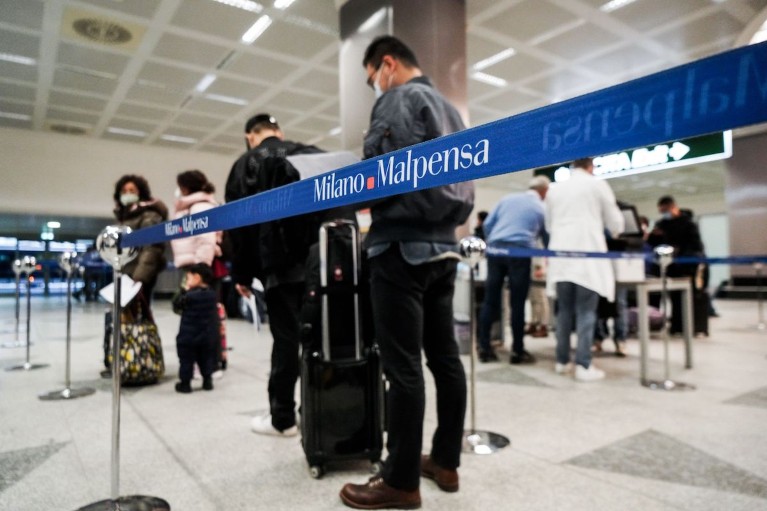
Anti COVID-19 tests for passengers arriving from China at Milan Malpensa airport, mandatory from 29 December 2022. Credit: Marfisi/AGF/Shutterstock.
Italy was the first European country to impose pre- and post-flight testing on travelers from China, as well as sequencing positive samples upon arrival. Other European countries followed suit, and on January 4, the European Union recommended pre-flight testing for all travelers from China to the EU. It is the response to a huge surge in infections and severe cases in China, following the end of that country's zero-COVID policy.
The Ministry of Health explained in a Dec. 30 press release that the new measures are aimed at reducing the risk of importing new variants from China. Nature Italy spoke about the effectiveness of these measures with Stefano Merler, an epidemiologist and mathematician at the Bruno Kessler Foundation in Trento, who advised the Italian government in the first two years of the pandemic.
Governments have resorted to air travel control measures at other times during the pandemic. In February 2020, most countries blocked entry from China. Then, in late 2021, the US and most European countries banned travel from some Southern African countries to keep out the Omicron variant. What have we learned from these experiences?
Even before COVID-19, we knew that travel restrictions can only have a major impact if they are implemented comprehensively and quickly. The COVID-19 disease, being largely asymptomatic, has made things much more difficult. Several studies have shown that a ban on entry from China in 2020 delayed the surge of the epidemic in the rest of the world by a few weeks at most. This is mainly due to the fact that travel was halted almost two weeks after the first export cases were detected in Thailand, Japan and South Korea. The same happened with Omicron: when the ban was imposed, the variant was already out of southern Africa. We've never stopped the spread of a single variant with these kinds of measures, and this time will be no different.
As for sequencing the positive swabs of incoming travellers, what impact could it have?
It will help us track the virus variants arriving in our country, which is helpful. This does not mean that we will keep the new variants away, because travelers from China could easily reach our country by stopping elsewhere. Italy had already established a genomic surveillance system of the virus in April 2021, which collects data in the Italian COVID-19 Genomic platform. It was designed by the Istituto Superiore di Sanità to answer public health questions, i.e. whether the drugs available to us, such as vaccines, antivirals and monoclonal antibodies, are effective on the circulating variants.
How many samples does this surveillance system sequence?
Almost 1000 samples a week, on which the ISS publishes a monthly report . This number is sufficient to detect variants with a prevalence of up to 0.5%, and sequencing is directed at infections most likely to be caused by new variants of concern. In particular those concerning patients in hospitals and intensive care units, reinfections, immunocompromised subjects and people from countries under observation by international health organizations. China was already on our radar before the latest regulations were introduced. In addition to this, we also carry out monthly flash surveys focusing on variants already identified as worrying.
What kind of questions do flash surveys answer?
We [at the Kessler Foundation] started these investigations together with the ISS in January 2021 to estimate to what extent Alpha was more transmissible than the most prevalent variant in Europe at that time. To estimate transmissibility, we needed to measure how the prevalence of the variant grew over time. We assumed an initial prevalence of at least 5% and calculated the fraction of positive samples that each region would need to sequence to obtain a statistically reliable measure. We repeated the survey monthly. This initiative informed the measures taken by the government in the first months of 2021. The investigations then became structural and, when the Omicron variant emerged, were conducted on a bi-weekly basis.
Other countries, such as the UK, are sequencing much more. Should Italy step up its efforts?
Considering the funds available, Italy is doing well. Of course, one could consider expanding the sequencing campaign, but always keeping in mind that each initiative should be designed to answer a specific question. The UK is certainly not wasting funds, and its contribution to global scientific knowledge about this virus is crucial.