x




Scent information from the two nostrils leads to two types of neural activity.
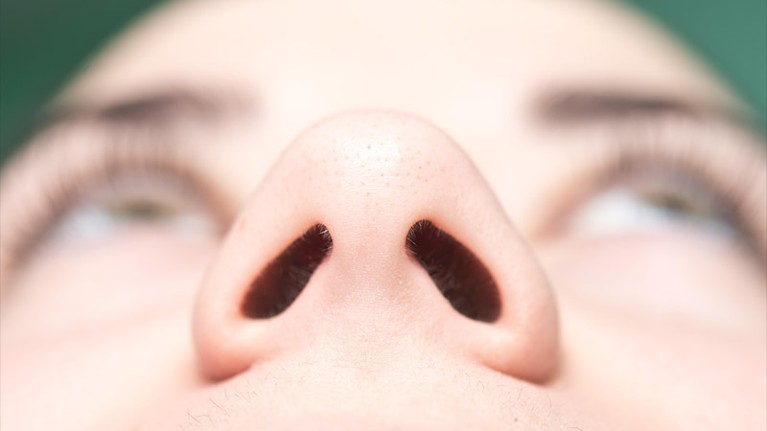
Scientists asked volunteers to sniff odours such as coffee, banana and orange to reveal the brain activity linked to each nostril.Credit: Ruslan Nassyrov/Alamy
When the scent of morning coffee wafts past the nose, the brain encodes which nostril it enters, new research shows1. Integrating information from both nostrils might help us to identify the odour. The results were published today in Current Biology.
A region of the brain called the piriform cortex, which spans the brain’s two hemispheres, is known to receive and process information about scents. However, scientists were unsure whether the two sides of the piriform cortex react to smells in unison or independently.
To investigate this question, researchers recruited people with epilepsy who were undergoing brain surgery to identify the areas of their brains responsible for their seizures. Participants were awake for the surgery, during which the scientists delivered scents to one or both nostrils through tiny tubes that reached roughly one centimetre into each nostril. The authors took advantage of electrodes placed in the study participants’ brains to take readings of activity in the piriform cortex.

Unpicking the link between smell and memories
In reality, scents rarely hit only one nostril. Instead, they’re likely to enter one nostril slightly ahead of the other. “The question to ask is, well, can the brain exploit these potential differences?” says Naz Dikecligil, a neuroscientist at the University of Pennsylvania in Philadelphia and a co-author of the study.
The findings suggest that the brain does make use of the different arrival times. When an odour was delivered to a single nostril, the side of the brain closest to that nostril reacted first, and a reaction then followed in the opposite side of the brain. “There seem to be actually two odour representations, corresponding to odour information coming from each nostril,” Dikecligil says.
When the researchers provided a scent to both nostrils simultaneously, they saw that both sides of the brain recognized the scent faster than either did when it was delivered through only one nostril. This suggests that the two sides do synergize to some degree, even though one lags behind the other in encoding a scent, Dikecligil says.
“It’s rare to get to see electrical recordings directly from the human olfactory cortex,” says Kevin Bolding, a neuroscientist at the Monell Chemical Senses Center in Philadelphia. The results are consistent with those others have seen in work with animal models, which lends credence to the study, he says.
The brain compares inputs from each ear to help people to localize sounds, raising the question of whether a similar system exists for scents. People are typically not very good at discerning the direction of a scent, however. When the researchers delivered a scent through the right or the left nostril and asked study participants which nostril a scent was coming from, they were no better at giving the correct answer than if they’d guessed randomly.