x




Ältester Asteroiden-Einschlag der Erdgeschichte
An asteroid struck Australia today, 2.2 billion years ago. Environment and climate changed drastically.
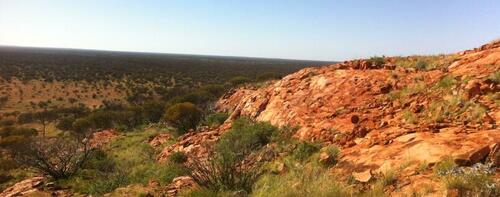
In Australia, researchers have dated the oldest known impact crater of an asteroid: the Yarrabubba crater, which had a diameter of around 70 kilometers but has now been completely eroded, was created by the impact of a celestial body in what is now the state of Western Australia more than 2.2 Billion years ago. This is what researchers around Timmons Erickson from the Nasa Johnson Space Center in Houston report in the journal "Nature Communications".
In its early days, the young earth was constantly hit by celestial bodies. But tectonics and erosion have largely blurred the traces of such impacts over the course of billions of years. To date, the oldest known structures have been the two-billion-year-old Vredefort crater in northern South Africa and the slightly younger Sudbury Basin in southern Ontario, Canada - both more than 200 kilometers in diameter.
No crater testifies to the Yarrabubba impact in the Mid West region, but a magnetic anomaly in an elliptical range from 11 to 20 kilometers in diameter. Based on isotope analyzes of the minerals zircon and monazite, the researchers dated the time of the impact to 2.229 billion years ago - this corresponds to almost half of today's age. In that phase, the rhyacium, there were probably already multicellular organisms on Earth.
Impacts affected the climate worldwide
This makes the crater about 200 million years older than the Vredefort crater. For comparison: The Nördlinger Ries with a diameter of a good 20 kilometers between the Swabian and Franconian Jura was created almost 15 million years ago by a meteorite impact.
The impact in Australia may have affected the global climate, the team speculates. At that time, large parts of the world were covered in ice to low latitudes - traces of glacier deposits that are at least 2.225 billion years old can be found in the province of Transvaal in northern South Africa. The researchers later wrote that the ice had withdrawn for a period of at least 400 million years and saw a connection to the impact.
Further texts on asteroid impacts and the consequences:
The end for the dinosaurs came from above, not from below
Prevention is necessary: "At some point a big chunk will come down"
The moon as a protective wall for asteroids
"Several factors that were triggered by the Yarrabubba impact could have changed the regional or global climate," the team writes. For example, the impact could have catapulted huge amounts of carbon dioxide, water vapor and other greenhouse gases into the then poor oxygen atmosphere.
Huge amounts of ice evaporated
If the region was covered by a layer of ice two to five kilometers thick, the team calculated that 95 to 240 cubic kilometers of ice could have evaporated and melted up to 5400 cubic kilometers. If the steam had reached the upper atmosphere, it could have caused a greenhouse effect, the team writes. However, it admits that this is only one possibility.
"The age of the Yarrabubba impact matches the decline of a number of old glaciers," co-author Nicholas Timms of Curtin University in Perth quotes in a statement from the university. “After the impact, glacier deposits have been missing from the rock archive for 400 million years. This twist suggests that the large meteorite impact may have changed the global climate