x




.jpg)
The End of Scarcity Thinking and the Rise of Ethical Abundance
For thousands of years, human civilization has been shaped by one dominant idea:
Scarcity.
The belief that there is never enough.
Not enough land.
Not enough food.
Not enough wealth.
Not enough opportunity.
Not enough security.
Not enough success to go around.
Scarcity thinking became deeply embedded in the way societies were structured because, for much of human history, scarcity was a reality.
Resources were limited.
Production was limited.
Communication was limited.
Knowledge was limited.
Human labor itself was limited.
Entire economic systems were built around managing shortages.
And because scarcity was real, competition became the dominant strategy.
People competed for resources.
Businesses competed for markets.
Nations competed for power.
Individuals competed for jobs.
The assumption was simple:
If one person gains, someone else must lose.
But as we move further into the twenty-first century, something remarkable is beginning to happen.
For the first time in human history, many of the traditional limitations that created scarcity are starting to disappear.
And this may fundamentally change the way we think about economics, opportunity, and human potential.
Scarcity shaped almost every institution we know.
Education was built around limited opportunities.
Employment was built around limited positions.
Financial systems were built around limited access to capital.
Even social status often emerged from limited recognition and influence.
When resources are scarce, systems naturally become competitive.
Access becomes restricted.
Gatekeepers emerge.
Hierarchies form.
This was not necessarily because people were selfish.
It was because scarcity demanded allocation.
Someone had to decide who received access and who did not.
The interesting thing about scarcity is that even when conditions change, the mindset often remains.
People continue acting as though resources are limited long after technology begins expanding access.
This happens because beliefs change more slowly than systems.
Generations inherit assumptions that were once useful.
And those assumptions continue shaping behavior long after the environment has evolved.
Many people still approach opportunity with the belief that there is only room for a few winners.
But increasingly, that assumption may no longer reflect reality.
Throughout history, abundance has usually followed innovation.
Agricultural advances increased food production.
Industrial advances increased manufacturing capacity.
Digital advances increased information access.
Technology repeatedly expands what is possible.
Today we are witnessing another acceleration.
Artificial intelligence can generate knowledge at extraordinary speed.
Digital networks connect billions of people instantly.
Global collaboration can occur across continents in real time.
Automation can perform tasks that once required enormous human effort.
These developments do not eliminate all scarcity.
But they dramatically reduce many traditional limitations.
Consider knowledge.
For most of history, access to information was restricted.
A person might spend years trying to obtain knowledge that today can be accessed within seconds.
Libraries were scarce.
Experts were scarce.
Educational institutions were scarce.
Today, knowledge is available almost everywhere.
The challenge is no longer finding information.
The challenge is using it wisely.
This represents a profound shift from scarcity toward abundance.
One of the most powerful forms of abundance is connection.
In previous centuries, people were limited by geography.
Today, individuals can:
Connection allows ideas to spread rapidly.
It allows opportunities to emerge in unexpected places.
It enables people to create value together at scales that were previously impossible.
This changes how abundance itself develops.
Scarcity thinking asks:
Abundance thinking asks:
The difference is significant.
Scarcity focuses on dividing existing resources.
Abundance focuses on generating new possibilities.
It is important to be realistic.
Abundance does not mean everything becomes infinite.
Time remains limited.
Energy remains limited.
Some physical resources remain limited.
Ethical abundance is not about pretending constraints do not exist.
It is about recognising that human creativity, innovation, collaboration, and participation can dramatically expand what is possible.
The goal is not fantasy.
The goal is expansion.
Abundance alone is not enough.
History has shown that increased wealth does not automatically produce better outcomes for everyone.
Technology does not automatically create fairness.
Growth does not automatically create inclusion.
That is why ethics matter.
Ethical abundance asks an important question:
How can expanding opportunity benefit more people rather than concentrating advantages in fewer hands?
This question sits at the heart of the Beyond UBI vision.
Many traditional systems operate through extraction.
Value flows upward.
Participation is often limited.
Benefits become concentrated.
Emerging systems increasingly allow value creation to be distributed more broadly.
People can contribute directly.
Communities can collaborate.
Networks can create opportunities together.
The focus shifts from extracting value to creating value.
This creates a healthier foundation for long-term growth.
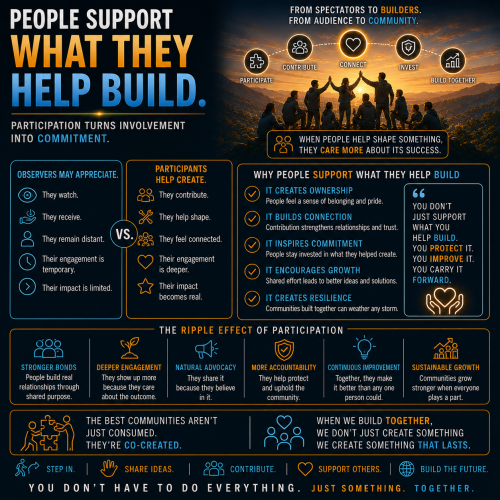
Communities often flourish when abundance thinking is present.
Why?
Because abundance encourages collaboration.
People become more willing to:
This creates positive feedback loops.
The more value participants create, the stronger the community becomes.
The stronger the community becomes, the more opportunities emerge.
Growth becomes self-reinforcing.
Many people still view opportunity as something scarce.
They believe opportunities are controlled by institutions.
Controlled by geography.
Controlled by gatekeepers.
Increasingly, that is changing.
Networks create opportunity.
Participation creates opportunity.
Connection creates opportunity.
Communities create opportunity.
The future may contain more pathways to participation than any previous era in human history.
But recognising those pathways requires a shift in mindset.
Scarcity often produces fear.
Fear of loss.
Fear of competition.
Fear of being left behind.
Fear narrows vision.
People focus on protecting existing positions rather than exploring emerging possibilities.
Abundance thinking encourages a different perspective.
Not blind optimism.
Not denial of risk.
But recognition that growth remains possible even in uncertain environments.
Younger generations increasingly operate inside abundant information environments.
They are accustomed to:
As a result, many naturally think beyond traditional scarcity models.
They often assume that value can be created rather than simply redistributed.
This mindset may become increasingly important as economic systems continue evolving.
The industrial age often rewarded efficiency.
The emerging age may increasingly reward expansion.
Expansion of:
The people who understand how to expand value may become some of the most influential participants in future economies.
Beyond UBI has never simply been a conversation about income.
It is a conversation about possibility.
A conversation about participation.
A conversation about creating systems that allow more people to contribute and benefit from expanding opportunities.
At its core lies a simple idea:
Human potential is far greater than most existing systems allow.
And when people gain access to participation, collaboration, and meaningful opportunity, extraordinary things become possible.
For centuries, scarcity shaped the way humanity organised itself.
And in many ways, that was necessary.
But the world is changing.
Technology is expanding access.
Networks are expanding connection.
Communities are expanding participation.
And these changes create the possibility of something new.
A future built not primarily on competition for limited resources, but on the ethical expansion of opportunity.
A future where value is created rather than merely divided.
A future where participation matters more than privilege.
A future where abundance is not measured solely by wealth, but by the number of people able to contribute, connect, create, and thrive.
Because the greatest opportunity of the twenty-first century may not be discovering new resources.
It may be discovering that humanity itself has always been the most abundant resource of all.