x




.jpg)
Why Ownership Changes the Way People Think, Act, and Prosper
For most people, ownership is viewed as a financial concept.
You own a house.
You own shares.
You own a business.
You own an asset.
And while all of these are forms of ownership, they only tell part of the story.
Because ownership is much more than a financial arrangement.
Ownership is a mindset.
It changes how people think.
How they behave.
How they make decisions.
And ultimately, how they build wealth.
This is one of the reasons why The Ownership Economy represents such a profound shift from traditional economic thinking.
It is not simply about owning more things.
It is about helping more people move from the mindset of a consumer to the mindset of an owner.
And that change can alter entire communities, businesses, and even societies.
For decades, most economic systems have trained people to be consumers first.
Consume products.
Consume services.
Consume entertainment.
Consume information.
Consume opportunities created by others.
Again, there is nothing inherently wrong with consumption.
Every economy needs consumers.
But when consumption becomes the dominant role people play, something happens.
People begin to view the economy as something external.
Something created by others.
Something they participate in only after the important decisions have already been made.
Their role becomes reactive rather than proactive.
They respond to systems rather than helping shape them.
Ownership changes this relationship completely.
Owners see the world differently.
Instead of asking:
“What can I get?”
They begin asking:
“What can I build?”
Instead of asking:
“What does this cost?”
They begin asking:
“What value can this create?”
Instead of focusing only on immediate outcomes, they focus on long-term growth.
Owners naturally begin thinking about:
Because they are connected to the future of the system itself.
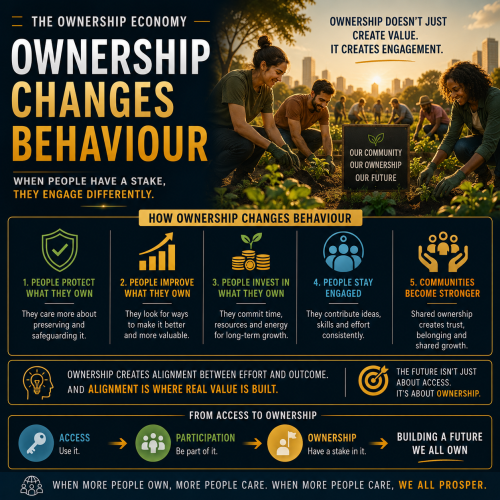
One of the most overlooked aspects of ownership is responsibility.
When people own something, they care about it differently.
A renter and a homeowner often think differently.
A customer and a business owner often think differently.
A participant and a stakeholder often think differently.
Ownership encourages stewardship.
People become more invested in success because they have a direct connection to the outcome.
This creates stronger communities and more resilient systems.
Many people spend their lives focused primarily on income.
Income is important.
We all need it.
But income and wealth are not the same thing.
Income is what you earn.
Wealth is often what you own.
Income helps you meet today's needs.
Ownership creates the possibility of participating in tomorrow's growth.
This distinction is central to understanding The Ownership Economy.
Because long-term prosperity is often built through ownership rather than income alone.
The industrial era was built around employment.
Large organisations needed workers.
Workers needed income.
The relationship was straightforward.
Time was exchanged for money.
This system helped create unprecedented economic growth.
But it also created a culture where most people focused primarily on earning rather than owning.
As a result, millions helped build valuable systems without sharing significantly in the ownership of those systems.
That model is now beginning to evolve.
Technology has enabled a new possibility.
People can now participate in communities, networks, and ecosystems in ways that were previously impossible.
The barriers that once separated contributors from owners are beginning to change.
Participation itself is becoming more valuable.
Communities are creating value collectively.
Networks are creating opportunities collectively.
And increasingly, people are exploring ways to connect participation with ownership.
This represents a major shift in economic thinking.
One reason ownership is so powerful is that it aligns incentives.
When participants share in growth, everyone benefits from creating value.
People are encouraged to:
Because success is no longer a zero-sum game.
Growth becomes something that can be shared.
This creates healthier and more sustainable environments than systems built entirely around competition.
Communities become stronger when participants think like owners.
Why?
Because owners care about outcomes.
They care about:
Instead of focusing solely on individual gain, owners often begin considering how the entire ecosystem can improve.
This shift creates powerful network effects.
As more participants think this way, the community becomes stronger, more resilient, and more valuable.
Consumers often think in days or weeks.
Owners often think in years.
This longer time horizon changes decision-making.
Short-term thinking asks:
“What benefits me today?”
Long-term thinking asks:
“What creates value over time?”
Many of the world's most successful businesses, communities, and ecosystems were built by people willing to think beyond immediate rewards.
Ownership naturally supports this perspective.
For generations, wealth creation was concentrated within relatively small groups.
Access to ownership opportunities was limited.
Access to investment opportunities was limited.
Access to growth opportunities was limited.
Technology is changing that.
Participation is becoming more accessible.
Communities are becoming more connected.
People can contribute, collaborate, and create value together at unprecedented scales.
This opens the door to broader participation in future wealth creation.
This is important.
The Ownership Economy is not about shortcuts.
It is not about speculation.
It is not about chasing the latest trend.
It is about creating sustainable value.
Building meaningful communities.
Supporting growth.
Participating in systems that create opportunity over time.
True ownership thinking focuses on long-term value rather than short-term excitement.
Ownership without contribution can become passive.
Contribution without ownership can become frustrating.
The strongest systems combine both.
People contribute value.
People help the ecosystem grow.
People share in the outcomes created by that growth.
This alignment encourages participation and creates stronger incentives for everyone involved.
Perhaps the most important change is psychological.
Ownership changes how people see themselves.
They stop seeing themselves as spectators.
They stop seeing themselves as outsiders.
They begin seeing themselves as builders.
As contributors.
As stakeholders.
As participants in something larger than themselves.
That mindset often becomes the foundation for meaningful long-term success.
The future economy is unlikely to reward passivity.
It is likely to reward:
The people who thrive may not simply be those who work the hardest.
They may be those who place themselves inside growing ecosystems and contribute meaningfully to them.
Because participation creates opportunities that observation alone never can.
Prosperity has traditionally been measured through accumulation.
How much do you own?
How much do you earn?
How much have you acquired?
The Ownership Economy introduces a broader perspective.
Prosperity becomes connected to:
This creates a more inclusive vision of success.
One where growth can be created together rather than pursued alone.
Ownership is not merely a financial concept.
It is a way of thinking.
A way of participating.
A way of creating value.
And perhaps most importantly, a way of aligning individual success with collective growth.
The Ownership Economy is built on a simple but powerful idea:
When people move from being consumers to becoming owners, everything changes.
Their perspective changes.
Their behavior changes.
Their opportunities change.
And over time, their future can change as well.
Because the most important asset a person can own may not be a house, a share certificate, or a business.
It may be an ownership mindset.
A mindset that asks not:
“What can I take from the future?”
But rather:
“What can I help build, own, and grow as part of the future?”