x




.jpg)
Why the Future Belongs to Builders, Not Spectators
Throughout history, progress has always been driven by a relatively small group of people.
Not necessarily the wealthiest.
Not necessarily the most educated.
Not necessarily the most powerful.
But by people willing to build.
People willing to create something that did not exist before.
People willing to participate rather than simply observe.
People willing to step forward while others stood on the sidelines waiting to see what would happen.
As we move deeper into the twenty-first century, this distinction may become one of the most important economic and social divides of all.
Because the future is increasingly rewarding builders.
And leaving spectators further behind.
For decades, many people have been trained to become consumers first.
We consume:
There is nothing inherently wrong with consumption.
Society needs consumers.
Markets need consumers.
Businesses need consumers.
But something interesting happens when consumption becomes the dominant activity in a person's life.
They begin spending more time watching than participating.
More time observing than contributing.
More time analysing than creating.
Without even realising it, they become spectators.
Spectating is safe.
When you watch from the sidelines:
There is emotional comfort in observation.
You can always wait.
Always learn a little more.
Always gather another opinion.
Always postpone action until some future moment when everything feels clearer.
The problem is that clarity rarely arrives before participation.
Most clarity arrives because of participation.
Not before it.
Builders do not necessarily possess more information than everyone else.
In fact, they often begin with less certainty.
What makes them different is their willingness to engage.
To test.
To experiment.
To participate.
To create.
While spectators are studying possibilities, builders are generating experience.
And experience often becomes a far more valuable teacher than theory.
Because reality provides feedback that observation alone never can.
Industrial-era systems often rewarded compliance.
You followed established processes.
You learned established rules.
You operated within established structures.
But emerging economies increasingly reward initiative.
People who can:
Often create opportunities for themselves rather than waiting for opportunities to appear.
This changes the relationship between individuals and the economy.
It is easy to look at successful systems and assume they were inevitable.
But they were not.
Every company started small.
Every community began with a few people.
Every movement began with an idea.
Every innovation started as an experiment.
Behind every system that exists today was someone willing to build before success was guaranteed.
That willingness is what separates builders from spectators.
Builders tend to think differently.
Instead of asking:
"What already exists?"
They ask:
"What could exist?"
Instead of asking:
"Who will solve this?"
They ask:
"Can I help solve this?"
Instead of waiting for perfect conditions, they begin working with the conditions available.
This mindset creates momentum.
And momentum often creates opportunity.
Technology has dramatically lowered the barriers to building.
A single individual can now:
Capabilities that once required large organisations are now accessible to ordinary people.
This does not guarantee success.
But it expands participation.
And expanded participation creates new possibilities.
Spectators often become skilled critics.
It is easy to identify flaws.
Easy to point out problems.
Easy to explain why something might fail.
Creation is harder.
Building requires:
Builders understand that imperfect action often creates more value than perfect criticism.
Because systems improve through participation, not observation.
Builders tend to attract other builders.
Communities grow around action.
People are naturally drawn toward individuals who create momentum.
This creates a powerful effect.
One builder inspires another.
One project attracts additional contributors.
One community creates opportunities for many participants.
Over time, these connections become ecosystems.
And ecosystems create leverage.
Many people feel trapped.
They feel as though opportunity belongs to someone else.
As though progress is happening somewhere beyond their reach.
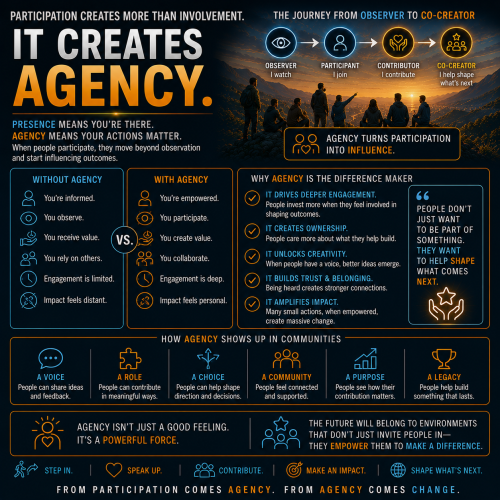
Often this feeling emerges because they remain positioned as observers rather than participants.
Observation creates awareness.
But participation creates agency.
Agency changes everything.
Because once people begin contributing, they start influencing outcomes rather than simply reacting to them.
One of the greatest benefits of building is accelerated learning.
When you create something:
Learning becomes practical.
And practical learning tends to compound faster than passive learning.
This is why builders often develop capabilities rapidly.
They are constantly interacting with reality.
As automation and artificial intelligence continue expanding, routine activities may become increasingly automated.
But building remains deeply human.
Building requires:
These qualities become more valuable as predictable tasks become less valuable.
The future economy may therefore reward people who can create rather than simply perform.
Last week we explored the growing importance of communities.
Communities do not appear automatically.
They are built.
By people who contribute.
By people who organise.
By people who share ideas and create value.
Every thriving community is ultimately the result of builders choosing to participate consistently over time.
Opportunity often emerges through the act of building itself.
People meet collaborators while creating projects.
People discover new systems while participating.
People gain visibility by contributing value.
In other words, building often generates opportunities that could never have been predicted beforehand.
This is one reason builders frequently seem "lucky."
Their activity places them where opportunities naturally emerge.
Many people avoid building because they imagine success requires enormous beginnings.
But nearly every successful system starts small.
A conversation.
A project.
A community.
A simple idea.
Builders understand that scale comes later.
The important step is beginning.
Because momentum can only develop after movement begins.
The future may not ask:
"What credentials do you have?"
Or:
"How much experience do you have?"
Instead, it may increasingly ask:
"What have you built?"
What value have you created?
What communities have you contributed to?
What systems have you helped strengthen?
These questions reflect participation rather than observation.
And participation is becoming increasingly valuable.
Imagine a future where more people stop waiting.
Where more people choose to contribute.
Where more people build rather than merely consume.
Such a future would likely be:
Because builders create possibilities that spectators can only discuss.
The world does not move forward because people watch.
It moves forward because people build.
Every advancement.
Every community.
Every system.
Every opportunity.
Exists because someone chose to participate instead of remaining on the sidelines.
As the economy continues evolving, this distinction may become increasingly important.
Not between rich and poor.
Not between young and old.
But between those who build and those who merely observe.
Because the future is unlikely to be shaped by spectators.
It will be shaped by people willing to create, contribute, participate, and build.
And perhaps the most important question any of us can ask is:
“Am I spending more time watching the future happen—or helping to build it?”