x




The Swiss journalist visited the dachas of several Muscovites. The furnishings there are usually very simple, often without any special amenities. So why do Russians love their dachas so much? The Swiss found several answers to this question at once. Sometimes a dacha is a political concept, and sometimes a cultural phenomenon.
Mythic dacha: a summer house that evokes sentimental thoughts. Many Russians flee here from the crowdedness of their city apartments, from the heat of the city and from the Russian reality.
The last residential quarters of Moscow float past the car window. The ring road separates the capital, with its 12 million inhabitants, from the surrounding countryside. Gas stations and supermarkets with large parking lots flit along the road.
Finally, the countryside opens up: wide fields to the horizon, villages here and there. Moscow region - this is the name of the area around the capital. It is bigger than Switzerland. Many Muscovites have dachas here.
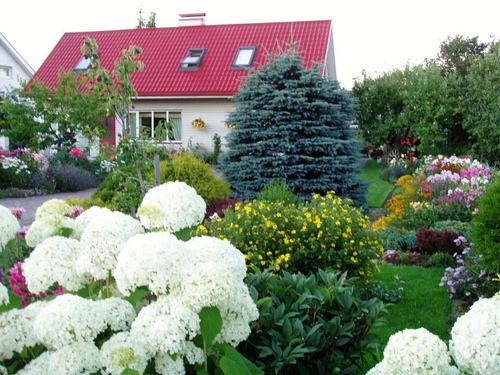
The suburban village of Pikalovo is located 70 kilometers south of Moscow. There are about a hundred houses in it: some are wooden, others are brick. As a rule, houses are surrounded by high blank fences. But if you get to the plots, you see well-groomed gardens, children's pools, flower beds. Small world of ordinary people.
Behind the large green gate is the kingdom of Helena. She introduced herself to us only by name. Elena is a retired German teacher. She is wearing a wide sports T-shirt, jeans and slippers, that is, a typical country wardrobe. She spends most of the summer in the country. “What should I show you?” She asks. "Ah, I'll show you where it all started."
Elena leads us to a wooden house in the back of the garden and opens the door. Before us is an old children's bicycle, a garden umbrella from the sun, a couple of boards. What today looks like a closet was once the home for the whole family. Like many other Soviet citizens, Elena and her now deceased husband received a small piece of land from the state in the 1980s. They erected the first building on it with their own hands.
“My husband glued a model of the house out of cardboard. He dreamed of building such a life-size house, ”says Elena. The dream came true a few years later. After the collapse of the Soviet Union, Elena began to make good money with translations, and with this money they finally built a house - a two-story building with a gable roof and a small terrace, which previously existed only in a cardboard version.
"Dacha is a state of mind"
What does dacha mean for Elena? “In Moscow I have a small apartment, only two rooms. Although I love city life, here, outside the city, I have a piece of land, it belongs to me, I'm in charge here and I can do whatever I want. "
Karina, Elena's adult daughter, also spends a lot of time at the dacha due to the pandemic. She is sitting in the garden, wearing shorts and pilot's sunglasses. Karina is a top cultural manager. She gladly talks about her trips to Western Europe: she was in Italy, in Lugano, in Zurich.
But still she adds: “This is my homeland. And of course I like it here. Today we went to pick mushrooms and make a delicious soup from them. Well, besides, the dacha is something like a museum of my childhood, here all the objects from that time - plates, cups, lamps, furniture. "
The dacha for Karina is full of memories. The fact that the situation here is quite simple and the toilet with a cesspool does not bother her at all. On the contrary: “We have money to build a real civilized house, like in Europe. But this is not for me. Because in the country, comfort is not the main thing. Dacha is a state of mind. "
Visiting "Mister Dacha"
The first dachas, if I may say so, were the summer residences of Russian aristocrats. The communists turned the dacha into a mass phenomenon. Today, about 40% of Russian families own such summer houses.
Another summer cottage settlement - 50 kilometers east of Moscow. Andrey Tumanov opens heavy iron gates and invites to his site. If anyone can tell about the dachas, then first of all he, the Russian "Mister Dacha".
Almost 30 years ago, Tumanov created a dacha magazine and eventually became, as it were, the country's main dacha lobbyist. There was even a period when he sat in parliament.
"Summer residents are exemplary citizens"
He believes that the state should do more for summer residents: “When I hear that the state energy concern Gazprom is the main support of the economy, I say: no, such support is summer residents. It was we who saved Russia from collapse in the 1990s. People grew at least vegetables in their dachas and so they survived. "
Indeed, in the 1990s, the dacha was for many not a place of rest, but the basis of their existence. But those days are over. There are a lot of tomatoes and cucumbers in Russian supermarkets.
Nevertheless, Tumanov considers summer residents to be the mainstay of the state: “The owners of summer cottages are exemplary citizens: they practically do not go to demonstrations, they pay taxes accurately. And above all, they want the system to remain as it is. They don't want change because they are afraid of losing their property. "
That is, the dacha is not only a place where dreams are given. The dacha stabilizes the political regime.
Dacha as a cultural phenomenon
But the dacha is also a cultural phenomenon. Musicians in the dachas composed music, writers created novels, poets composed poetry. And today the Moscow cultural intelligentsia is drawn to nature for the summer coolness.
Here is a summer evening at one of these artistic dachas. About two dozen people gathered: artists, journalists, musicians. They drink wine, have a snack. Then, when it got dark, the group is located around the fire. Two women and a man sing folk songs from deep Russia. Songs full of longing for the old days.
Best Russia
Denis Likhin and Alexey Blinkin, two adult men, are standing a little to the side. They indulge in childhood memories. "How good it was then with all the friends in the country!" - says Alexey. And Denis adds: "Especially when we climbed the neighboring gardens and stole strawberries." They both laugh.
Alexey is a musician, Denis organizes a big festival of alternative music every year. Both are passionate summer residents. Why? Alexey says: “At the dacha, the main thing is to break out of the familiar reality. The dacha is a place where you can live a different life. " For him, as Alexei says, a dacha is, first of all, special emotions, a personal space of peace. Denis also adds a political aspect here.
“When a politician is removed, what do they say? Ivan Ivanovich went to his dacha. Dacha is a place of exile. It was considered so in Soviet times. And now Soviet realities are returning to the country again.
Alexei agrees with this: "Our life is again driven into the same framework as then, and no one asks if we agree to this."
Judicial sentences to oppositionists, arrests, poisoning of Navalny. 2020 is the year when clouds thickened over Russia. Denis quotes Nobel Prize laureate in literature Joseph Brodsky, whom the Soviet government first threw in prison and then forced to leave the country: "If you have to live in an empire, then at least in a small house by the sea."
The dacha is more than just a summer house. She is a place to run to. She is a memory of childhood, a place where you are happy. This is a different, better Russia. Sincerely, Lyubov Sultanova. Yes, I want to add on my own that I myself have a dacha with a bathhouse and a vegetable garden and I love it all very much. Dacha is a state of the Russian mysterious soul.