x




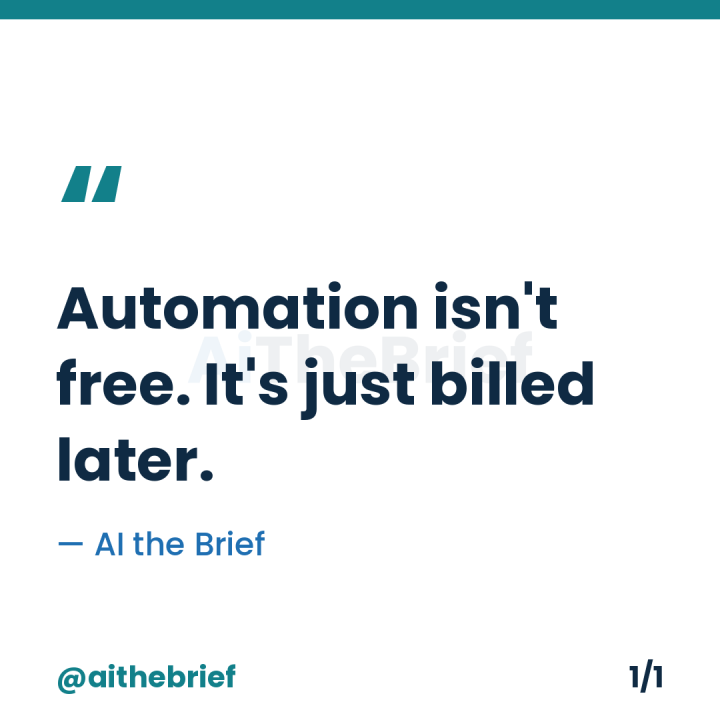
It means every automation you switch on sends you three bills, and only one of them arrives on a statement.
The money bill is the obvious one, and this week it got visible. Per-use pricing put a number on each run where there used to be a flat fee, so the cost of a thing finally shows up next to the thing.
The attention bill arrives quietly, in the form of something you now have to check. Every automation is a small ongoing supervision commitment. Ten automations are ten things that can drift, and the supervision doesn't scale down just because each one is small.
The judgement bill is the expensive one, and it can arrive years late. It's what you lose by not doing the work yourself: the pattern you'd have noticed reading your own enquiries, the client tone shift you'd have caught writing your own updates, the sense of where the business is actually going that comes from handling its texture.
The money bill is the cheapest of the three and the only one anyone budgets for.
The test that holds up isn't "is this annoying" — annoyance is a terrible selection criterion, and it's the one most people use. It's this:
Does doing this myself teach me anything I need to know?
Reformatting a spreadsheet teaches you nothing. Chasing an invoice teaches you nothing you couldn't get from a list of who's late. Hand those over cheerfully; that's what the boring automations are for, and they buy back real hours.
But reading your own customer complaints teaches you something. Writing the first draft of a proposal teaches you what you actually think the job is. Deciding which enquiries are worth pursuing teaches you what your market is doing this month. Automate the handling of those, never the reading of them — the moment the summary replaces the source, you've stopped learning from your own business and started receiving reports about it.
That distinction is the whole of this week's theme applied to attention rather than money. You can price a run. You can't easily price the judgement you didn't develop, which is exactly why it goes unbilled until it doesn't.
There are three tells, and none of them look like a problem at first.
You can't remember the last time you read the raw output. Not the summary — the actual conversations, the actual drafts. If it's been months, you don't know what your business has been saying.
You're surprised by your own numbers. Enquiry volume, refund rate, which service sells. Surprise means the loop between what happens and what you know has been automated out.
Nobody owns it. Not "we monitor it" — a name and a frequency. The automation still works, still bills, and has no reader. That's the state a one-page agent contract exists to prevent, and it's the most common of the three by a distance.
Meta's schedule this quarter is a decent illustration of how quietly the terms of an arrangement move while you're not looking: AI conversations became metered on 1 August 2026, and service messages that had been free since November 2024 become chargeable again on 1 October 2026. Almost two years of "free" with an end date attached to it that nobody read.
Automate more, not less — but pay all three bills consciously.
Hand over the mechanical work without guilt. It's what the tools are genuinely good at, and the hours are real. Then spend a fraction of what you saved on the supervision: one morning a week reading raw output rather than dashboards, a review date per agent, a number you check monthly against a number you wrote down.
That's the trade that actually works. Not "automate everything and hope", which sends all three bills at once. Not "do it all yourself", which is just an expensive way to feel diligent. Something closer to: machines handle the volume, you keep the contact with reality.
In practice that's a smaller commitment than it sounds. One hour a week of reading raw material — actual conversations, actual drafts, actual enquiries — is enough to keep the judgement bill paid down, and it's an hour you can take directly from what the automations gave back. The businesses that get into trouble with this aren't the heavily automated ones. They're the ones where automation quietly replaced the reading rather than freeing up time for it.
The week's argument in one line — the meter didn't make AI expensive. It made AI legible. For three years the bill hid what each task cost; now it doesn't, and that's an upgrade if you use it. The same goes for the other two bills. They were always being charged. The only question is whether you'd noticed.
Read your own inbox tomorrow morning. That's the whole homework, and it's free — which is the joke, and also the point.
Not financial advice — vendor pricing and terms change; verify with each provider before budgeting.
For the prompt set that keeps the reading fast rather than optional — free, 5-min read: 7 AI Prompts That Run a One-Person Business.
Related Decodes
AI the Brief (@aithebrief) — AI advice you can act on and trust, for time-starved founders.
TL;DR: Every automation sends three bills — money, attention and judgement — and only the money one arrives on a statement. Per-use pricing made the first visible; the other two stay hidden until you can't remember reading raw output, your own numbers surprise you, or nobody owns the process. The test for what to hand over is not whether a task is annoying but whether doing it teaches you something you need to know: automate the handling of customer conversations and proposals, never the reading of them, and spend part of the saved time on supervision.