x



For three years, whether you told anyone you used AI was a matter of taste. Some founders mentioned it. Most didn't. Nobody was obviously wrong.
On 2 August 2026 that stopped being a matter of taste for a large slice of the world's businesses. The transparency obligations in Article 50 of the EU AI Act became applicable — and unlike most of the Act, this part isn't aimed at people training frontier models. It's aimed at people using AI in front of other people. Which, at this point, is nearly everyone reading this.
AI transparency rules applied on 2 August 2026. Here's the 20-minute disclosure audit, the three sentences to write once, and why saying it first wins work.
The good news first, because the headlines won't lead with it: for a one-person business this is usually an hour of configuration, not a compliance project. A greeting line. A label. A page.
Three obligations matter to a small business, and they're narrower than the panic suggests.
One: an AI people can talk to has to say it's an AI. If you run a chatbot, auto-responder or DM automation that converses with a person, that person must be told they're dealing with a machine. Article 50 requires this "in a clear and distinguishable manner, at the latest at the time of the first interaction or exposure" — not buried in a footer, not on request, and not after they've already typed their problem into it.
Two: synthetic media gets labelled. Images, audio and video generated or meaningfully altered by AI must be marked as such.
Three: AI-written text published to inform the public on matters of public interest gets disclosed — unless a human took editorial responsibility and reviewed it. That last clause matters enormously for anyone publishing a blog, and most summaries drop it.
There is a transitional period, but it's narrower than commonly reported: it applies to the machine-readable marking duty for providers of generative systems already on the market, running to 2 December 2026. Content generated before 2 August needs no retroactive labelling. The user-facing disclosures above applied on the 2nd.
Two facts to file. The European Commission's AI Office has published a voluntary Code of Practice on Transparency of AI-Generated Content — a recognised route to demonstrating compliance, not a new burden. And non-compliance can attract fines of up to €15 million or 3% of worldwide annual turnover, whichever is higher. Nobody is fining a sole trader €15 million; the number tells you which category of obligation this is.
The honest answer: scope follows your users, not your postcode. The Act reaches businesses whose AI output is used by people in the EU — a UK consultancy with one German client, a Kenyan agency with an EU-facing website, a solo founder whose chatbot answers whoever lands on the page. Worth checking properly rather than assuming out of.
But run the counterfactual, because it's the more useful exercise. Suppose it definitively doesn't apply to you. Would you be comfortable with a client discovering, on their own, that the report you sent was drafted by a model? If not, the regulation was never the reason to disclose. It just gave you a date.
Not legal advice — a plain-English summary; your position depends on facts this post doesn't know.
Do this once, this week. Four surfaces — most founders name two.
For each, three questions. Would a client be surprised? Where would they find out — from you, or from someone else? And what is the one line that fixes it?
That third question is the whole job, because nearly every gap closes with a sentence. "This chat is answered by an AI assistant." "Image generated with AI." "We draft with AI and review everything before it reaches you."
If you've already written the two-column list of what's safe to automate, the hard half is done: the left-hand column is your disclosure list.
Your disclosure is three sentences, written one time: what you use AI for (name the tasks, not the tools — drafting, summarising, first-pass research), what a human still does (every client output reviewed; decisions and advice human; you sign it, not the model), and what you never feed it (no client data without permission, no confidential documents, plus your own hard limit).
Then four places: your about page, your proposal template, your chatbot's first message, your onboarding pack. Ten minutes.
The test isn't whether it's technically true. It's whether a client would be surprised. Buried in your terms doesn't count.
We've used that model for a year, and disclose has always been the step people skipped — vetting feels like diligence and verifying feels like quality, while disclosing just feels like admitting something.
It isn't. Nobody was ever paying you for keystrokes. They were paying for judgement — for someone who knows which draft is wrong and why. Disclosure doesn't reveal that a machine did your work; it clarifies that you did the part that mattered. That's the trust boundary, pointed outwards.
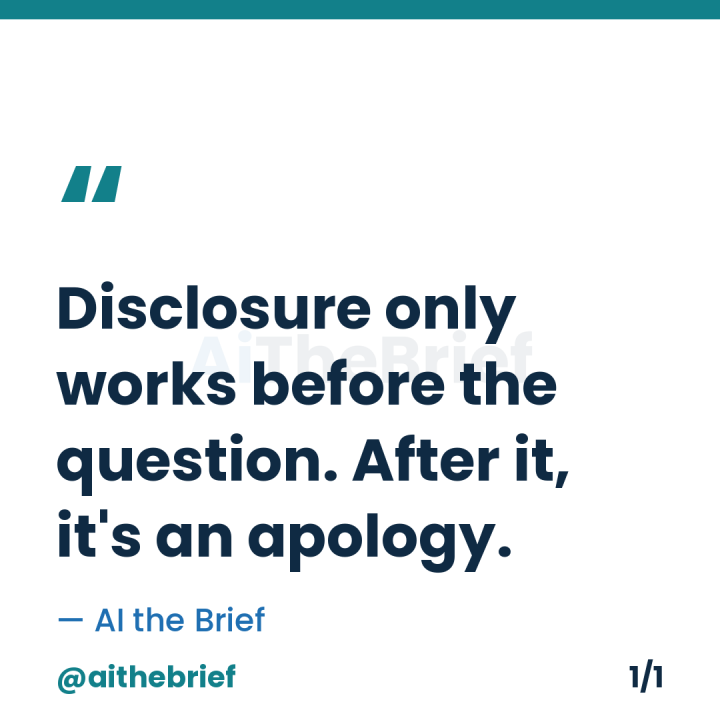
And timing is the entire value. Told first reads as confidence; told second reads as damage control, even when nothing was hidden. That asymmetry doesn't care whether the Act applies to you, which is why speed stopped being the premium and this didn't.
Twenty minutes of audit. Three sentences. One page. Then it's done, and it's an asset rather than an exposure.
Say it out loud, before somebody asks.
Educational only — evaluate your own business risks; results may vary. Not legal advice.
TL;DR: The EU AI Act's Article 50 transparency obligations became applicable on 2 August 2026, and they land on businesses that use AI in front of people, not only on those building it: a chatbot must tell people it's an AI at the first interaction, synthetic images and video must be labelled, and AI-written text published to inform the public on matters of public interest must be disclosed unless a human took editorial responsibility. A limited transition to 2 December 2026 covers only machine-readable marking by providers of systems already on the market, and pre-2 August content needs no retroactive labelling. For a solo business the practical work is a 20-minute audit of four surfaces (chatbots and auto-replies, generated media, client-facing drafts, about and policy pages), a three-sentence disclosure written once and pasted in four places, and a one-page AI policy. Scope follows where your users are — and the timing is the point: told first reads as trust, found out later reads as damage control.
For the checklists we use to run this — free, 5-min read: 7 AI Prompts That Run a One-Person Business.
Follow @aithebrief for one AI move a day — practical, vetted, no hype.