x




Artificial intelligence is entering a new phase.
For years, the technology was primarily discussed as a tool: something people could use to write emails, generate images, answer questions, analyse information or produce code. But the latest developments suggest a much bigger transformation is underway.
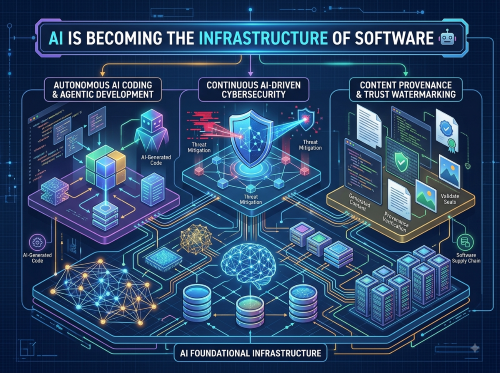
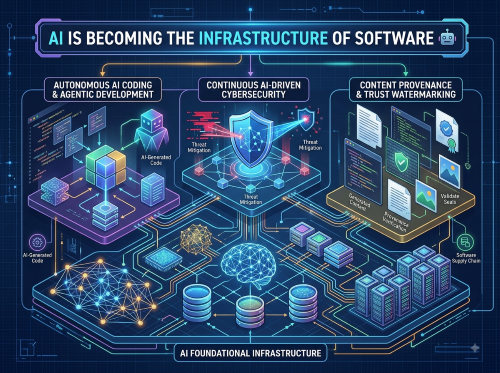
AI is increasingly becoming infrastructure — embedded in the systems that create software, defend digital networks and establish whether content can be trusted.
Three developments illustrate this shift particularly well: AI-generated-content watermarking, increasingly capable AI models crossing cybersecurity thresholds, and the rapid rise of AI coding companies.
Individually, each trend is significant. Taken together, they reveal an emerging technology landscape in which AI is becoming part of the underlying machinery of the digital economy.
The explosion of generative AI has created an obvious problem: it is becoming increasingly difficult to determine whether a piece of content was created by a person, an AI model, or a combination of the two.
That uncertainty matters.
A generated marketing article is one thing. AI-produced content used in education, journalism, political communication, legal documents or financial information presents a very different challenge.
This is where AI content watermarking could become important.
Watermarking aims to introduce identifiable signals into AI-generated material, allowing specialised systems to assess whether content is likely to have originated from an AI model. Unlike a visible logo or disclaimer, a digital watermark can potentially be embedded within the structure of generated content without being obvious to the reader.
The idea is not entirely new. Digital watermarking has existed for years in areas such as photography, audio, and video. Generative AI, however, creates a much broader problem because text, images, audio, video, and computer code can all now be produced synthetically at enormous scale.
The challenge is making those signals reliable, durable and difficult to remove.
Text is particularly complicated. A person can take AI-generated text, edit it, translate it, restructure it or combine it with human writing. At some point, determining whether the final product is "AI-generated" becomes considerably more nuanced than simply detecting whether a model produced the original words.
That means watermarking is unlikely to become a perfect AI detector.
Instead, it could form part of a wider content provenance ecosystem, alongside metadata, cryptographic signatures and systems designed to establish where digital content came from.
This distinction is important. The future of AI authentication may not depend on one magical detector that answers "human or machine?" Instead, it may depend on multiple technologies that provide evidence about the history and origin of a piece of content.
The implications extend well beyond spotting essays written by chatbots.
Imagine a future in which much of the internet is generated or modified by AI. Search engines, social networks and businesses could need better ways to establish the origin of information.
News organisations could use provenance information to demonstrate that an image was captured by a camera rather than generated from scratch. Businesses could identify synthetic customer communications. Online platforms could provide additional context around AI-generated posts.
At the same time, there are legitimate concerns.
A watermarking system must not become a mechanism for surveillance or an excuse to automatically distrust synthetic content. AI-generated material can be useful, creative and entirely legitimate. A piece of content being produced by AI does not automatically make it false or low quality.
The more useful question is therefore not simply "Was AI involved?"
It is:
"How was AI involved, and can we verify the content's provenance?"
That subtle change could become increasingly important as synthetic media becomes indistinguishable from conventional digital content.
The second major development is arguably even more consequential.
AI models are becoming increasingly capable at programming, reasoning and analysing complex systems. Those abilities have obvious benefits for cybersecurity — but they can also introduce new risks.
Modern AI systems can already help security professionals analyse code, identify vulnerabilities, investigate suspicious behaviour and automate parts of incident response.
But the same capabilities can potentially be used offensively.
An advanced model that can understand a large software repository, identify a vulnerability and produce an effective exploit could dramatically reduce the expertise and time required to attack software.
This is why AI cybersecurity thresholds are becoming such an important concept.
Rather than asking whether an AI model is simply "good" or "bad" for cybersecurity, researchers and AI companies increasingly need to assess what the system can actually accomplish.
Can it discover previously unknown vulnerabilities?
Can it chain multiple weaknesses together?
Can it write malicious code that works outside a laboratory environment?
Can it adapt when an attempted attack fails?
Can it operate with minimal human supervision?
Each capability changes the risk profile.
An AI model that explains a known vulnerability to a security researcher is fundamentally different from one that can autonomously find exploitable weaknesses in unfamiliar software.
This creates the possibility of an accelerating AI security arms race.
Defenders can use AI to inspect millions of lines of code, detect anomalies and respond to incidents faster. Attackers can potentially use AI to search for vulnerabilities, automate reconnaissance and develop malicious software more efficiently.
The advantage may therefore go to whichever side can deploy AI more effectively.
That has profound implications for businesses.
Traditional cybersecurity already struggles with a basic asymmetry: defenders must protect every exposed system, while attackers may only need to discover one exploitable weakness.
AI could intensify that imbalance.
A vulnerability that previously required an experienced specialist several days to investigate could potentially be identified much faster by an advanced coding model. Conversely, defensive AI systems could continuously test applications, monitor networks and automatically propose fixes.
The result could be a future in which cybersecurity becomes less about periodic testing and more about continuous machine-assisted defence.
This is one reason reports about frontier AI models approaching critical cybersecurity capabilities deserve attention. The issue is not simply that an AI can write code. It is that increasingly sophisticated models may eventually be capable of reasoning about complex software systems at a scale and speed that humans cannot match.
That leads directly to the third trend: the rapid emergence of companies building AI systems specifically for software development.
AI coding assistants began relatively simply. They could autocomplete a function, explain an error or generate a small piece of code.
Today's systems are moving towards something much more ambitious.
Instead of asking AI to write a few lines, developers can increasingly describe a software feature in natural language and ask an AI system to plan, implement, test and modify it.
This has given rise to a new generation of AI coding companies.
Some are building coding agents. Others are creating AI-native development environments. Some are attempting to automate software engineering workflows from beginning to end.
The important development is the transition from AI-assisted programming to AI-driven software development.
That distinction could prove enormous.
A traditional coding assistant makes an individual developer faster.
An autonomous coding agent potentially changes the economics of an entire software team.
One of the biggest consequences could be the democratisation of software creation.
Historically, building a sophisticated application required knowledge of programming languages, databases, cloud infrastructure, testing frameworks, security practices and deployment systems.
AI coding tools can reduce some of those barriers.
A founder with limited programming experience might be able to describe a product idea and have an AI agent construct an initial version. An experienced developer might use several agents to handle repetitive engineering work while concentrating on architecture and product decisions.
This does not necessarily mean programmers become obsolete.
In fact, the opposite may be true in many organisations.
As software becomes easier to generate, software architecture, verification, security and judgement could become more valuable. Someone still needs to decide whether generated code is correct, maintainable and secure.
The bottleneck could move from writing code to knowing what code should be written.
There is a potential downside to dramatically increasing software production.
If AI makes software development ten times easier, the world may simply produce far more software.
That sounds positive until you consider the security implications.
Every application contains dependencies. Every dependency can contain vulnerabilities. Every API creates an interface. Every automated system can introduce configuration mistakes.
If organisations begin deploying huge quantities of AI-generated code without appropriate review, testing and security controls, the volume of software vulnerabilities could increase alongside productivity.
This makes AI coding and AI cybersecurity inseparable.
The companies building autonomous coding systems therefore have a particularly important responsibility: generated code needs to be tested, reviewed and secured as rigorously as — or more rigorously than — human-written code.
This is perhaps the most important shift of all.
Software has traditionally had a relatively understandable production chain: humans design it, humans write it, automated systems compile and test it, and organisations deploy it.
AI introduces another layer.
An AI model may now generate the code. Another AI system may test it. A security model may inspect it. An automated agent may deploy it. Another system may monitor it in production.
In other words, AI itself is becoming part of the software supply chain.
That raises questions that technology companies will have to answer.
Which model generated this code?
What instructions was it given?
Which libraries did it select?
Was the output independently tested?
Were vulnerabilities identified and fixed?
Can the generated software be traced back to its source?
These questions connect directly to the issue of AI watermarking and provenance.
The same principle — establishing where something came from and what happened to it — could eventually apply not only to media, but to software.
Put these developments together and a much larger picture emerges.
AI-generated-content watermarking addresses trust.
Cybersecurity-capable AI addresses security.
AI coding systems address creation.
Together, they represent three essential layers of the digital economy: determining what can be trusted, defending digital systems and producing the software those systems run on.
That is why describing AI merely as a productivity tool increasingly feels inadequate.
AI is becoming infrastructure.
It is moving into the background of everyday digital operations, much like cloud computing, databases and networking did before it. Users may not always know which AI system generated a piece of code, inspected a security event or authenticated digital content — but those systems could increasingly determine how digital services function.
The next stage of the AI revolution may therefore be less visible than the chatbot boom.
Instead of constantly interacting with an AI assistant, people may encounter AI indirectly.
A developer will have AI agents building software.
A security team will have AI systems continuously searching for vulnerabilities.
A platform will have provenance technology identifying synthetic content.
A business will have automated systems checking and modifying code.
And consumers may increasingly rely on invisible authentication systems to determine whether digital information is trustworthy.
The big question is whether these technologies develop in a coordinated way.
If AI becomes capable of creating software at unprecedented speed, security must keep pace. If synthetic content becomes ubiquitous, provenance systems must become more sophisticated. And if AI systems become powerful enough to attack software autonomously, defensive infrastructure must evolve just as quickly.
The technology industry is therefore entering an era in which creation, security, and trust are becoming interconnected AI problems.
That may ultimately prove more significant than the chatbot revolution itself.
The first era of generative AI taught people that machines could create.
The next era may be about something much bigger: machines helping to build, secure and authenticate the digital world itself.
For a broader look at the rapid evolution of AI development tools, TechCrunch's coverage of AI coding and developer technology provides a useful window into how quickly this market is changing.
And as AI systems become more capable of interacting with software autonomously, Reuters' technology coverage is worth following for developments around AI safety, cybersecurity, and the companies building the next generation of models.
The fundamental shift is already underway. AI is no longer simply sitting on the other side of a chat window waiting for instructions. Increasingly, it is becoming part of the machinery behind the software, security, and information systems that society depends upon.
Disclaimer: This article is provided for informational purposes only, mistakes may be made, and it's not offered or intended to be used as legal, tax, investment, financial, or any other advice.