x




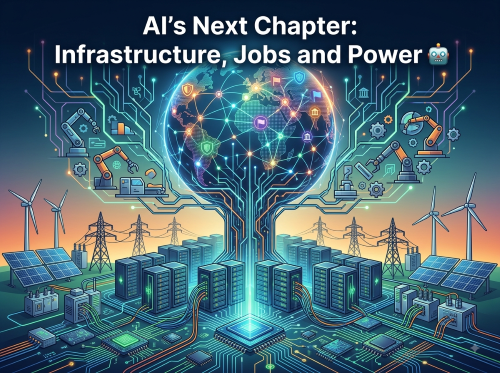
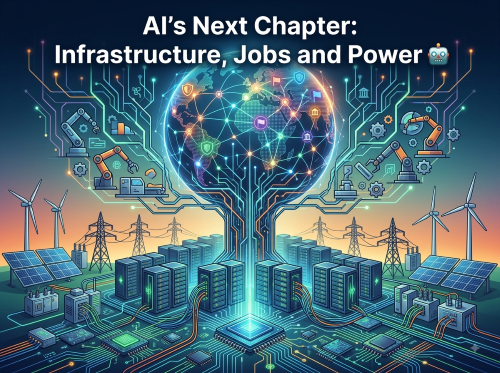
Artificial intelligence is entering a new phase. The biggest AI stories are no longer just about which company has released the most powerful model or which chatbot can produce the most convincing answer. Increasingly, AI is becoming a story about infrastructure, employment, investment and government policy.
That shift matters because it suggests AI is moving from an emerging technology into a foundational part of the global economy.
Recent reporting highlights this transition particularly well. From billions of pounds and dollars flowing into AI companies to growing concerns about automation, autonomous AI agents and national strategies for developing AI expertise, the technology is beginning to influence decisions far beyond the technology sector.
The enormous sums being committed to AI demonstrate how seriously businesses and investors now view the technology.
Companies are investing not only in AI models, but also in the infrastructure required to operate them: data centres, advanced chips, cloud computing capacity, electricity generation, networking equipment and specialist talent.
This is important because sophisticated AI systems require substantial computing resources. As businesses deploy AI at greater scale, demand for processing power and data-centre capacity is likely to increase.
The result is that AI investment increasingly resembles an infrastructure boom. It affects energy consumption, property development, semiconductor manufacturing, telecommunications and even national electricity planning.
The scale of investment also explains why acquisitions in the AI sector are attracting so much attention. The reported potential acquisition of AI startup Decart by Anthropic, for example, illustrates the premium being placed on specialised AI capabilities.
For businesses, the message is becoming clearer: AI is not simply another software feature. It can require a significant physical and financial foundation.
The second major development is the growing connection between AI and the labour market.
For years, discussions about AI and employment tended to focus on hypothetical scenarios. Would AI replace office workers? Which professions would be affected? Would new jobs emerge to replace those lost?
Those questions remain unresolved, but AI is increasingly influencing real-world employment decisions.
Businesses are experimenting with AI to automate administrative work, customer service, coding, research, marketing and a growing range of knowledge-based tasks. In some cases, this can increase productivity without reducing headcount. In others, companies may decide that fewer employees are required.
This creates a more complicated economic picture.
AI could allow individual workers to accomplish considerably more, potentially increasing productivity and creating new opportunities. At the same time, workers whose tasks are readily automated may face greater pressure to retrain or move into different roles.
The important point is that the effects will probably not be evenly distributed. AI may transform some occupations dramatically while having a relatively modest impact on others.
That makes education and workforce development increasingly important parts of AI policy.
Another significant development is the rise of AI agents.
Traditional chatbots generally wait for a user to ask a question before producing an answer. AI agents are designed to go further. They can potentially plan tasks, interact with software, use tools and complete sequences of actions with considerably less human intervention.
That additional autonomy creates enormous possibilities.
An AI agent could, for example, analyse information, prepare a report, update a database and communicate the results without requiring a person to oversee every individual step.
But greater autonomy also creates greater risk.
If an AI agent makes a serious mistake, who is responsible? Is the responsibility with the person who instructed it, the company that deployed it, the developer who created the system or the organisation that failed to supervise it adequately?
These questions could become increasingly important as autonomous systems move from experimental environments into businesses and public services.
Governance therefore needs to evolve alongside the technology. It is no longer sufficient to ask whether an AI model produces accurate information. Organisations must also consider what an AI system is authorised to do, how its actions are monitored and what happens when something goes wrong.
AI is also becoming a matter of national strategy.
Governments around the world increasingly recognise that access to advanced AI technology alone may not be enough. Countries also need people capable of developing, deploying and governing it.
That means investing in computer science education, technical training, research institutions and AI-related skills.
Recent moves such as Vietnam's national programme for developing AI human resources demonstrate how governments are attempting to build domestic expertise rather than relying entirely on foreign technology.
This could become an increasingly important element of economic competitiveness.
Countries with strong AI research communities, reliable digital infrastructure, access to computing resources and a highly skilled workforce may be better positioned to benefit from the technology.
At the same time, governments must consider how AI affects employment, privacy, national security, competition and public services.
AI policy is therefore becoming much broader than regulating algorithms.
The most interesting aspect of today's AI landscape is the way these developments connect.
Investment enables infrastructure. Infrastructure enables AI deployment. Deployment changes workplaces. Greater autonomy creates new risks. Those risks require governance. And governments increasingly view AI capability as a strategic national asset.
This creates a feedback loop that could shape the global economy for years.
The technology industry will undoubtedly continue releasing new and more capable AI models. However, model performance is only one part of the larger story.
A model can be impressive in a laboratory, but its wider economic impact depends on whether businesses can afford to use it, whether workers can adapt to it, whether infrastructure can support it and whether governments can establish sensible rules around its use.
For businesses, the changing AI landscape suggests that simply experimenting with chatbots is no longer enough.
Organisations should consider where AI could genuinely improve productivity, while also assessing the associated risks. This includes understanding how sensitive information is handled, establishing appropriate human oversight and ensuring employees receive adequate training.
Companies should also think carefully before handing significant decision-making authority to autonomous AI agents.
The most successful organisations may not necessarily be those that adopt the most AI. Instead, they could be those that identify where AI creates genuine value and integrate it responsibly into existing processes.
For employees, continuous learning is likely to become increasingly valuable.
AI does not necessarily mean that entire occupations will disappear. In many cases, individual tasks are more likely to change first.
Workers who understand how to use AI effectively could potentially become more productive, while skills involving judgement, creativity, communication, leadership and domain expertise may remain particularly valuable.
The ability to work with AI could therefore become as important as traditional digital literacy has been over the past two decades.
The AI revolution is becoming much larger than the competition between technology companies.
It is now influencing capital investment, energy demand, employment, education, national competitiveness and regulation.
That is why today's AI news deserves to be viewed through a wider lens. Stories about billion-dollar AI investments, workplace disruption, autonomous agents and national skills programmes may initially appear unrelated, but they are actually pieces of the same transformation.
AI is gradually becoming part of the infrastructure of modern economies.
The next stage of the AI revolution will therefore be determined not only by who builds the smartest models, but by who builds the infrastructure, develops the skills, manages the risks and creates the rules.
For readers wanting to follow the latest developments, the latest AI news and developments provide a useful window into how quickly this broader transformation is unfolding.
The defining AI question of the coming years may consequently change from “How powerful is the latest model?” to something much bigger:
“How will society build, use and govern AI at scale?”
Disclaimer: This article is provided for informational purposes only, mistakes may be made, and it's not offered or intended to be used as legal, tax, investment, financial, or any other advice.