x




The mystery surrounding Bitcoin has always been its most compelling feature. We are talking about a parallel monetary system worth trillions of dollars, yet its creator has never been photographed, never been identified, and has never spent a single penny of an estimated one hundred billion dollar fortune. In April 2011, this mysterious entity sent one final email, typed three sentences, and disappeared completely.
While conventional finance views Bitcoin strictly as a digital asset, code, or a hedge against inflation, serious academics at places like Berkeley and Oxford are beginning to look at it through a completely different lens. They argue that Bitcoin is not just functioning like a network; it is functioning as a techno-libertarian religion. When you dive deep into the origins, the culture, and the structural design of Bitcoin, the parallels to classical religious frameworks stop being a metaphor and start looking like a blueprint.
Every major religion requires a foundation built on a messianic figure and a dedicated group of early followers who transmit the message. In the crypto world, Satoshi Nakamoto acts as the absent Messiah, but the historical parallels truly come alive when you look at the early cryptographers who walked alongside them.
Consider Adam Back, who invented Hashcash in 1997. This proof-of-work system eventually became the fundamental engine for Bitcoin mining and was cited by name in the Bitcoin white paper. In 2008, Back became the very first human being Satoshi ever contacted on this planet. Much like biblical forerunners who pointed toward a greater system while denying they were the central figure themselves, Back has consistently maintained a three-word response to investigations: "I'm not Satoshi."
Then there is Wei Dai, the creator of B-money, whose conceptual scaffolding laid the groundwork for Bitcoin. Dai never sought fame, rarely spoke publicly, and faded into the background, leaving his texts to speak for his legacy. Similarly, Hal Finney stands as the ultimate beloved disciple. He was the person who tweeted "Running Bitcoin" just days after the network went live and received the first-ever Bitcoin transaction from Satoshi. Even as Finney faced a devastating battle with ALS, he continued to code using eye movements, leaving behind posts that the community now treats as sacred text. Today, Finney's body is cryogenically preserved, with many believers holding onto the quiet, faithful hope of a future medical resurrection funded by the very network he helped build.
From Nick Szabo, the intellectual giant who created Bit Gold and acts as the doubting Thomas of the narrative, to Gavin Andresen, who was handed the literal administrative keys to the code repository before Satoshi vanished, the inner circle matches the classic structure of early religious transmission. Even the emergence of false messiahs and dramatic excommunications within the developer community mirrors the historical evolution of ancient faiths.
Religions do not survive purely on the memory of their founder; they require signs, wonders, and fulfilled prophecies to anchor the faith of the believers. Bitcoin has several distinct milestones that the community views as foundational proof of its unique nature.
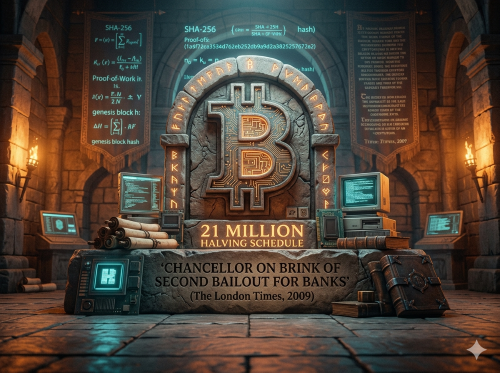
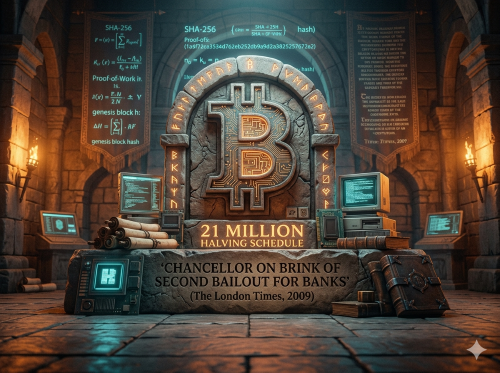
First is the immaculate conception of the timing. On Halloween in 2008, precisely as the global financial system was on fire from the Lehman Brothers collapse, an anonymous stranger uploaded a nine-page PDF to an obscure mailing list. When the genesis block was mined a few months later, Satoshi permanently embedded a London Times front-page headline about bank bailouts into the code. It was a timestamp serving as both an accusation against central banking and a prophecy for a new order.
Second is the immutable monetary policy. Satoshi programmed a 131-year deflationary schedule where the supply cuts in half every four years, and then walked away. No human institution, from the Federal Reserve to the Bank of England, has ever successfully established a century-long policy without tweaking the rules or succumbing to political pressure.
The subsequent milestones read like a steady march toward global adoption: nation-states like El Salvador adopting it as legal tender, the United States establishing strategic reserves, and massive Wall Street institutions launching spot ETFs that shattered financial history records. Finally, there is the miracle of the untouched fortune. The one million coins mined by Satoshi have sat completely motionless for sixteen years. Resisting the urge to become one of the wealthiest people on Earth is not a financial calculation; it is an ultimate act of faith that preserves the purity of the system.
Because the intersection of skills required to build Bitcoin is so impossibly rare, some corners of the community have unironically turned to supernatural explanations, whispering about aliens or time travellers.
To create Bitcoin, a person or group had to be a world-class cryptographer, a distributed systems engineer capable of solving the double-spend problem that had defeated computer scientists for decades, an Austrian-school economist, a master game theorist, and a political philosopher. Furthermore, they needed the foresight to map out a quantum-resistant migration plan fifteen years before governments fully acknowledged the threat.
When security researchers tried to dismantle the original code, they found it completely impenetrable on the first try, with no public alphas or failed prototypes. Whether you prefer the theory of a once-in-a-century lone polymath or a perfectly secure collective that somehow never suffered a single operational leak, the sheer gap between what seems humanly possible and what exists is what drives people toward extraordinary conclusions.
Ultimately, this religious gravity is the real driver behind Bitcoin's massive market cap and its five-to-one valuation premium over its closest technical competitors.
From a legal perspective, you cannot subpoena a ghost. While other major crypto projects have visible founders who can be sued or pressured by regulatory bodies, Bitcoin is an absolute orphan. It has no central enterprise, no marketing department, and no boardroom meetings.
This unreachability is the ultimate source of its authority, transforming the white paper into a text that cannot be edited or patched by a governing elite. This exact quality has allowed Bitcoin to cross into global theological acceptance. Renowned Islamic scholars have issued formal guidance declaring Bitcoin permissible under Sharia law because it lacks interest payments, offers transparent certainty, and represents pure computational labor. Simultaneously, Christian theologians find alignment with its strict opposition to currency debasement.
When the market crashes, standard investors sell their assets, but Bitcoin holders "hodl" because they are acting on a deeply ingrained discipline. The mystery of Satoshi Nakamoto is not a problem to be solved; it is the core mechanism that makes the entire system work. Faith requires a gap, and the permanent absence of Bitcoin's creator ensures that the code remains something far greater than mere software.
Coin Bureau - Was Satoshi Even Human?
"Bitcoin isn't just changing finance, it may be rewriting the rules of belief. In this video, DC breaks down why top academics and Bitcoiners alike use the word ""religion"" to describe the world's most famous cryptocurrency. We look at the messiah myth of Satoshi Nakamoto, the disciples, the prophecies fulfilled, and how the network built actual pilgrimage sites and rituals into its culture. From peer-reviewed papers at Berkeley to the Church of Bitcoin, from Texas billboards to carnivore diets: the parallels aren’t a stretch... They’re uncanny!
Discover why some people treat Bitcoin’s whitepaper as sacred text, why legendary figures like Adam Back, Hal Finney, Nick Szabo, and Michael Saylor map eerily onto archetypal religious roles, and how Satoshi’s vanishing act completed a story arc older than money itself. Don’t miss this deep look at how Bitcoin is reshaping meaning, trust, and hope for millions. Decide where you stand. Watch now!"
~ TIMESTAMPS ~
0:00 The Mystery Of Satoshi Nakamoto
2:45 Why Academics Call Bitcoin A Religion
5:20 Adam Back, Hashcash & Bitcoin’s Origins
8:01 Hal Finney Receives The First Bitcoin Transaction
10:36 Satoshi Hands Over The Keys To Bitcoin
13:21 Michael Saylor’s Bitcoin Conversion Story
15:20 Bitcoin’s Biggest Prophecies Explained
17:25 BlackRock, ETFs & Institutional Bitcoin Adoption
19:20 Was Satoshi Nakamoto An Alien Or Time Traveller?
22:15 Satoshi Predicted The Quantum Computing Threat
25:05 The Three Biggest Theories About Satoshi’s Identity
28:20 Why Bitcoin’s Religion Is Driving The Price Higher
31:16 Why Bitcoin’s Supply Can Never Be Changed
33:20 Why Bitcoin Is Considered Halal Under Islamic Finance
37:13 Why Bitcoin Believers Never Stop Holding
Source 👉 https://www.youtube.com/watch?v=AiUhJfeADek
Disclaimer: This article is provided for informational purposes only, mistakes may be made, and it's not offered or intended to be used as legal, tax, investment, financial, or any other advice.