x




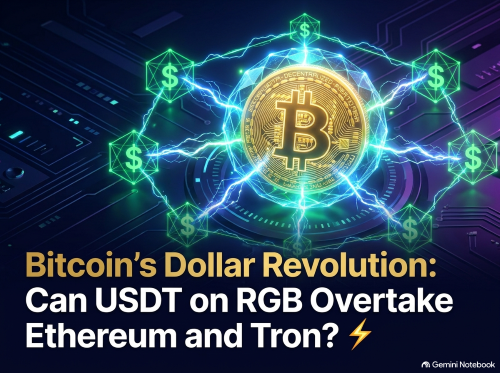
For over a decade, Bitcoin has held undisputed dominance as the ultimate decentralized store of value. Yet, when it comes to everyday medium-of-exchange utility—specifically moving fiat-pegged stablecoins across the globe—networks like Ethereum and Tron have stolen the spotlight. Ethereum hosts deep decentralized finance liquidity, whilst Tron processes billions in daily low-cost transfers for retail users and overseas merchants.
Now, a dramatic shift is underway. Tether's flagship stablecoin, USD₮, is returning home to the Bitcoin network. Powered by the RGB protocol and engineered by Dubai-based startup Utexo, private and lightning-fast dollar transfers are becoming a reality on Bitcoin's base and Layer-2 rails.
As explored in a recent Cointelegraph Magazine feature, this migration brings confidentiality and sub-second payment finality directly to Bitcoin. But with over $300 billion in stablecoins already circulating on competing blockchains, can a bridged, Bitcoin-native USD₮ genuinely challenge the entrenched dominance of Ethereum and Tron?
Many crypto observers forget that Tether actually began its journey on Bitcoin back in 2014 using the Omni Layer protocol. Omni allowed tokens to be minted directly on Bitcoin's blockchain. However, as Bitcoin's blockspace grew more valuable and base-layer transaction fees rose, Omni struggled to keep pace. The lack of smart-contract flexibility and native decentralized exchanges caused volume to migrate toward faster, cheaper alternatives.
The turning point arrived in August 2023, when Tether officially discontinued support for Omni Layer. At the time, Tether made it clear that while Omni was being phased out, the vision of anchoring stablecoins to the security of Bitcoin remained an absolute priority.
The missing puzzle piece was scalable, production-ready infrastructure that could process dollar transactions without clogging Bitcoin's L1 blockchain or broadcasting every commercial detail to a public ledger.
Enter the RGB protocol. Developing quietly since 2016, RGB represents a fundamental departure from how smart contracts operate on Ethereum or Tron.
On conventional blockchains, every smart contract interaction, balance change, and wallet address is broadcast to every node and recorded permanently on a public ledger. Whilst transparent, this architecture presents severe drawbacks for real-world commercial adoption. Businesses are rarely comfortable broadcasting their supplier payouts, payroll data, or corporate treasury movements to the entire world.
RGB solves this by utilising client-side validation and single-use seals. Instead of executing contract logic on-chain, transaction data and state history are kept off-chain, held exclusively by the participating counterparties. Only compact cryptographic commitments are anchored directly to Bitcoin unspent transaction outputs (UTXOs).
As detailed extensively within the official RGB documentation, RGB is not a sidechain or an independent Layer-1; it is a Bitcoin-native protocol that inherits Bitcoin’s unassailable proof-of-work security while delivering confidential state transitions. Payments are private by design, protecting sensitive transaction histories while giving institutional users the tools for selective disclosure when regulatory compliance or audit reports require it.
This breakthrough was further solidified by Tether's official announcement to launch USD₮ on RGB, signalling strong conviction that RGB represents the premier path forward for Bitcoin digital assets.
Privacy is only half of the equation; the other half is operational performance. Traditional Bitcoin on-chain transactions take minutes to confirm and can become costly during peak network congestion.
RGB bridges seamlessly into the Lightning Network, allowing USD₮ to travel off-chain through payment channels. By routing stablecoin transactions over Lightning, settlement times drop to around 100 milliseconds—faster than Solana, Sui, or traditional payment gateways.
Crucially, this setup addresses fee volatility. Transacting USD₮ over Utexo's Lightning channels allows operators to pay predictable, ultra-low fees denominated directly in USD₮ rather than fluctuating Bitcoin gas rates. This removes fee uncertainty for merchants and payment processors who require stable overheads.
Building the underlying cryptographic protocols is one thing; making them accessible for exchanges, wallets, and institutional market makers is another. Abstracting this technical complexity is the core mission of Utexo.
Founded by industry veterans Viktor Ihnatiuk and Renat Skitsan, Utexo offers a unified API stack that allows financial platforms to route native USDT payments over Bitcoin without re-engineering their core custody workflows. Capital backing followed swiftly: Tether and prominent venture funds co-led a $7.5M seed round in Utexo to fast-track its development.
To bootstrap initial dollar liquidity, Utexo introduced a cross-chain bridging gateway. Under the hood of the Utexo Mint portal, verified operators deposit USDT0 on networks such as Arbitrum, Ethereum, or Tron. These assets are securely locked in smart contracts, triggering the 1:1 minting of RGB-native USDT on Bitcoin. When users want to move capital back, burning the RGB tokens releases the collateral on the source chain.
To safeguard these bridge mechanisms, Utexo utilises Trusted Execution Environments (TEEs) on AWS Nitro Enclaves alongside independent cryptographic validation, audited by security firm Oxorio. Ahead of the public launch, verified operators entered the Utexo Mint early access sandbox on Bitcoin Signet to test confidential minting and redemption flows.
For any new payment rail to succeed, it must reach existing user bases. Utexo has already secured major integration partners, most notably naming UniSat's integration announcement as a premier launch partner.
UniSat, renowned as a primary hub for Bitcoin Ordinals, Runes, and BRC-20 tokens with over one million weekly active users, will incorporate native sending, receiving, and swapping of RGB-based USDT directly into its browser wallet. By exposing RGB assets to a mainstream Bitcoin audience that previously relied strictly on on-chain inscriptions, UniSat significantly lowers the barrier to entry for daily stablecoin adoption on Bitcoin.
Beyond retail wallets, Utexo is targeting over-the-counter (OTC) trading desks, payment service providers, and Bitcoin mining operations. Miners, in particular, stand to benefit: being able to convert earned BTC directly into confidential USD₮ on Bitcoin rails reduces reliance on centralized exchanges and minimises custodial risk.
Comparing Bitcoin’s new stablecoin engine to incumbents requires looking at distinct use cases:
Utexo’s leadership team acknowledges that Bitcoin will not—and should not—attempt to replicate Ethereum’s complex smart-contract ecosystem. Bitcoin was designed primarily as a settlement layer for value transfers. By focusing on private peer-to-peer payments, escrow arrangements, and commercial settlement, Bitcoin plays directly to its native strengths.
While bridge architecture always carries inherent counterparty considerations compared to pure native issuance, the combination of complete commercial privacy, sub-second Lightning speed, and Bitcoin's unmatched network security presents a compelling value proposition that public smart-contract chains simply cannot match.
Utexo has set a target of reaching between $1 billion and $5 billion in USD₮ circulation on Bitcoin within its first year. If realised, this influx of stablecoin activity could generate substantial routing and transaction fees for Lightning node operators and Bitcoin miners alike.
The launch of fast, private USDT on RGB marks a full-circle moment for cryptocurrency. Dollar-denominated liquidity is returning home to the world's most resilient monetary network.
By merging Bitcoin's base-layer security, RGB's privacy-focused client-side validation, and Lightning's instant execution, Utexo and Tether are laying the groundwork for a truly sovereign global payment rail. Whether it fully displaces Tron or Ethereum remains to be seen, but one thing is clear: Bitcoin is firmly back in the digital dollar race.
Disclaimer: This article is provided for informational purposes only, mistakes may be made, and it's not offered or intended to be used as legal, tax, investment, financial, or any other advice.