x




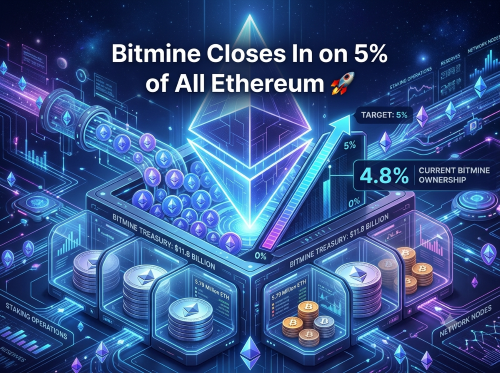
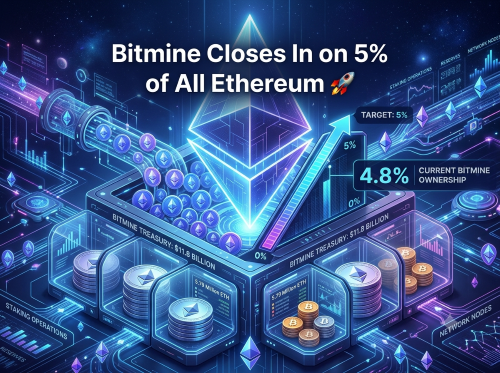
The corporate crypto treasury model is undergoing a massive evolution, and BitMine Immersion Technologies is leading the charge for Ethereum. In a landmark update, the treasury firm announced that its total assets have surged to an astronomical $11.8 billion. At the centre of this strategy is an aggressive accumulation of Ethereum (ETH), placing the firm within touching distance of its ambitious goal: acquiring 5% of the total circulating supply of the world's second-largest cryptocurrency.
With institutional adoption picking up pace, Bitmine's moves signal a profound shift in how corporate treasuries view digital assets, moving beyond passive holding towards active yield generation and long-term supply dominance.
Bitmine’s total asset balance sheet has expanded rapidly under the leadership of Chairman Tom Lee. The company now holds 5.79 million ETH, currently valued at approximately $11.3 billion. This staggering stockpile represents roughly 4.8% of all Ethereum currently in circulation.
While Ethereum forms the core of Bitmine’s balance sheet, the firm’s $11.8 billion total treasury is diversified across high-growth strategic positions and cash reserves:
This multi-faceted approach combines liquid crypto exposure with strategic equity bets, providing the firm with both massive exposure to crypto upside and steady operational flexibility.
Unlike traditional Bitcoin corporate treasuries, which rely purely on capital appreciation, Ethereum allows treasury holders to earn native yield through staking. Bitmine is capitalising on this feature in a big way.
Through its proprietary Made in America Validator Network (MAVAN)—launched earlier this year to provide institutional-grade validator infrastructure—Bitmine has already staked 4.9 million ETH.
Once the full scope of Bitmine's Ethereum portfolio is fully staked across MAVAN and partner infrastructure, the company projects annualised staking rewards of approximately $299 million. This creates a massive cash-flow engine that feeds directly back into the company's growth strategies, effectively compounding its Ethereum accumulation without relying solely on external capital raises.
The decision to double down on ETH accumulation coincides with growing confidence in Ethereum's relative performance against Bitcoin. Tom Lee highlighted that the ETH/BTC ratio recently hit a three-month high of 0.3000, which the firm interprets as a clear indicator of underlying market strength.
Despite potential delays surrounding crypto regulatory frameworks like the Clarity Act in 2026, Bitmine views the macroeconomic environment as increasingly favourable for Ethereum. The company has set immediate price targets for ETH, anticipating tests of the $2,000 and $2,500 levels as momentum builds.
In tandem with its crypto purchases, Bitmine is actively returning value to shareholders. Over the past week alone, the company repurchased 6.1 million shares under its authorised $4 billion buyback programme. This brings total share repurchases to 11.6 million shares since the beginning of July, demonstrating high management conviction that the company's stock remains an attractive value proposition relative to its net asset holdings.
For years, corporate crypto adoption was defined by MicroStrategy’s relentless Bitcoin strategy. Today, a growing cohort of public companies—including Sharplink, Bit Digital, and BitMine—are tailoring that playbook specifically for Ethereum.
By leveraging proof-of-stake yields, equity buybacks, and index inclusion (such as Bitmine’s entry into the Russell 1000 Index), institutional players are proving that holding Ethereum offers dual benefits: capital growth and predictable, recurring yields.
As Bitmine edges closer to holding 1 in every 20 ETH in existence, its treasury strategy may well set the benchmark for institutional asset management in the web3 era.
For further reading and context on this developing story, read the original coverage on Decrypt:
👉 Bitmine Nears Goal of Controlling 5% of Ethereum Supply With $11.8 Billion Treasury
Disclaimer: This article is provided for informational purposes only, mistakes may be made, and it's not offered or intended to be used as legal, tax, investment, financial, or any other advice.