x




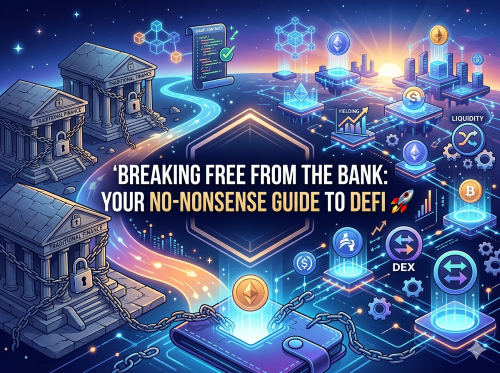
The landscape of finance is undergoing a seismic shift. If you have recently dipped your toes into the world of cryptocurrency by purchasing Bitcoin or Ethereum, you have likely encountered a buzzword that is reshaping how we think about money: DeFi.
Short for Decentralized Finance, DeFi is more than just a trend; it is a full-scale alternative to the traditional banking system. By leveraging blockchain technology, DeFi removes the middlemen—banks, brokers, and clearinghouses—allowing you to lend, borrow, and trade assets directly with others across the globe.
In this guide, we will explore the mechanics of DeFi, the opportunities it presents, and the essential safety measures every investor must know.
At its core, DeFi is a category of financial applications built on blockchain networks. Unlike Fintech (think PayPal or Venmo), which still relies on centralized institutions to verify transactions, DeFi operates through smart contracts.
A smart contract is a self-executing program where the terms of the agreement are written directly into code. Think of it like a vending machine:
In DeFi, there is no loan officer to check your credit score and no bank teller to approve your transfer. If the code's conditions are met, the transaction happens instantly and transparently.
Traditional finance (TradFi) relies on gatekeepers who decide who can access capital and what fees they must pay. DeFi disrupts this model in three key ways:
How do you actually "do" DeFi? The ecosystem is primarily built on five activities:
Platforms like Aave or Compound allow you to deposit your crypto into "liquidity pools" to earn interest. Conversely, you can borrow assets by providing collateral. Because there are no credit checks, DeFi loans are typically over-collateralized—meaning you must deposit more value than you intend to borrow to protect the lender against market volatility.
A DEX, such as Uniswap, allows you to swap one token for another without an intermediary. These platforms use Automated Market Makers (AMMs) to price assets based on mathematical formulas rather than a traditional order book.
Staking involves locking your tokens to support the security of a blockchain network (Proof of Stake) or a specific protocol. In exchange for this commitment, you receive rewards, often in the form of additional tokens.
You can become a "Liquidity Provider" (LP) by depositing pairs of tokens into a DEX. In return, you earn a share of the trading fees generated by that pool. However, LPs must be aware of impermanent loss, which occurs when the price of your deposited tokens diverges significantly from when you deposited them.
The freedom of DeFi comes with the weight of total responsibility. There is no "forgot password" button for your wallet, and no fraud department to reverse a mistake.
If you are ready to explore the frontier of decentralized finance, follow these "rules of the road":
DeFi represents a fundamental shift toward financial sovereignty. It offers high-yield opportunities and unparalleled privacy, but it demands a high level of technical literacy and caution. By moving slowly and prioritizing security, you can harness the power of a financial system that never sleeps and answers to no one but the code.
For more in-depth information on the evolving world of decentralized finance, visit the original article at yahoo!finance
👉 What is DeFi? A complete guide to decentralized finance.
Disclaimer: This article is provided for informational purposes only, mistakes may be made, and it's not offered or intended to be used as legal, tax, investment, financial, or any other advice.