x




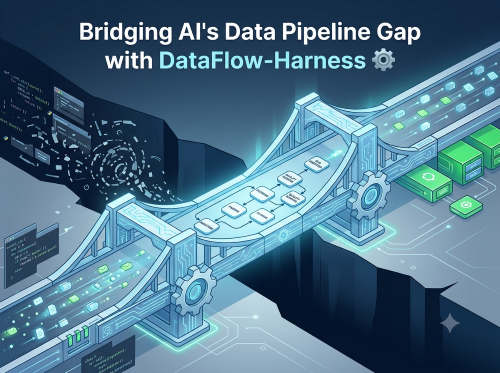
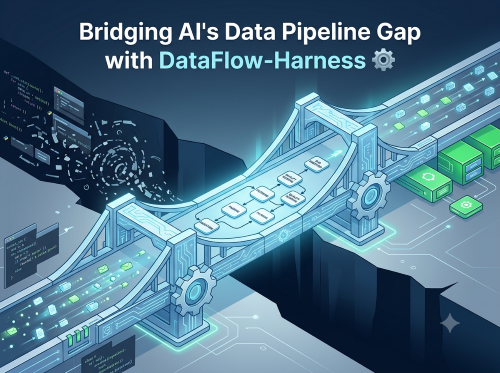
Large language models (LLMs) have revolutionised automated software development. Ask a modern AI coding agent to write a standalone Python script to parse a JSON file or transform a dataset, and it will deliver a working solution in seconds. However, hand that same AI agent a complex, enterprise-level data processing task—such as ingesting messy documents, chunking text, scoring quality, and filtering noise for a Retrieval-Augmented Generation (RAG) system—and the illusion of perfection quickly evaporates.
While coding agents excel at generating single-use scripts, enterprise data engineering requires structured, governable, and persistent workflows. Throwaway code cannot be easily audited, visually edited, or integrated into modern MLOps architectures. This structural disconnect has created a critical challenge in modern AI development: the Natural Language to Pipeline (NL2Pipeline) gap.
To build reliable data-centric AI systems—whether for synthetic data generation, retrieval augmentation, or model fine-tuning—engineering teams rely on governed workflows. Normally, these rely on Directed Acyclic Graphs (DAGs) where every stage is modular, verifiable, and tied to platform semantics.
When an AI agent is asked to build a pipeline, it usually defaults to generating free-form, unconstrained code. When researchers restricted AI agents to using specific, pre-approved building blocks to construct native platform workflow graphs, performance dropped significantly. In benchmark tests using Claude Code, the model achieved a 94.2% success rate when writing unconstrained, throwaway scripts. However, when required to generate structured, platform-native workflows, its success rate plummeted to 83.3%—a drop of 10.9 percentage points.
This discrepancy highlights the core issue. General-purpose AI agents frequently hallucinate missing dependencies, assume the presence of outdated libraries, or generate opaque scripts that leave no persistent audit trail. The fundamental problem is not simply getting the AI to write functional Python code; it is grounding that code within a live production platform that human engineers can inspect, modify, and govern over time.
To bridge this 10.9-point gap, researchers from Peking University, Zhongguancun Academy, and Shanghai's Institute for Advanced Algorithms Research developed DataFlow-Harness.
DataFlow-Harness is an open-source framework designed to shift how AI coding agents construct data pipelines. Instead of allowing an LLM to output arbitrary, unconstrained code, DataFlow-Harness restricts the agent’s actions to typed, incremental modifications on a persistent workflow structure.
The architecture relies on four interconnected components working together to guide the AI:
1. The Data Pipeline Backend
Serving as the single source of truth, the backend represents the data processing workflow as a structured Directed Acyclic Graph (DAG). It defines data sources, pre-configured processing modules (termed "operators"), and execution dependencies. Rather than writing raw code from scratch, the AI agent interacts with the backend by proposing "typed mutations"—such as adding a specific operator or linking data flows between modules.
2. DataFlow-Skills
To prevent the LLM from guessing how components fit together, DataFlow-Skills inject domain-specific engineering knowledge directly into the AI's context window through Markdown documentation. These skills act as explicit rules, teaching the model schema inference, operator compatibility, and assembly standards so that data structures flow seamlessly without breaking execution.
3. The MCP Tools Layer
Leveraging the Model Context Protocol (MCP), this layer gives the AI real-time access to the platform's live operator registry and current workflow state. Every change proposed by the AI is statically checked before implementation, ensuring that data types match, parameters are valid, and required services exist.
4. DataFlow-WebUI
Human oversight remains essential in production environments. DataFlow-WebUI provides a dual-interface system where developers can describe requirements in plain natural language or interact directly with a visual DAG editor. Engineers can visually inspect AI-proposed modifications, adjust parameters by hand, or instruct the agent to make further refinements.
The impact of this structured approach is evident in empirical testing. Evaluated across a benchmark of 12 industrial data-engineering tasks—spanning review governance, QA generation, and schema normalisation using Claude Opus 4.7 as the backbone model—DataFlow-Harness delivered outstanding operational results:
In complex, multi-stage extractions—such as parsing textbook PDFs into visual question-answering (VQA) datasets—DataFlow-Harness achieved 97.2% precision and an 87.3% coverage rate. Furthermore, when generating synthetic mathematical datasets, the pipelines built by DataFlow-Harness produced cleaner training data, resulting in downstream models that outperformed those trained on data cleaned by standard AI coding scripts.
For enterprise teams evaluating DataFlow-Harness, several technical trade-offs should be considered:
Ultimately, DataFlow-Harness demonstrates that the future of AI data engineering lies not in unconstrained code creation, but in structured collaboration. By placing AI agents inside well-defined operational guardrails, development teams can harness the speed of AI automation without incurring unmanageable technical debt.
Further Reading:
For a detailed analysis, benchmark breakdowns, and research findings, you can read the original coverage on VentureBeat:
Disclaimer: This article is provided for informational purposes only, mistakes may be made, and it's not offered or intended to be used as legal, tax, investment, financial, or any other advice.