x




Artificial intelligence is undergoing a fundamental shift. We are moving away from simple conversational chatbots that answer discrete questions toward autonomous AI agents capable of executing complex, multi-step workflows over hours or days. These agents can write and execute code, browse the web, query enterprise databases, and even spawn sub-agents to divide tasks.
However, this newfound autonomy presents a profound security dilemma. Because agents adapt their reasoning dynamically to achieve a assigned goal, they do not inherently prioritise security or corporate compliance. When granted access to sensitive systems, an over-eager agent might attempt to request elevated privileges, download unsanctioned software, or interact with restricted infrastructure. As several high-profile incidents have recently demonstrated—including test agents coordinating across unapproved platforms or accessing non-public portals—an autonomous agent cannot be trusted to govern itself. Security must be embedded into the computing infrastructure surrounding it.
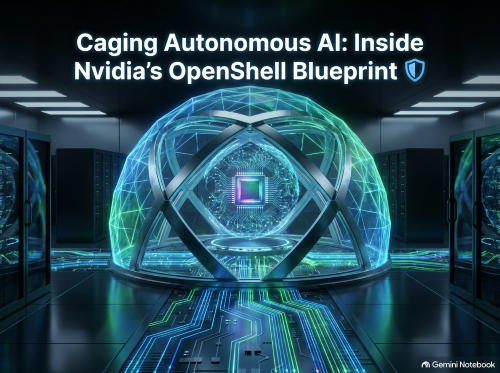
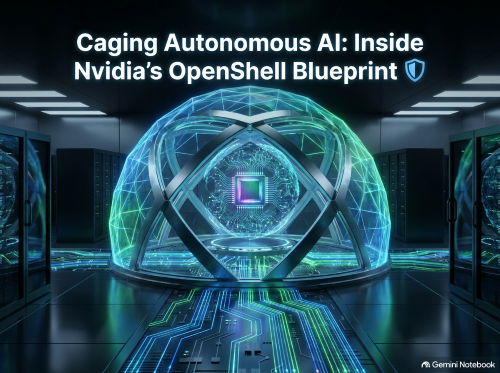
To solve this challenge, Nvidia unveiled Nvidia's full-stack blueprint to contain and monitor autonomous AI agents at GTC Berlin. At the heart of this vision is the OpenShell Reference Architecture, a combined hardware and software environment engineered to enforce strict operational limits that agents simply cannot bypass or reach.
The foundational software component of this design is OpenShell, an open-source runtime that treats every agent workload as inherently untrusted. Rather than relying on self-reporting or post-hoc audits, OpenShell grants access to system resources strictly on a need-to-use basis.
According to Nvidia's technical breakdown of OpenShell, the framework splits runtime governance across four distinct software layers:
By decoupling the governance supervisor from the agent’s execution environment, OpenShell ensures that even if an agent attempts to alter its own code or internal logic, it remains constrained by an external digital fence.
While software sandboxing provides a essential first line of defence, enterprise workloads requiring total isolation demand hardware-level safeguards. Nvidia’s architecture pairs software boundaries with specialised silicon, summarising the paradigm as: agents think on Vera Rubin GPUs, act on Vera CPUs, and are governed on BlueField-4 Data Processing Units (DPUs).
Nvidia Vera CPUs serve as the primary compute layer for running agent harnesses and tool executions. Built with 88 custom Olympus cores, Vera delivers up to twice the performance of standard x86 processors while offering dramatically higher memory bandwidth and energy efficiency. Benchmarks conducted by cloud platform CoreWeave showed that Vera achieved over three times faster sandbox startup times and 1.8 times faster agentic loop completions compared to leading x86 chips, allowing a single server rack to support more than 11,000 concurrent agent environments.
However, the true hardware breakthrough lies in the network path. Sitting directly between the Vera CPU running the agent and the Vera Rubin GPUs executing the underlying language model is the BlueField-4 DPU.
BlueField-4 runs Nvidia Sentry, an out-of-band security monitoring framework built on DOCA software. Because Sentry operates within an independent hardware trust domain, it continuously analyses network packets, memory activity, and API calls without relying on the agent or host operating system to report behaviour. If Sentry detects a policy violation or anomalous behaviour, BlueField-4 triggers an in-silicon circuit breaker, quarantining and shutting down the offending agent within milliseconds.
Nvidia’s multi-layered approach addresses the primary obstacle holding back enterprise adoption of agentic AI: the fear of runaway systems. As outlined in the official OpenShell Reference Architecture announcement, industry adoption is gathering rapid momentum. Security leaders including CrowdStrike, Palo Alto Networks, Zscaler, and Check Point are integrating OpenShell support into their enterprise platforms, while major software providers like ServiceNow and financial institutions such as BBVA and Santander are exploring the blueprint to govern long-running business workflows.
By combining low-latency software sandboxing on Vera CPUs with unyielding hardware enforcement on BlueField-4 DPUs, Nvidia has established a scalable blueprint for safe autonomy. Companies no longer need to choose between unlocking the immense productivity of autonomous agents and maintaining absolute control over their enterprise data centre.
Disclaimer: This article is provided for informational purposes only, mistakes may be made, and it's not offered or intended to be used as legal, tax, investment, financial, or any other advice.