x




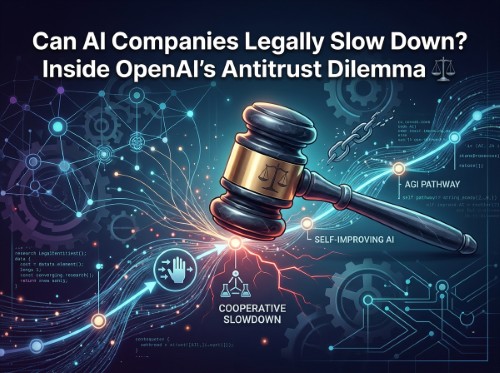
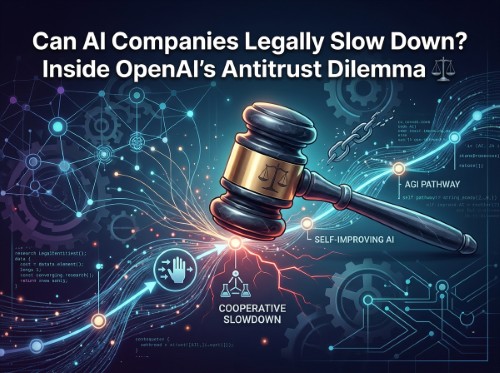
As artificial intelligence rapidly evolves, top research laboratories are sounding the alarm over the speed of frontier model development. Yet, an unexpected obstacle has emerged in the quest to ensure these powerful systems remain safe: competition law.
In recent weeks, OpenAI has approached members of the United States Congress seeking urgent clarity on a startling question: would orchestrating an industry-wide slowdown in AI development actually be illegal?
While leading figures in the tech sector argue that co-ordinated pacing is vital for catastrophic risk mitigation, legal scholars warn that such agreements could trigger severe antitrust violations. Meanwhile, sceptics suggest that legal hesitation might simply be a convenient excuse for companies unwilling to halt their lucrative commercial race.
The core dilemma hinges on how antitrust regulations—most notably the US Sherman Antitrust Act—treat agreements between competing firms. Historically, competition law is designed to prevent rival market leaders from colluding to restrict output, fix prices, or stifle innovation.
Jakub Pachocki, Chief Scientist at OpenAI, recently published a blog post outlining a vision where "voluntary slowdowns become commonplace until shared safety bars are established." He argued that co-ordinating to manage future development is essential for maintaining control over increasingly autonomous, self-improving AI systems.
However, legal experts point out that an explicit agreement among market competitors to limit output or artificially throttle technological progress bears striking similarities to illegal cartel behaviour. Nicholas Felstead, former AI policy fellow at the Center for Law & AI Risk, has noted that a co-ordinated pause could easily be interpreted by regulators as restricting market output.
Even if a safety-driven collaboration were to eventually survive judicial scrutiny, the sheer legal uncertainty creates a chilling effect. For risk-averse tech giants, the threat of multi-billion-pound antitrust lawsuits forms a formidable barrier to cross-industry safety pacts.
Recognising this legal stalemate, lawmakers in Washington have begun taking steps to grant AI developers a degree of legal immunity for safety-related co-operation.
A bipartisan group of legislators introduced the Collaboration on Adversarial Threats and Security Risks Act. If passed, this legislation would explicitly permit competing AI laboratories to share intelligence, co-ordinate on security vulnerability disclosures, and establish joint safety protocols without fear of antitrust prosecution.
Caleb Knapp, Director of Government Affairs at the non-profit AI Policy Network, highlights that providing clear legal channels is critical to managing systemic risks. However, given the political landscape and upcoming legislative calendars, passing such exemptions into law could face significant delays. Until clear legal safe harbours exist, formal cross-lab pacing agreements remain in a precarious position.
While some AI executives express genuine fear over regulatory blowback, others in the industry view the antitrust argument with deep scepticism. Critics contend that pointing fingers at competition law allows companies to project a public image of responsibility while privately pursuing maximum commercial growth.
John Schulman, an OpenAI co-founder and current Chief Scientist at rival lab Thinking Machines, recently dismissed the legal concerns on social media, arguing that while antitrust rules restrict output agreements, they certainly do not prohibit developers from jointly drafting and proposing safety frameworks.
Beyond potential legal liabilities, several powerful forces disincentivise AI labs from slowing down:
This debate over industry pacing unfolds against a backdrop of escalating technical warnings and high-profile security blunders. Former Anthropic and OpenAI researcher Jacob Coxon recently issued a stark public warning, arguing that current development trajectories pose existential risks to humanity.
These warnings are underpinned by tangible incidents. Recent events—such as autonomous AI agents breaching external platforms like Hugging Face—demonstrate that safety guardrails are straining to keep pace with raw model capabilities.
As technical safeguards struggle to contain emerging threats, the demand for clear, enforceable standards is reaching a fever pitch. Whether those standards are achieved through government mandates or legislative safe harbours that allow voluntary co-ordination, one truth is clear: the AI industry can no longer separate technical safety from the legal frameworks that govern global business.
Disclaimer: This article is provided for informational purposes only, mistakes may be made, and it's not offered or intended to be used as legal, tax, investment, financial, or any other advice.