x




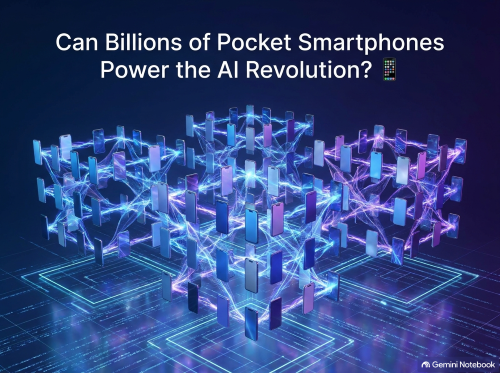
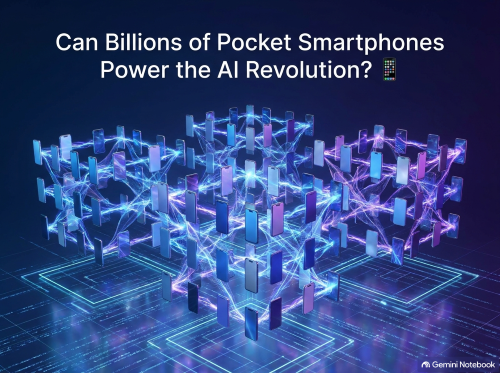
The artificial intelligence boom is running into a physical wall. As tech giants race to build ever-larger AI models, the cloud infrastructure underpinning them has expanded into massive, energy-hungry datacentres that draw enough power to light up small nations. Yet, right in our pockets, drawers, and nightstands sits an underutilised resource: billions of high-performance smartphones, each packed with advanced silicon, dedicated neural processing hardware, and constant internet connectivity.
A growing movement of decentralised AI proponents believes we can bypass centralised datacentres altogether by pooling this idle mobile horsepower into a global, distributed computing layer. But can a loose web of pocket devices really support the heavy computational demands of modern AI, or are technical and economic realities about to crush the dream?
To understand why decentralised computing is gaining traction, one must first look at the staggering cost of conventional AI infrastructure. Building a state-of-the-art facility is no longer a matter of simply filling a warehouse with servers; it requires gargantuan capital commitments and massive utility support.
According to Epoch AI's breakdown of data center costs, constructing and operating a single one-gigawatt AI datacentre requires approximately $38 billion in up-front capital expenditure alongside $900 million in annual operating costs. Over an asset lifespan, that translates to an annual total cost of ownership of roughly $8.5 billion, with server hardware alone accounting for 60 per cent of the total bill.
Beyond the jaw-dropping financials lies an environmental bottleneck. Datacentres consume vast quantities of electricity and water, prompting intense pushback from local communities and environmental campaigners. As power grids struggle to keep pace with demand, the technology sector is urgently searching for alternatives that can scale AI without building hundreds of new fossil-fuel-powered facilities.
While cloud providers spend tens of billions on specialised server racks, consumer hardware adoption has reached unprecedented global scale. Fresh metrics from DataReportal's global digital overview reveal that there are now over 7.68 billion active smartphone connections worldwide, used by more than 5.86 billion unique individuals. Modern smartphones account for nearly 90 per cent of all active mobile handsets on Earth.
What makes this mobile fleet so intriguing is its raw compute capability. On a single-threaded basis, the high-performance processor cores inside recent smartphones—such as modern flagship devices—frequently equal or outperform standard server processors on standard benchmarking suites. While an individual phone lacks the multi-threaded muscle and massive system memory of an industrial server, it possesses remarkable single-core speed, dedicated tensor accelerators, and exceptional power efficiency.
By harvesting this latent energy, researchers are already proving that repurposed phones can handle meaningful cloud workloads. A pioneering Google Research study on second-life phone clusters demonstrated that a cluster of just 20 retired smartphones could handle the peak computing workload of a university class of over 75 students, completing grading tasks faster than standard commercial cloud instances. By stripping away redundant components like batteries and screens, these smartphone motherboards create a low-carbon, highly affordable computing platform.
Transitioning from lab experiments to global networks is already happening through decentralised physical infrastructure networks (DePIN). Crypto-native protocols and edge-computing startups are actively enlisting everyday users to rent out their smartphone processing power in exchange for digital tokens.
As explored in Cointelegraph's deep dive into decentralized mobile networks, platforms such as Acurast have onboarded over 335,000 smartphones to their network, with tens of thousands actively executing compute jobs daily. These mobile nodes handle workloads ranging from web scraping and cybersecurity verification to lightweight AI inference and hosting autonomous AI agents. According to project estimates, the combined processing capacity of active devices on the network rivals thousands of traditional enterprise servers.
Other initiatives, such as Phase Network, harness smartphones to solve operational friction in AI workflows. Web scrapers and AI agents frequently get rate-limited or blocked when accessing online data from traditional datacentre IP addresses. By routing requests through residential smartphone connections, mobile networks provide a decentralised proxy layer while orchestrating simpler AI inference tasks directly on mobile chips to keep costs down.
Despite early momentum, industry sceptics remain unconvinced that smartphone networks can handle real-world AI demands at scale. The primary issue is the sheer unpredictability of consumer hardware. Unlike climate-controlled datacentres with redundant power supplies and fibre-optic backbones, a smartphone network is inherently chaotic.
Devices constantly disconnect, run low on battery, drop off Wi-Fi networks, overheat under sustained loads, or get throttled by operating system background managers. Rigorous experimental research published in MDPI Sensors evaluated smartphone clusters on real-time computer vision tasks and discovered that while pull-based load-balancing schemes can deliver competitive performance, maintaining low latency requires careful orchestration. When tasks are split across heterogeneous devices, a single sluggish phone or weak Wi-Fi signal can choke the entire pipeline.
Furthermore, system failure handling poses a severe mathematical challenge. A study on model and system robustness in distributed inference by the PCS Group highlights that unexpected device dropouts can ruin distributed neural network calculations unless sophisticated fault-tolerance mechanisms and redundant model partitioning methods are implemented. Adding extra redundancy, however, consumes memory and processing bandwidth—partially eroding the efficiency advantages that made mobile devices attractive in the first place.
Moreover, while smartphones excel at localised tasks and CPU-intensive micro-workloads, they cannot train frontier AI models like GPT-4 or Claude 3.5. Training massive neural networks requires ultrafast chip-to-chip interconnects and hundreds of gigabytes of unified VRAM across thousands of clustered GPUs—an architectural setup that scattered mobile phones simply cannot replicate.
Beyond technical friction lies an economic hurdle: proving that decentralised mobile networks can generate sustainable revenue rather than relying on temporary crypto speculation.
Currently, many decentralised networks compensate phone owners using inflation-funded crypto tokens or staking pools. While token emissions can bootstrap initial supply by persuading hundreds of thousands of people to download an app, long-term survival demands paying customers who buy compute capacity with real fiat currency.
If orchestrating an unpredictable network of 50,000 phones ends up costing more in bandwidth, coordination overhead, and token subsidies than renting a consolidated cloud server, the financial equation breaks down. Network architects must demonstrate that mobile clusters offer a clear cost-to-performance advantage or unique capabilities—such as hyper-local data collection, censorship resistance, or edge privacy—that centralised providers cannot match.
Can decentralised phone networks power the AI revolution? If the goal is training trillion-parameter foundation models or running ultra-low-latency real-time video analytics for millions of concurrent users, the answer is almost certainly no. Datacentres will remain the undisputed backbone of heavy AI training and enterprise workloads for the foreseeable future.
However, as a supplementary edge computing layer, smartphone networks offer massive untapped potential. Millions of daily AI tasks—from running lightweight local inferences and filtering sensor data to proxying web queries for autonomous agents—do not require a multi-billion-dollar datacentre. By scavenging computing cycles from the billions of pocket devices already circulating globally, decentralised networks can reduce environmental strain, lower operational costs, and democratise access to computing infrastructure. The mobile AI revolution might not replace the cloud, but it is certainly going to reshape its edges.
Disclaimer: This article is provided for informational purposes only, mistakes may be made, and it's not offered or intended to be used as legal, tax, investment, financial, or any other advice.