x




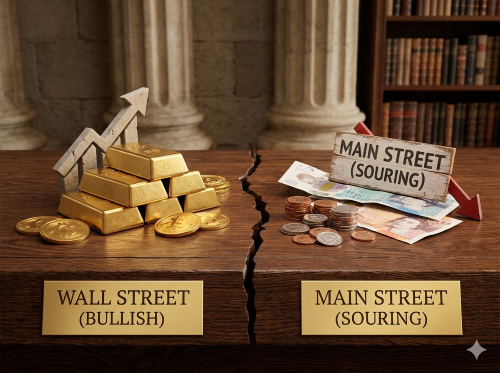
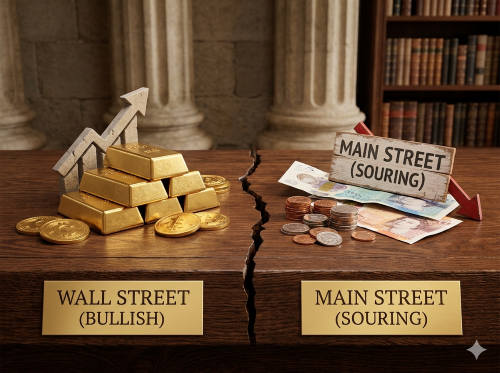
The global gold market has experienced another week of volatile trading, driven by a complex mix of geopolitical shifts, macroeconomic indicators, and shifting investor mindsets. In a fascinating turn of events, the latest market sentiment reveals a distinct divergence: institutional experts on Wall Street have flipped firmly bullish, while retail investors on Main Street have grown increasingly cautious.
As a crucial week of US economic data looms, the precious metal sits at a critical technical and fundamental crossroads.
Gold began the weekly trading session on a high note, starting at $4,508.30 per ounce and quickly climbing to test resistance near $4,580. This initial surge was primarily fuelled by safe-haven demand as traders reacted to ongoing tensions in the Middle East. However, these gains began to erode by midweek as a stronger US dollar, elevated Treasury yields, and persistent inflation concerns took hold.
The downward pressure intensified following renewed US strikes on Iran, which pushed oil prices higher and stoked fears of a prolonged inflationary cycle. By Thursday, spot gold had plummeted to a weekly low of $4,365.85 per ounce, briefly slicing through its 200-day moving average for the first time in two years.
Just as the bears seemed to take control, the market staged a dramatic late-week turnaround. Rumours of a potential ceasefire agreement between the US and Iran helped cool energy markets, causing oil prices to drop and easing immediate inflation anxieties. Supported by a modest pullback in the Greenback and softer Treasury yields, gold staged an aggressive rebound, hitting a weekly high of $4,594.92 on Friday before settling to close the week at $4,539.03 per ounce.
The dramatic late-week recovery has reshaped market sentiment, though not uniformly. The weekly survey highlights a stark contrast between institutional analysts and everyday retail traders.
Wall Street's Bullish Rebound
Among market experts, confidence has returned in a major way. An impressive 75% of surveyed analysts predict gold prices will rise in the coming days. Only 17% anticipate a decline, while a mere 8% expect the market to consolidate horizontally.
Many analysts view the technical bounce off the 200-day moving average as a highly encouraging sign for bulls. Experts note that a potential breakthrough in US-Iran negotiations removes the immediate threat of forced asset liquidations by oil-importing nations. Furthermore, if gold can decisively break above the $4,585 to $4,630 zone, it could completely neutralise the recent corrective phase and restore a long-term upward trajectory.
Main Street's Bearish Turn
In contrast, retail investors have grown noticeably wary. For the first time in months, Main Street has relinquished its bullish majority. Only 44% of retail poll participants expect gold to climb next week, while 26% predict further losses, and 31% anticipate sideways movement.
This softening of retail sentiment suggests that everyday investors are feeling the fatigue of a highly headline-driven market. With conflicting news flashes appearing almost hourly, trading with conviction has become incredibly difficult for those without institutional resources.
Beneath the headline-driven volatility lie structural economic realities that continue to influence precious metals.
The Federal Reserve and the Debt Dilemma
The wider financial community is looking ahead to the mid-June Federal Reserve meeting, which will be the first under the guidance of the new chairman, Kevin Warsh. The market is desperate for clarity on whether the central bank will adopt a hawkish or dovish stance on interest rates.
While traditional economic theory dictates that interest rates should rise to combat stubborn inflation, the reality of servicing a massive US national deficit makes aggressive rate hikes incredibly dangerous. Some strategists believe the Fed may be forced to look for ways to grow out of the economic slowdown via quantitative easing (QE), a scenario that would ultimately be highly bullish for gold.
Liquidity Chasing the AI Boom
Another headwind for precious metals has been the sheer momentum of the technology sector. Generative Artificial Intelligence (AI) continues to capture investor imagination, soaking up massive amounts of market liquidity. Speculative, shorter-term capital that helped drive gold to record highs earlier this year has largely migrated toward tech stocks. Analysts point out that when this current tech momentum cools, liquidity is likely to flow back into hard assets like gold and silver.
As the new trading week commences, market participants are shifting their focus from geopolitics to the health of the US labour market. A series of critical economic data releases will heavily influence Federal Reserve rate expectations and, consequently, the direction of gold:
A weaker-than-expected jobs report on Friday could add significant fuel to gold's upside, especially if it reduces market bets regarding potential interest rate hikes later in 2026. Conversely, robust employment figures could cap gold's near-term upside.
From a purely technical standpoint, gold remains in a delicate balancing act. Having successfully defended major support around the $4,400 mark, the metal has shown that buyers are ready to step in during sharp pullbacks.
Long-term structural tailwinds—such as robust central bank purchasing, fiscal deficit worries, and a desire for dollar diversification—remain firmly intact. However, momentum indicators suggest the market is no longer heavily oversold but rather beautifully balanced. A decisive break below the critical $4,400 support zone could open the door for a deeper correction toward the $4,100 level. On the flip side, pushing through the 50-day moving average near $4,630 would signal an official end to the multi-month downtrend.
For now, precious metals traders are practising patience, keeping a close eye on the support floors, and waiting to see whether peace headlines or macroeconomic data will provide the next major catalyst.
For a deeper dive into the metrics, expert opinions, and survey breakdowns driving this market shift, you can read the full breakdown on the original Kitco News report here:
Disclaimer: This article is provided for informational purposes only, mistakes may be made, and it's not offered or intended to be used as legal, tax, investment, financial, or any other advice.