x




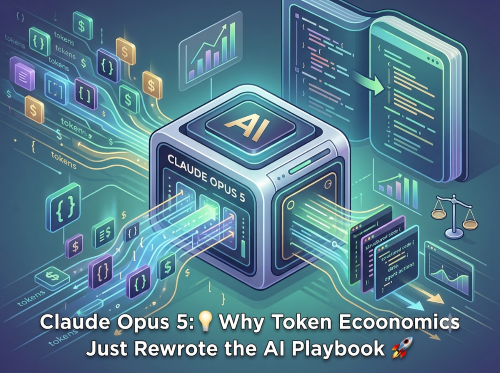
The frontier of artificial intelligence is undergoing a fundamental recalibration. Where early model releases were judged almost exclusively on raw benchmark scores and peak capabilities, enterprise adoption in 2026 demands an entirely different metric: unit economics. Anthropic’s launch of Claude Opus 5 marks a pivotal shift in this trajectory, delivering near-frontier intelligence at a fraction of the computational overhead required by traditional flagship systems.
Priced at $5 per million input tokens and $25 per million output tokens, Opus 5 maintains the price tag of its predecessor, Opus 4.8, while delivering a massive leap in functional efficiency. Rather than competing solely for peak technical output, Anthropic is addressing a pragmatic reality facing modern businesses: the vast majority of valuable automated work happens in a middle band of complexity where cost-per-task decides what actually reaches production.
Anthropic’s positioning of Opus 5 reflects a mature understanding of enterprise workload design. Instead of marketing a single model as a universal solution, the company has stratified its portfolio to reflect distinct operational horizons:
The evaluation benchmarks highlight this distinction clearly. On Frontier-Bench v0.1, an agentic terminal coding benchmark, Opus 5 achieved a 43.3% score — more than double Opus 4.8’s 18.7% and comfortably ahead of Fable 5’s 33.7% — all while operating at a lower overall cost per completed task. On OSWorld 2.0, a benchmark testing computer usage, Opus 5 surpassed Fable 5’s top result at roughly one-third of the financial expense.
This performance split illustrates a critical trend in model evaluation: traditional benchmarks excel at measuring bounded tasks with concrete outcomes, which plays directly to Opus 5’s strengths. Fable 5 remains the solution of choice when a project outruns bounded evaluation frameworks and demands sustained coherence across hours or days of execution.
Inference costs have officially moved from experimental budgets to board-level financial scrutiny. For enterprises deploying automated coding agents, financial modelling engines, and workflow integrations across thousands of daily operations, token usage directly impacts operating margins.
Early enterprise testing of Opus 5 reveals that higher task completion rates are being achieved with significantly reduced resource consumption:
Equipped with an adjustable "effort" setting, Opus 5 grants developers granular control to balance raw intelligence against execution speed and token consumption. In a commercial landscape where Anthropic holds significant enterprise market share, reducing the cost per successful outcome expands the scope of processes that are economically viable to automate.
Beyond benchmark metrics, the true differentiator for deployable enterprise AI lies in error recovery. Plausible output is easy to generate; verifiable, self-correcting output is what makes autonomous agents reliable in production.
Most hidden expenses in corporate automation stem from manual validation — human engineers spending hours auditing machine outputs. Opus 5 mitigates this by demonstrating a persistent, self-verifying operational style:
By proactively verifying its work before presenting a final output, Opus 5 dramatically shortens human review cycles and minimises repetitive prompting passes.
Anthropic’s approach to safety in Opus 5 emphasises alignment alongside deliberate capability design. The model achieved a low misaligned behaviour score of 2.3 in automated safety audits, demonstrating low susceptibility to manipulation and deceptive prompting.
In cybersecurity, Anthropic deliberately restricted offensive training while maintaining strong defensive utility:
To balance user access with risk management, Anthropic introduced an automatic fallback mechanism. If a prompt triggers safety classifiers in environments like Claude.ai or Claude Code, the request falls back to Opus 4.8. Because the fallback model possesses lower raw capability limits, the downstream risk of unintentional harm is reduced, ensuring continuous workflow availability without exposing systems to high-level capability misuse.
The launch of Opus 5 comes at a pivotal moment for Anthropic. Following substantial revenue expansion and enterprise adoption, the business faces massive infrastructure obligations, including major cloud computing commitments across Azure and Google Cloud.
To sustain this momentum, holding model pricing flat while dramatically upgrading performance per token serves as an aggressive strategy to capture recurring enterprise workloads. Lowering the cost of task execution encourages organisations to transition experimental pilots into high-volume background processes.
Features shipping alongside the primary release — including a Fast mode running at 2.5 times default speed, automated API fallback routing, mid-conversation tool updating without prompt cache invalidation, and zero data retention for general enterprise access — further streamline deployment for software engineers building autonomous agents.
The broader lesson of Claude Opus 5 is clear: the AI landscape is shifting away from occasional, high-cost demonstrations of peak capability toward reliable, cost-effective daily execution. For enterprise organisations building durable automation pipelines, that transition represents a major step forward.
To read the original reporting and learn more about this release, visit VentureBeat's coverage on Anthropic's Claude Opus 5 launch:
👉 Anthropic launches Claude Opus 5, a cheaper AI model for coding, agents and enterprise workflows
Disclaimer: This article is provided for informational purposes only, mistakes may be made, and it's not offered or intended to be used as legal, tax, investment, financial, or any other advice.