x




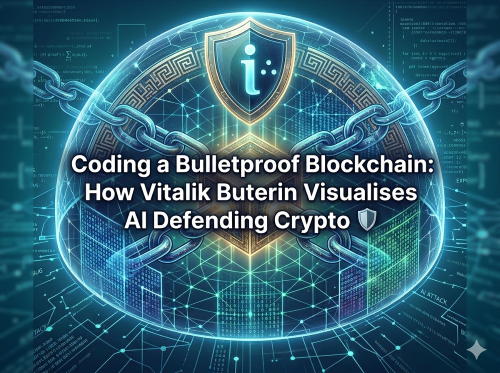
The cryptocurrency sector has always been an intellectual and technological battlefield. On one side stand developers, meticulously crafting decentralized protocols; on the other, sophisticated cybercriminals seeking out the single line of flawed code that could unlock millions of pounds in digital assets. For years, the advantage has arguably tipped in favour of the attackers.
However, as artificial intelligence (AI) evolves at a breathtaking pace, this battlefield is transforming. In a compelling shift of perspective, Ethereum co-founder Vitalik Buterin has highlighted a revolutionary path forward: utilising AI-assisted 'formal verification' to mathematically guarantee the security of blockchain infrastructures. Far from being a mere tech upgrade, Buterin envisions this methodology as the ultimate shield against highly advanced, AI-driven cyber threats.
To understand why Buterin is championing this approach, one must look at the sheer potency of modern AI models. Historically, discovering vulnerabilities in software required human teams spending months auditing code. Today, AI can do it in minutes.
Recent benchmarks have sent shockwaves through the cybersecurity world. For example, testing of Anthropic’s cybersecurity-focused model, Claude Mythos, successfully identified 271 vulnerabilities within the Mozilla Firefox browser, which were promptly patched. More remarkably, a preview version of the same AI was reportedly utilised to construct a working exploit against Apple’s notoriously secure M5 chip protections in under a week. Concurrently, reports from the U.K. AI Security Institute have flagged that frontier models like OpenAI’s GPT-5.5 are demonstrating formidable offensive cyber capabilities.
In the crypto world, where smart contracts govern vast pools of capital autonomously, these automated exploit capabilities are terrifying. Unlike traditional finance, where a fraudulent bank transfer can often be reversed, blockchain transactions are immutable. When a vulnerability is exploited in a decentralised application, the funds are usually gone forever. The stakes are immense; the notorious state-sponsored Lazarus Group, for instance, has successfully syphoned off billions of pounds via sophisticated crypto exploits over recent years.
Faced with an era where hackers use AI to find bugs at lightning speed, Buterin argues that defenders must fight fire with fire. The solution lies in 'formal verification'—a methodology that dates back to the mid-20th century but is now being supercharged by artificial intelligence.
At its core, formal verification is the practice of using mathematical proofs to verify that a piece of software behaves exactly as intended. Instead of simply testing a program with various inputs and seeing if it crashes, formal verification proves mathematically that under every possible condition, the code will only execute the specific outcomes its creators designed.
As Buterin notes, recent leaps in AI make this historically tedious, mathematically gruelling process highly practical for everyday software engineering. When implemented correctly, it allows developers to create incredibly efficient low-level code whilst ensuring a level of security previously thought impossible. It is a concept that developer Yoichi Hirai has aptly deemed the "final form of software development."
For the average cryptocurrency user, the implications of AI-driven formal verification are profound. It radically alters the concept of 'trustlessness'—a founding pillar of the blockchain philosophy.
Currently, to be entirely sure a crypto platform is secure, an individual would technically need to audit thousands of lines of complex code themselves or trust a third-party auditing firm. Formal verification turns this on its head. If an end-to-end mathematical proof is established, the user no longer needs to review the entire labyrinth of code. Instead, they merely need to check the high-level statements that have been mathematically proven about it.
Furthermore, this technique shines a spotlight on 'interaction bugs'—the notoriously elusive glitches that occur at the boundary where two perfectly healthy subsystems meet. Because AI-assisted proofs can look at software systems holistically, they can eliminate these hidden traps before the code is ever deployed to the mainnet.
Despite his optimism, Buterin is careful to manage expectations, explicitly stating that formal verification is not a universal cure-all for every security woe. It is, however, uniquely suited to scenarios where the ultimate objective is straightforward, but the technical implementation is devilishly complex.
This applies directly to the highly sophisticated technologies currently being integrated into the next iterations of Ethereum, including:
Faced with warnings that AI-powered hacking could eventually make open-source software and decentralised systems entirely impossible to defend, Buterin firmly rejects a dystopian outlook. To accept that hackers will always win would be a bleak outlook for digital freedom. The foundational ethos of the cypherpunk movement relies on the principle that on the internet, the defender should hold the ultimate advantage.
The blueprint for the future of crypto security, therefore, does not involve building massive, complex, unmanageable codebases. Instead, it relies on maintaining a highly secured, mathematically proven, and restricted 'core' infrastructure. By aggressively limiting the size of this core and using AI to formally verify its absolute integrity, the crypto space can build an unassailable foundation capable of weathering any digital storm.
To read more about this topic and delve deeper into the intersection of blockchain security and artificial intelligence, view the original report on Decrypt.
👉 Ethereum Founder Vitalik Buterin Says AI Verification Could Help Secure Crypto Networks
Disclaimer: This article is provided for informational purposes only, mistakes may be made, and it's not offered or intended to be used as legal, tax, investment, financial, or any other advice.