x




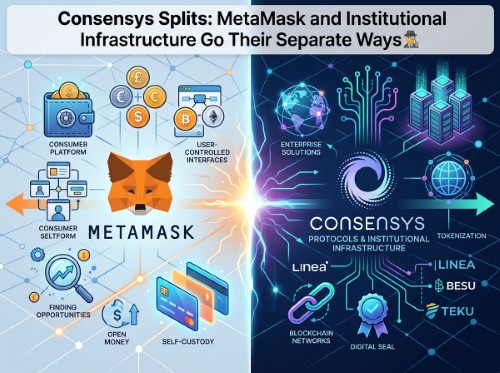
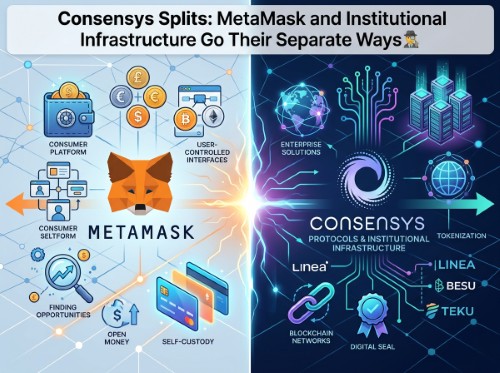
In a landmark decision that highlights the rapid maturation of the Web3 ecosystem, Consensys Software Inc. (CSI) has announced a major corporate restructuring. The company will divide its operations into two distinct, independently managed entities: MetaMask, focused exclusively on consumer self-custodial finance, and a newly formed Consensys, dedicated to protocol development and institutional blockchain infrastructure.
This strategic evolution reflects how the digital asset landscape has fractured into two distinct frontiers. On one side, consumer self-custody has shifted from an experimental niche into mainstream personal finance. On the other, global financial institutions have moved beyond preliminary pilot programmes to demand production-ready, always-on blockchain systems.
By unbundling its consumer and institutional divisions, the organisation aims to give each business the agility, leadership, and dedicated capital required to lead its respective market.
For over a decade, Consensys played a unified role as both an incubator and ecosystem builder for Ethereum. It provided everything from core protocol research and enterprise software to consumer wallet software. However, as the crypto economy matures, the operational demands of running a global consumer platform diverge significantly from building enterprise-grade, compliant financial market infrastructure.
The completion of the corporate separation is expected by the end of 2026. Once finalised:
This structural separation ensures that each entity can refine its strategy without the competing priorities inherent in a multi-segmented organisation.
Under the leadership of Ethereum co-founder Joe Lubin, who steps in as Chairman and Chief Executive Officer, the rebranded MetaMask company will focus entirely on expanding self-custodial finance.
Having surpassed 100 million downloads across nearly 190 countries and facilitated trillions of dollars in cumulative transaction volume, MetaMask is far more than a Web3 crypto wallet. The platform is positioning itself as an Open Money operating system—a unified digital space where users can hold, spend, save, and grow both digital assets and traditional financial instruments.
Key Focus Areas for MetaMask:
By stepping into the CEO role at MetaMask full-time, Lubin signals that scaling consumer self-custody to hundreds of millions of users requires the same single-minded focus that built Ethereum in its foundational years.
While MetaMask targets consumer finance, the newly formed Consensys company will cater to the rapidly expanding needs of institutional market participants, asset managers, and sovereign enterprises.
Led by Chief Executive Officer Mike Kriak and President David Cunningham, with Joe Lubin serving as Executive Chairman, Consensys will inherit the Protocols Group and enterprise portfolio.
The timing aligns with a massive global shift toward asset tokenisation. Financial institutions are actively deploying tokenised real-world assets (RWAs), private blockchains, and programmable settlement layers. According to a landmark report by Citi titled Tokenization 2030, tokenized assets are projected to reach between $5.5 trillion and $8.2 trillion by 2030.
The Institutional Technology Stack:
The newly formed Consensys entity brings together several foundational open-source and institutional technologies:
By focusing on privacy, resilience, and interoperability, Consensys aims to supply the underlying software powering always-on digital asset exchanges, stablecoin issuers, and tokenised financial market infrastructures.
The division of Consensys Software Inc. serves as a barometer for where the blockchain sector is headed. Key takeaways for market participants include:
As both entities prepare to operate independently by late 2026, the Web3 landscape achieves a clearer separation of concerns. MetaMask is set to redefine how individuals manage sovereign wealth, while Consensys builds the plumbing for the future of global financial institutions.
Both organisations remain unified in their core ethos: advancing Ethereum and fostering open, interoperable financial networks. However, by giving each side of the business its own stage, the vision of an onchain economy moves one major step closer to reality.
Disclaimer: This article is provided for informational purposes only, mistakes may be made, and it's not offered or intended to be used as legal, tax, investment, financial, or any other advice.