x




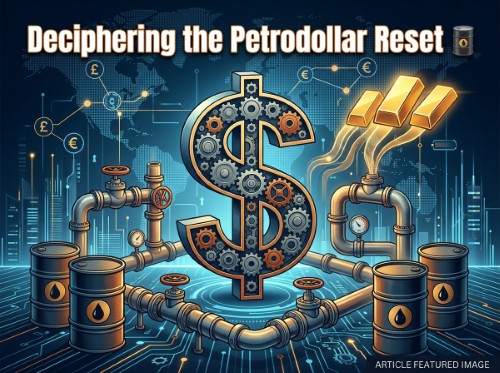
For half a century, the global economic order has rested upon an invisible yet remarkably powerful foundation: the petrodollar system. While market analysts frequently obsess over daily fluctuations in crude oil prices, the currency in which that energy is transacted has quietly shaped world power, international debt markets, and the strength of the United States dollar.
Understanding how energy trade turned into a structural engine for American financial dominance reveals not only how global money operates today, but also why subtle shifts in international trade settlement are quietly reshaping the global financial landscape.
To understand the petrodollar's origin, one must look back to August 1971, when President Richard Nixon officially suspended the direct convertibility of the US dollar into gold. Under the post-war Bretton Woods arrangement, foreign governments could exchange their paper dollars for physical gold at a fixed rate. As dollars accumulated overseas far beyond America's gold reserves, maintaining that guarantee became impossible. Closing the gold window effectively severed the dollar's link to a tangible commodity and left foreign central banks holding fiat currency without an intrinsic anchor.
To anchor global demand for the dollar without gold, Washington turned to energy. Following the severe oil price shocks of 1973, petroleum exporters found themselves accumulating immense cash surpluses. In 1974, a landmark economic and security understanding was cemented between the United States and Saudi Arabia. Under this informal yet highly pragmatic arrangement, Saudi Arabia agreed to price and settle its vast crude oil exports overwhelmingly in US dollars. In return, Washington provided military protection and advanced weaponry.
This arrangement created a self-reinforcing financial framework:
The engine that powered this system for decades is known as petrodollar recycling. This process functions as a circular capital flow that continually reinforces the global dominance of American financial markets.
When a country like Japan purchases oil from a Middle Eastern producer, it must first obtain US dollars through foreign trade, currency reserves, or foreign exchange markets. Once those dollars reach the energy exporter, only a fraction can be immediately spent on domestic infrastructure or consumer imports. The remaining surplus cash must be parked in deep, highly liquid financial assets.
Historically, energy producers routinely re-invested these vast dollar surpluses back into US Treasury securities. This round-trip flow delivered three immense strategic advantages to Washington:
While oil trade alone does not account for the dollar's total reserve currency status—which is also sustained by America's immense military, open capital accounts, and legal stability—petrodollar recycling served as a crucial catalyst for post-gold monetary expansion.
Beyond providing cheap government borrowing, the petrodollar system granted Washington an unprecedented geopolitical tool: economic leverage over global trade clearing.
Because the vast majority of international dollar transactions must ultimately pass through American correspondent banks or clearing networks, the United States gained extraterritorial reach over international banking. Financial institutions worldwide risk losing access to the primary dollar system if they facilitate trades for non-compliant nations or sanctioned entities.
The power of this mechanism became dramatically evident in 2022 following the escalation of conflict in Ukraine, when Western nations immobilised approximately $300 billion in Russian central bank foreign exchange reserves. For central banks around the globe, this action marked a profound conceptual pivot. Sovereign reserves stored in foreign government bonds or foreign bank deposits were suddenly understood to carry a layer of political risk that credit ratings and interest rates could not measure.
In response, numerous sovereign nations have begun evaluating alternative store-of-value assets. Physical gold, stored within domestic vaults, has re-emerged as a favourite reserve asset because it carries no counterparty risk and cannot be frozen remotely by foreign jurisdictions.
In mid-2024, sensational headlines spread across social media claiming that a fictional "50-year secret petrodollar treaty" between the United States and Saudi Arabia had expired, signalling an abrupt end to dollar dominance.
These claims fundamentally misunderstood how the system operates. There was never a single legal contract with a binding 50-year expiration date signed in 1974. The petrodollar system grew out of a flexible matrix of commercial relations, security guarantees, and financial convenience rather than a single fixed treaty.
However, while claims of a sudden collapse were groundless, gradual fragmentation is genuinely underway:
Rather than a sudden collapse, the petrodollar highway is simply acquiring new off-ramps that allow participating nations to bypass traditional settlement routes when geopolitical interests dictate.
As alternative trade mechanisms mature, the structural demand for US Treasuries faces new headwinds. This shift comes at a delicate moment for American fiscal policy, with US national debt surpassing historic levels and annual federal deficits projected to reach $1.9 trillion.
If foreign central banks and energy exporters reduce their automatic recycling of surplus capital into US Treasuries, Washington must attract alternative domestic and international investors. To persuade these buyers to absorb trillions of dollars in ongoing debt issuance, the market may demand higher yields, elevating borrowing costs across the global financial ecosystem.
Nevertheless, replacing the dollar remains a formidable challenge. No rival currency currently offers the complete package required of a global reserve asset:
The future of international money is unlikely to feature a single dramatic crown exchange. Instead, the global monetary system is evolving towards a more fragmented, multi-currency architecture where the dollar remains dominant, but coexists with expanded regional settlement networks and a renewed appreciation for unencumberable reserve assets like physical gold.
Finance Bureau - If You Don't Understand the Petrodollar, You Don't Understand Money
"The real story behind money today isn’t just about oil prices, it’s about the currency oil is traded in. This video breaks down how the US dollar became the world’s default through oil, and what happens as big players start to move away from it.
We dig into the petrodollar system, why it made borrowing easy for the US, and how global shifts in oil trade and sanctions are shaking things up. Find out what a weaker petrodollar could mean for the economy and your future."
~ TIMESTAMPS ~
0:00 - The Most Important Price in the World (and it’s not oil)
1:08 - How the US Dollar Conquered the Global Financial System
2:20 - 1974: The Notorious Secret Agreement that Saved the Dollar
4:50 - The Petro-Dollar Loophole: How America Borrows Trillions
8:42 - Weapons of Mass Blackmail: How the Dollar Dictates Global Power
10:50 - Why Central Banks are Quietly Panicking and Buying Gold
11:56 - The 50-Year Petro-Dollar Expiration Myth Exposed
13:18 - Project Mbridge: Saudi Arabia’s Secret Exit Strategy
15:20 - The $1.9 Trillion Crisis: Who Will Buy America's Debt?
18:30 - Why China's Yuan Can't Destroy the Dollar (Yet)
Source 👉 https://www.youtube.com/watch?v=cZyIfGZNipM
Disclaimer: This article is provided for informational purposes only, mistakes may be made, and it's not offered or intended to be used as legal, tax, investment, financial, or any other advice.