x




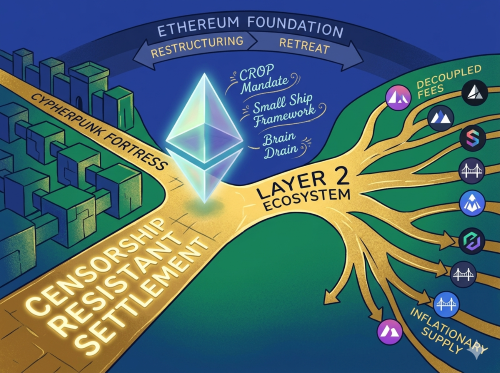
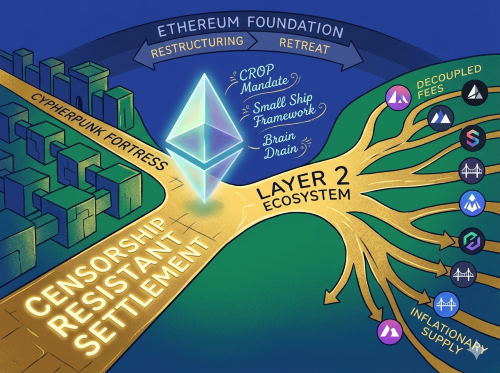
The cryptocurrency market is witnessing a profound shift in the narrative surrounding its second-largest asset. For years, Ethereum was championed as the undisputed king of smart contract platforms, a deflationary powerhouse operating under the "ultrasound money" thesis. However, recent market dynamics, internal leadership shifts, and a massive philosophical pivot from its co-founder, Vitalik Buterin, suggest that Ethereum’s future has taken an entirely new trajectory.
A recent deep dive by Coin Bureau outlines the brewing storm inside the Ethereum Foundation (EF), the economic realities of the network’s layer-2 scaling strategy, and whether Ethereum is genuinely repositioning itself for long-term institutional dominance or quietly retreating from the competitive arena.
In late May, Vitalik Buterin published a substantial, 1,500-word statement on X (formerly Twitter) that sent shockwaves through the crypto community. Rather than acting as a standard forward-looking roadmap, the post felt to many like an exercise in damage control.
Faced with mounting ecosystem pressure, Buterin introduced what he calls the "smaller ship" framework. Under this mandate, the Ethereum Foundation will actively shrink its footprint, decentralise its board, and step away from the aggressive throughput and transactions-per-second (TPS) wars dominating the blockchain sector. Buterin explicitly noted that competing head-to-head with rival networks on speed alone is a "route to mediocrity".
Instead, the foundation is refocusing entirely on a five-letter core mandate known as CROPS:
To appease critics who accuse the foundation of routinely dumping assets on retail investors, Buterin committed to selling less ETH, framing the treasury's management as a matter of longevity over breadth. He revealed that the foundation holds a mere 0.16% of the total token supply, a contrast to rival blockchain foundations that often retain between 10% and 50% of their circulating assets. Furthermore, Buterin disclosed that roughly 90% of his personal net worth remains held in ETH, attempts to reassure holders that his economic incentives are aligned with theirs.
While the manifesto paints a picture of a humbler, values-driven foundation returning to its cypherpunk roots, the timing tells a more complicated story. The announcement arrived just three days after a former senior foundation researcher published a rival proposal calling for a brand-new, $1 billion independent organisation. This proposed entity would explicitly focus on advocating for ETH as a financial asset and driving price appreciation—something critics argue the foundation has neglected.
The internal operations of the Ethereum Foundation have also faced a quiet crisis. The organisation has suffered an accelerating brain drain, with numerous high-profile protocol and operations leads resigning in quick succession. While Buterin frames a smaller foundation as a conscious choice towards healthy decentralisation, industry analysts worry it reflects an fracturing leadership core.
Beyond governance issues, Ethereum faces a structural crisis embedded in its very tokenomics. The network was heavily marketed on the premise that high transaction volume would burn supply, making the asset naturally deflationary.
The implementation of the Dencun upgrade in early 2024 altered this mechanic. By introducing "blob transactions," the upgrade successfully slashed data posting costs for Layer-2 (L2) networks by up to 90%. While this made L2 platforms like Arbitrum, Optimism, and Coinbase's Base incredibly cheap and user-friendly, it economically decoupled them from the Ethereum base layer.
With L2 networks retaining the vast majority of their lucrative sequencer revenue, the base layer transaction fees plummeted. Consequently, the daily ETH burn rate has cratered. Ethereum is now structurally inflationary, adding approximately 45,000 new tokens to its supply every month. For long-term holders invested in the "ultrasound money" narrative, this change represents a fundamental shift in the asset's investment thesis.
Ethereum's challenges are further compounded by shifting developer metrics. Data indicates that while Ethereum still commands the largest absolute pool of active digital asset developers, its total market share of blockchain developers has dropped from over 80% in 2020 to roughly 31%.
Concurrently, competing chains like Solana have experienced massive year-on-year growth in full-time developers. Compensation disparities may be accelerating this trend; data reveals that core Ethereum developers earn significantly less than the broader crypto market average. With a shrinking foundation and lower compensation packages, retaining top-tier engineering talent is becoming an uphill battle.
Despite these headwinds, an incredibly strong institutional bull case remains for Ethereum, centred on its role as a secure global settlement layer.
As global regulatory frameworks tighten, Ethereum's commitment to absolute decentralisation and censorship resistance positions it as the premium venue for traditional finance. The network already commands roughly 60% of the tokenised real-world asset (RWA) market and hosts over half of all stablecoin capitalisation.
Furthermore, Wall Street's integration via spot ETFs offers a structural feature that Bitcoin cannot replicate: a potential pathway toward yield-bearing investment products. Financial institutions projecting massive growth in asset tokenisation by the late 2020s view Ethereum not as a retail playground, but as indispensable industrial infrastructure.
Conversely, the bear case highlights a severe asymmetry in execution timelines. Ethereum is asking the market to value it based on a complex, multi-year institutional settlement thesis. Meanwhile, networks like Solana are winning the immediate market on sheer throughput and retail adoption.
Trading volumes, decentralized exchange (DEX) activity, and transaction counts on competing networks have regularly outpaced Ethereum mainnet. High-margin on-chain markets, such as perpetual futures, are increasingly being captured by highly specialised application chains. This stark divergence has caused high-profile industry figures to reallocate capital, with even prominent long-term Ethereum evangelists liquidating portions of their holdings.
For those holding or trading Ethereum, the coming months present several critical milestones that will dictate whether the asset undergoes a bullish reset or a continued narrative decline:
Ultimately, Ethereum is transitioning out of its youth. It may no longer be the hyper-growth asset designed for speculative retail flippenings, but rather a stable, secure, and deeply entrenched layer of global financial infrastructure. Whether the market chooses to price those foundational values as highly as raw transactional speed remains the ultimate question.
Coin Bureau - Ethereum’s Future Just Took a Sharp Turn
"Ethereum’s founder just made his most dramatic announcement yet: foundation downsizing, less ETH selling, and a personal step back from leadership. This move comes after public criticism and a rival $1 billion org proposal that could reshape the Ethereum landscape.
The story goes deeper than words. This video exposes the structural risks impacting ETH holders now. From developer brain drain to inflationary tokenomics and lost value capture. See what’s really changing for your ETH, and why the headlines barely scratch the surface."
~ TIMESTAMPS ~
0:00 - Vitalik’s Ethereum Shake-Up Begins
2:10 - Ethereum Foundation’s “Smaller Ship” Plan
4:08 - Is Vitalik Answering ETH Critics?
6:12 - The $1 Billion Ethereum Rival Proposal
8:13 - Why ETH Value Is Leaking to Layer 2s
11:12 - Ethereum’s Bull Case: ETFs, RWAs & Stablecoins
14:17 - Key ETH Catalysts Holders Must Watch
Source 👉 https://www.youtube.com/watch?v=HAAhbq_lefc
Disclaimer: This article is provided for informational purposes only, mistakes may be made, and it's not offered or intended to be used as legal, tax, investment, financial, or any other advice.