x




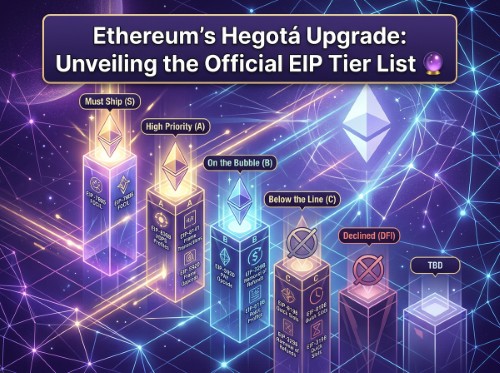
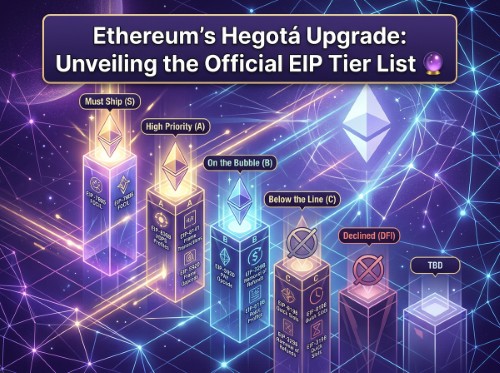
Ethereum’s core development methodology is evolving. For the first time in the network’s history, the Ethereum Foundation (EF) Protocol cluster—representing roughly 60 researchers and engineers across nine distinct teams—has released a single, unified evaluation of proposed network upgrades.
The publication maps out the protocol scoping for Hegotá, Ethereum’s upcoming hard fork. Out of 62 proposed Ethereum Improvement Proposals (EIPs), the cluster assigned definitive tier grades to establish what will define the next chapter of Ethereum, what remains on the bubble, and what has been explicitly rejected.
Here is a comprehensive breakdown of the Hegotá tier list, what these changes mean for the network, and why certain controversial proposals were turned away.
Following lessons learnt from the previous Glamsterdam upgrade—where engineering teams discovered that testing surface area is the scarcest resource and complexity compounds rapidly—the Protocol cluster adopted a rigorous scoring process.
Sixteen contribution templates yielded nearly 400 individual grades across the 62 candidate EIPs. Rather than relying purely on mathematical averages, the cluster conducted exhaustive working sessions to "steelman" every position before assigning final tiers:
The Hegotá upgrade focusses heavily on two core objectives: combating transaction censorship on the Consensus Layer and introducing native account abstraction alongside post-quantum preparation on the Execution Layer.
1. Consensus Layer Headliner: Decentralising Block Building with FOCIL
Fork-Choice Enforced Inclusion Lists (FOCIL) represent a massive leap forward for Ethereum's censorship resistance. Currently, transaction inclusion relies heavily on sophisticated, centralised block builders. FOCIL changes this dynamic by empowering validators to enforce inclusion lists directly via consensus mechanics.
By pairing EIP-7805 with EIP-8369 (which defines eligibility parameters), FOCIL ensures that ordinary users retain a guaranteed, permissionless path to get their transactions included on-chain, effectively neutralizing builder censorship.
2. Execution Layer Headliner: Native Account Abstraction
Frame Transactions locked in the top spot for the Execution Layer. This package delivers native account abstraction directly into the Ethereum Virtual Machine (EVM).
Beyond improving smart contract wallet usability, Frame Transactions provide a structural bridge toward post-quantum (PQ) security. They allow alternative signature schemes to be introduced without requiring a hard fork for every new cryptographic scheme, while enabling transaction batching and setting the stage to eventually retire legacy ECDSA (k1) keys.
Alongside the headliners, several high-value proposals received A-tier commitments to streamline EVM execution and protect block propagation:
While several proposals demonstrate strong merit, the cluster placed them in the B-tier due to strict prerequisite requirements:
Meanwhile, proposals like EIP-8368 and EIP-8372 (focused on state gas limit recalibrations) remain categorised as TBD, as developers await live telemetry from post-Glamsterdam mainnet usage before making structural adjustments.
Out of 62 proposals, 28 were assigned to the Declined for Inclusion (DFI) category. While many rejections stemmed from technical complexity or lack of necessity, the treatment of monetary policy proposals drew the most attention.
Both EIP-8363 (Tapered Issuance Burn) and EIP-8375 (ePBS Mandatory Burn of Execution Rewards) received unanimous DFI grades. However, the Protocol cluster clarified that this was not a rejection of their underlying economic merits.
Instead, the cluster emphasised that Ethereum’s monetary policy and issuance structure impact every staker, token holder, and long-term security budget across the entire ecosystem. Scoping a technical hard fork is not the appropriate venue for core developers to unilaterally decide economic policy. Changes of this magnitude must instead be carried out through a dedicated, multi-stakeholder ecosystem process with broad community engagement.
The Hegotá tier list paints a clear picture of Ethereum’s development philosophy: prioritise security, deliver generational features like inclusion lists and account abstraction, and aggressively cut scope to prevent protocol bloat.
By locking in 2 S-tier headliners, expecting 15 A-tier additions, and explicitly declining 28 high-risk or premature proposals, the Protocol cluster is targeting a clean, stable, and timely release.
Get More Info
To read the original post, explore the complete breakdown of all 62 EIPs, visit the official source article here:
👉 EF Protocol: The Hegotá EIP Opinion Post and Tier List
Disclaimer: This article is provided for informational purposes only, mistakes may be made, and it's not offered or intended to be used as legal, tax, investment, financial, or any other advice.