x




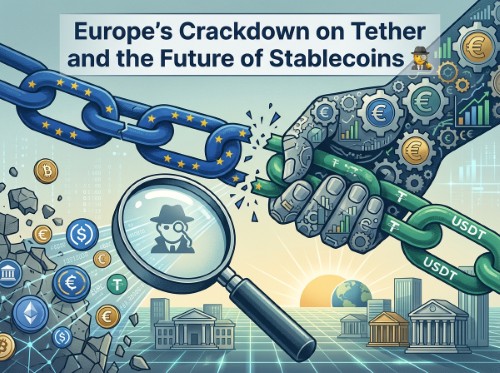
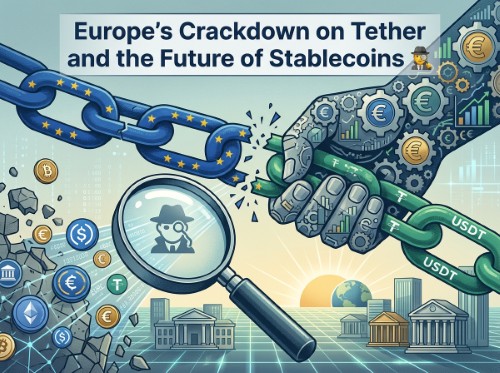
The regulatory landscape governing digital assets in the European Union is undergoing a seismic shift. Under the Markets in Crypto-Assets (MiCA) regulation, the European Union has implemented some of the most stringent stablecoin rules in the world. As a direct consequence, major licenced crypto asset service providers across the bloc—including Coinbase, Binance, Kraken, and Revolut—have systematically restricted, delisted, or auto-converted non-compliant stablecoins. At the very centre of this regulatory storm sits Tether (USDT), the world's largest stablecoin with a market cap exceeding $187 billion, which has notably refused to comply with the EU’s reserve mandates.
However, far from being a simple story of a single token being banned, the situation represents a fundamental restructuring of how digital fiat operates within the global financial architecture.
To understand why Tether pulled back from direct European compliance, one must examine MiCA’s framework regarding E-Money Tokens (EMTs). Under MiCA, any stablecoin pegged to an official currency must adhere to strict reserve backing requirements. Standard EMT issuers are required to hold at least 30% of their reserve assets as cash deposits within licenced European credit institutions. For stablecoins designated as 'significant'—a category Tether’s USDT undoubtedly falls into—that requirement escalates to 60%.
Tether’s leadership, led by CEO Paolo Ardoino, argued that this mandate introduces severe systemic risk rather than mitigating it. Ardoino’s critique hinges on the fundamental difference between sovereign debt and commercial bank deposits:
European deposit insurance schemes cap protection at €100,000 per institution, an negligible figure when set against multi-billion-dollar reserve pools. This concern is not merely theoretical; during the collapse of Silicon Valley Bank in March 2023, Circle had $3.3 billion of its USDC reserves trapped, briefly causing USDC to lose its dollar parity and depeg to 87 cents. From Tether’s perspective, forcing an issuer to park up to 60% of its backing in European commercial banks fundamentally destabilises the stablecoin.
Because MiCA places the burden of compliance on licenced intermediaries rather than private token holders, European exchanges were forced to eliminate non-compliant pairs to protect their operational licences. This regulatory shift created an immediate vacuum, which was swiftly filled by institutionally backed and bank-adjacent entities.
Circle positioned itself as the primary corporate beneficiary by securing an Electronic Money Institution (EMI) licence from France's ACPR. This allowed its US-dollar stablecoin (USDC) and euro-denominated token (EURC) to achieve full regulatory approval across the entire European Economic Area. Concurrently, traditional financial giants entered the fray. Société Générale’s digital asset arm introduced EURCV, alongside other bank-backed issuers such as Banking Circle (EURI), Quantoz (EURQ), and Allunity in Germany.
Rather than abandoning the European market entirely, Tether executed a strategic workaround. Instead of applying for a direct issuer licence under MiCA, Tether acquired strategic equity stakes in compliant local issuers, including Netherlands-based Quantoz and Malta-based Stabler. Furthermore, Tether launched its Hadron tokenisation platform to serve institutional clients and established US-compliant token structures via federally chartered entities. Through these investments, Tether maintains a commercial presence and derives revenue from compliant tokens without subjecting its main global reserve pool to European banking mandates.
The mechanics introduced by the European Union are not isolated to Europe. Regulatory bodies worldwide are adopting a near-identical playbook:
In the United States, legislation like the GENIUS Act establishes strict criteria for permitted payment stablecoins under the oversight of federal banking regulators. Similarly, the UK's Financial Conduct Authority (FCA) and Bank of England, Hong Kong's Monetary Authority, Singapore's MAS, Japan, and Canada have all established regimes that channel stablecoin issuance through traditional banks or tightly regulated payment institutions.
While MiCA addresses token issuance and exchange listings, the next phase of European regulation targets the intersection between regulated entities and self-hosted (unhosted) crypto wallets.
Under incoming Anti-Money Laundering (AML) directives, transactions exceeding €1,000 between a licenced crypto provider and a self-hosted wallet will trigger mandatory identity verification and enhanced due diligence procedures. Providers will be required to cryptographically verify that the customer owns and controls the destination address. Additionally, regulatory frameworks are directing exchanges to cease supporting anonymity-enhancing assets (privacy coins such as Monero, Zcash, and Dash).
It is crucial to note that holding USDT, maintaining self-custody, and executing peer-to-peer (P2P) transfers remain entirely legal for private individuals across Europe. MiCA and accompanying AML directives bind regulated businesses, not private software users.
Ultimately, these developments mark a definitive bifurcation in the cryptocurrency ecosystem. On one side sits a compliant, bank-led network of tokenised fiat integrated directly into traditional finance. On the other side sits the original, permissionless peer-to-peer blockchain infrastructure, operating independently of centralized corporate intermediaries.
Coin Bureau - Europe's War On Tether Is About To Get MUCH WORSE
"Tether’s biggest threat isn’t a ban, it’s regulation that cuts it out of Europe’s legal market. See how new EU rules push Tether out while big banks and USDC take over, and how Tether is quietly getting back in through local partners.
This crackdown is just the start. The same playbook is rolling out in the US, UK, Hong Kong, and beyond. Find out what comes next for your stablecoins and wallets as enforcement goes global."
~ TIMESTAMPS ~
0:00 – The EU's Secret Crusade Against Tether Explained
2:01 – Why Exchanges Are Quietly Delisting USDT
4:03 – The "Very Dangerous" Rule Tether Refuses to Follow
6:05 – This Token Is Rapidly Replacing Tether in Europe
8:07 – Tether’s Brilliant Workaround to Re-enter the Market
10:08 – Global Lawmakers Unite to Control Your Crypto
12:10 – Will New Wallet Restrictions Make Self-Custody Illegal?
14:12 – The Only Part of Crypto Governments Can't Stop
Source 👉 https://www.youtube.com/watch?v=Yh-tTK7Rulg
Disclaimer: This article is provided for informational purposes only, mistakes may be made, and it's not offered or intended to be used as legal, tax, investment, financial, or any other advice.