x




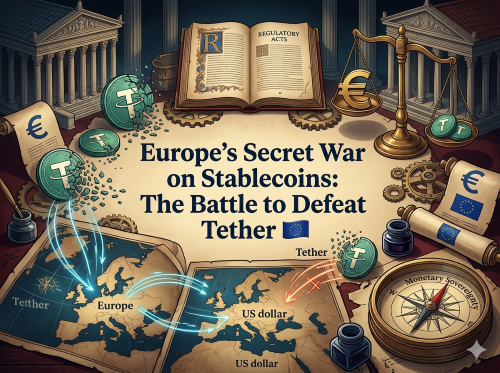
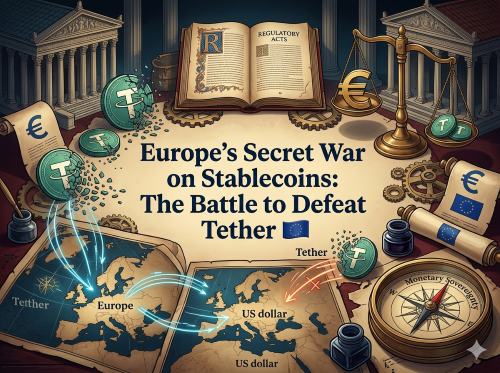
The global financial landscape is experiencing a silent but monumental shift, with the European Central Bank (ECB) initiating a regulatory offensive targeted directly at the heart of the stablecoin market. At the centre of this geopolitical tussle is Tether (USDT), the world’s largest stablecoin. European regulators increasingly view the massive circulation of dollar-denominated stablecoins not merely as a technological trend, but as a direct challenge to the monetary sovereignty of the euro and an extension of American financial dominance.
With billions of euros flowing out of traditional banking systems into US dollar assets, Europe has begun deploying a sophisticated regulatory framework designed to curb the influence of offshore digital dollars and establish its own state-backed alternatives.
The primary catalyst for Europe's aggressive stance is the sheer dominance of the US dollar within the digital asset ecosystem. The vast majority of the global stablecoin market is denominated in greenbacks, with Tether accounting for a massive share of this value. As a private entity headquartered in El Salvador, Tether has grown so large that its reserve holdings of US Treasury debt eclipse those of many G20 nations, making it one of the largest sovereign debt holders globally.
Every time a user converts local fiat currency into USDT, those funds essentially exit the local banking architecture and are reinvested into American government debt. For the ECB, this trend signals a dangerous future of digital dollarisation. If European citizens and businesses heavily adopt dollar-denominated stablecoins for day-to-day digital transactions, the central bank risks losing its grip on its own monetary policy and financial system.
Europe’s first major move to counter this trend came with the Markets in Crypto-Assets (MiCA) regulation. While presented on the surface as a standard framework for consumer protection and licencing, MiCA contains specific mechanisms acting as structural barriers against foreign stablecoins.
Under these rules, stablecoins like USDT are classified as electronic money tokens denominated in non-EU currencies. This classification triggers strict operational mandates:
The practical impact of these rules has caused significant shifts across European crypto platforms. Major digital asset exchanges have already begun delisting non-compliant stablecoins, restricting trading pairs, or moving assets into sell-only modes for European users. This has led to a massive collapse in USDT trading volumes on regulated EU venues, allowing fully compliant alternatives like Circle’s USDC to capture the vacant market share.
While MiCA represents the defensive strategy to limit the growth of digital dollars, Europe’s offensive strategy relies on constructing its own tokenised financial infrastructure. Analysts often misunderstand the purpose of the upcoming digital euro, assuming it is designed simply as a retail debit card alternative for consumers who already have access to fast payment rails.
Instead, the ECB's primary objective is to own the underlying rails of tokenised institutional finance before private entities do. To achieve this, European authorities are developing critical pieces of infrastructure:
By ensuring that serious wholesale finance and tokenised asset markets rely on state-controlled infrastructure, Europe hopes to render offshore dollar stablecoins obsolete within its borders.
The European approach stands in stark contrast to recent developments in the United States. While Europe is actively tightening the screws and implementing restrictive caps to protect the euro, the US has moved toward formalising and turbocharging its stablecoin industry.
Through legislative efforts like the Genius Act, American policymakers are establishing a clear federal licencing framework that mandates one-to-one backing in cash or short-term US treasuries. By codifying these rules, the US government is strategically turning private stablecoins into permanent, structural buyers of American national debt. This symbiotic relationship helps suppress borrowing costs for the US government while utilising the digital asset market to extend global dollar supremacy deep into the digital age.
This regulatory divide has split the stablecoin industry into two distinct camps. Circle has chosen a path of total alignment with Western authorities, securing essential electronic money licenses in France, maintaining rigorous attestation standards, and transitioning into a publicly traded entity on the New York Stock Exchange.
Tether, conversely, has leaned into a strategy of decentralised resilience. Operating deliberately outside mainstream Western enforcement jurisdictions, the company has accumulated massive net profits, using its capital to build an independent ecosystem backed not just by treasuries, but by significant reserves of physical gold and Bitcoin. For European regulators, breaking Tether's dominance is essential; failing to enforce compliance would signal that Europe's regulatory frameworks lack teeth.
As the hard deadlines for MiCA enforcement arrive, the friction between European protectionism and American digital dollar expansion is set to intensify. European banking consortiums are already preparing to launch institutional, bank-backed euro stablecoins at scale, while major global payment processors expand their own stablecoin products.
The coming years will decide who controls the fundamental architecture of digital value transfer. Crypto markets and DeFi protocols will find themselves caught directly in the crossfire of this regulatory tug-of-war, as superpowers race to lay the digital rails that will govern global finance for the next century.
Coin Bureau - Europe’s Plan to Crush Tether
"Europe’s financial war just went public. In this episode, DC uncovers how the ECB is using MiCA to hit Tether—and by extension, the dollar—where it hurts.
Discover why the eurozone is so threatened by USDT, how new rules will force stablecoin issuers to choose: obey EU controls or get kicked out. See why Circle wins from both sides and how the digital euro’s true goal is about controlling the future rails of finance—not just consumer payments.
With regulatory deadlines hitting, US and EU strategies clashing, and DeFi caught in the middle, every crypto holder needs to know where the battlefield lines are being drawn. Don’t let new rules catch you off guard—watch now."
~ TIMESTAMPS ~
0:00 Europe's Stablecoin Problem
2:50 MiCA's Hidden Kill Switch
4:10 The Digital Euro Endgame
7:00 Why Tether Is the Main Target
8:50 The Bigger Currency War
10:25 Winners, Losers, and Key Catalysts
Source 👉 https://www.youtube.com/watch?v=oEfoKp-uTzQ
Disclaimer: This article is provided for informational purposes only, mistakes may be made, and it's not offered or intended to be used as legal, tax, investment, financial, or any other advice.