x




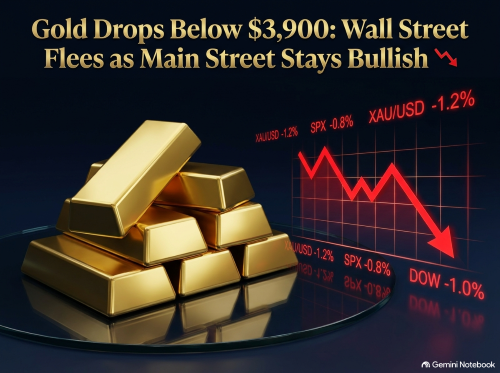
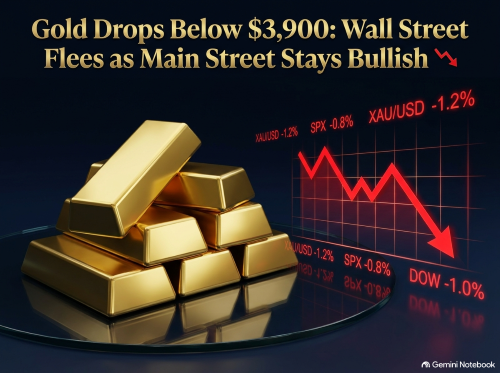
Precious metals markets experienced a dramatic shakeout this week as gold tumbled past major support levels, triggering fresh anxiety across global markets. Following a mid-week bounce that briefly carried spot prices to a weekly high of $4,082.50 per ounce, a wave of aggressive selling dragged the yellow metal to a low of $3,870.25 per ounce on Friday afternoon — its lowest valuation in over a year. Gold settled near the bottom of its range at $3,875.05 per ounce, marking a 3.74% weekly decline.
The sharp downturn has exposed a stark divide in market sentiment. Institutional analysts have rapidly turned pessimistic, while retail investors continue to hold out for a rebound. Detailed market coverage shows how Wall Street abandons ship after gold sinks below $3,900/oz, highlighting how macroeconomic pressures and equity liquidations have reshaped short-term expectations.
The root of this week’s decline lies in a combination of hawkish central bank messaging and broader financial market turbulence. Gold started the week trading at $3,994.95 per ounce on Sunday evening, initially drawing support from bargain hunters. Sentiment received a temporary boost ahead of Wednesday's Federal Reserve policy announcement, where officials voted 10-2 to maintain interest rates at 3.75% to 4.00%, despite two policymakers dissenting in favour of a 25-basis-point increase.
However, the rally was short-lived. Stronger-than-expected third-quarter GDP growth alongside elevated core PCE inflation figures released on Thursday reinforced expectations that monetary policy will remain restrictive for longer.
The pressure intensified dramatically on Friday when a sharp decline in technology shares, sparked by investor scepticism over artificial intelligence capital expenditure returns, triggered broad-based portfolio liquidations. Investors sold liquid assets to meet margin requirements across financial markets, overwhelming traditional safe-haven demand for gold and silver alike.
The latest Kitco News Weekly Gold Survey illustrates a sharp divergence between institutional market strategists and individual investors:
Retail market participants appear to view the pullback as a buying opportunity, whereas institutional analysts warn that technical damage could lead to deeper losses.
Market strategists point to significant chart damage following gold's failure to maintain key floor levels.
Marc Chandler, managing director at Bannockburn Global Forex, noted that gold had traded near $4,700 per ounce as recently as late August. He observed that while prices are currently trading below the lower Bollinger Band, a true capitulation trade has not yet materialised, suggesting gold could test the $3,750 to $3,850 range.
Colin Cieszynski, chief market strategist at SIA Wealth Management, stressed that the breakdown below $4,000 carries strong technical significance. Independent analyst Jesse Colombo, founder of the BubbleBubble Report, noted that the $3,900 to $4,000 zone served as a critical floor established a year ago. If this support zone fails to hold on strong volume, Colombo warned that the next major downside level to monitor sits around $3,500 per ounce.
From a structural perspective, Alex Kuptsikevich, senior market analyst at FxPro, pointed out that gold has now corrected by 61.8% of its multi-year advance from four-year lows to early 2026 highs. He cautioned that liquidity demands in falling equity markets often drag gold down alongside stocks, raising the potential for a deeper correction toward $3,300 per ounce.
Daniel Pavilonis, senior commodities broker at StoneX Group, suggested that without clear signals of central bank easing, gold could face a extended consolidation, potentially sliding toward $3,000 per ounce by the first quarter of next year before establishing a durable base. He recommended that investors holding physical or paper positions consider collaring strategies to manage downside risk.
Geopolitical developments also continue to weigh heavily on investor calculations. Analysts including Adam Button of investingLive and Rich Checkan of Asset Strategies International highlighted potential escalations surrounding Iran and oil shipping lanes in the Strait of Hormuz. Rising energy prices tend to stoke inflation concerns and push real yields higher, applying additional downward pressure on precious metals.
Neil Welsh, head of metals at Britannia Global Markets, emphasised that gold requires tangible proof of economic deceleration — rather than just a central bank pause — to ignite a sustained recovery.
Investors will face a flurry of high-impact events next week that could dictate gold's short-term trajectory:
With non-farm payrolls and election results looming, traders will be closely watching whether labor market softness can halt gold's retreat, or if institutional selling will push prices down to test lower support levels.
Disclaimer: This article is provided for informational purposes only, mistakes may be made, and it's not offered or intended to be used as legal, tax, investment, financial, or any other advice.