x




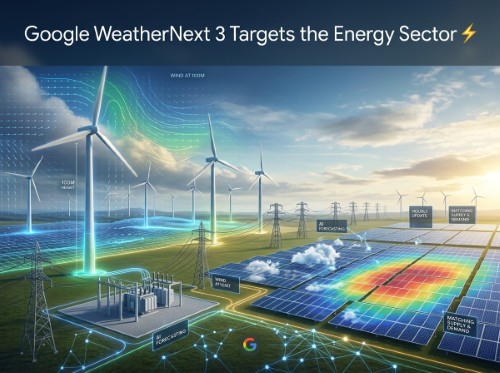
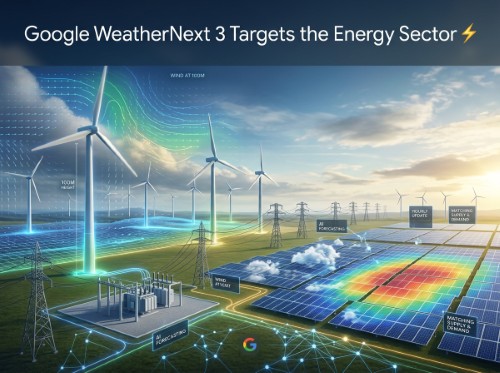
Weather forecasting is no longer merely a tool for deciding whether to carry an umbrella. In the modern power market, predicting atmospheric changes has become a high-stakes, multi-billion-pound imperative. With the release of WeatherNext 3, Google DeepMind and Google Research have moved far beyond consumer weather apps, placing a powerful new enterprise tool directly into the hands of energy traders, wind and solar developers, and national grid operators.
By providing hourly updates at a five-kilometre resolution and tracking atmospheric variables specifically tailored to renewable generation, Google is making a direct bid to dominate the energy intelligence market.
Modern electrical grids are experiencing unprecedented stress from two opposing forces: volatile supply and skyrocketing demand.
On the supply side, national power grids are shifting rapidly away from predictable fossil fuels towards intermittent renewable generation. Wind turbines and solar farms generate electricity according to localised weather conditions rather than customer demand. As a result, every gigawatt of clean energy added to the system increases the necessity for ultra-precise, localised, short-term weather forecasts.
On the demand side, energy consumption is expanding at a rate not seen in decades. This surge is largely driven by the rapid expansion of artificial intelligence infrastructure and massive hyperscale data centres. Utilities are frequently forced to revise their load projections upwards as heavy compute clusters demand vast amounts of continuous power.
When a weather forecast fails, the financial repercussions for grid operators are severe:
Both scenarios represent costly systemic failures driven by inaccurate weather prediction.
Previous iterations of AI weather models, such as WeatherNext 2, operated on a broader 25-kilometre grid and refreshed only once every six hours. WeatherNext 3 drastically upgrades these specifications, offering a global forecast that refreshes every hour at a five-kilometre resolution.
Crucially, Google has introduced specialised variables designed specifically for energy assets:
The architectural shift behind WeatherNext 3 marks a major departure from traditional AI weather forecasting.
Historically, most AI weather models were trained on data generated by Numerical Weather Prediction (NWP) systems. NWP systems are supercomputer-driven physics simulations that naturally suffer from a five-to-seven-hour processing lag, introducing inherent biases into rapidly changing metrics like local rainfall and surface temperature.
WeatherNext 3 bypasses much of this pipeline by ingesting live geostationary satellite imagery and training directly on ground readings from real-world weather stations. By utilising observational data rather than relying solely on atmospheric simulations, Google has successfully cut data latency down to three or four hours, allowing operators to make decisions based on fresher atmospheric information.
Google is entering a mature commercial landscape populated by specialised incumbents such as Vaisala, Solcast, DNV, IBM, and Swiss AI firm Jua.
Google’s primary advantage lies in its unprecedented infrastructure reach. The exact same forecasting data powering everyday Google Search queries and Gemini responses can be instantly queried by enterprise customers via Google Cloud BigQuery, Earth Engine, or downloaded in bulk via Google Cloud Storage without requiring complex model setup.
However, specialist competitors argue that data-driven AI models still face fundamental limits during extreme weather events.
Physics-based models encode non-negotiable physical laws regarding mass and thermodynamic conservation. Purely data-driven AI models, by contrast, rely on patterns learnt from historical records. During unprecedented extreme weather events—such as record-shattering storms or anomalous cold snaps that fall outside historical training data—physics-constrained models may still offer grid operators greater reliability when the stakes are highest.
Google’s entry into energy forecasting carries a clear commercial logic. As one of the world's largest corporate purchasers of renewable power, Google operates data centres whose soaring electricity demands contribute directly to the grid balancing challenges facing utilities today.
Developing tools that accurately predict when wind and solar assets will generate power directly helps hyperscalers manage their own massive clean-energy power purchase agreements (PPAs). By releasing WeatherNext 3, Google is not only opening a lucrative cloud data pipeline for utilities, but also refining the very systems needed to power the next generation of global AI infrastructure.
Disclaimer: This article is provided for informational purposes only, mistakes may be made, and it's not offered or intended to be used as legal, tax, investment, financial, or any other advice.