



x
Black Bar Banner 1
x

Alert!  New Secured Wallets are installed! new Blog system with AI  power and auto blog curation coming soon  Alert! 

Ads by Markethive - View All
Blogs
The Blog Feed
Write a New Blog Post
Search Blog Status
Most Viewed
Most Recent
Most Shared
Alphabetical
Blog Main Menu
Markethive Blog (default)
All Blogs
My Blog Posts
Friends' Blogs
Blog Categories
All
Advertising
Blockchain & Cryptocurrency
Business Development
Diet & Weight Loss
Environmental
Health and Wellness
History and Culture
Home and Garden
Marketing
Mentoring & Training
Money & Finance
Other
Political
Prayer & Religion
Programming & Technical
Real Estate
Search Engine Optimization
Social Media
Spirituality
Sports & Recreation
Transport
Travel & Events
Website Design
Blogging Tools & Assets
My Blog Info
Members Subscribed to You
Blogs You Are Subscribed To
Website Widget
Wordpress Plugin

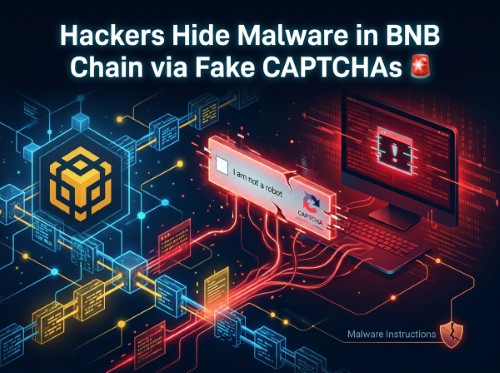
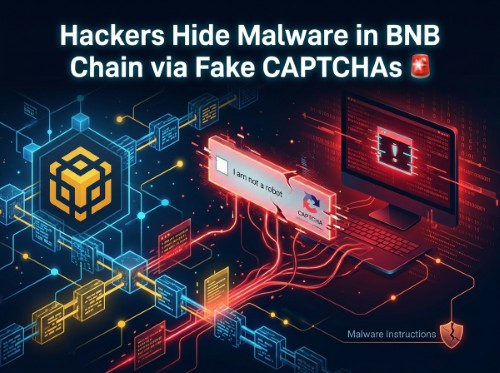
Hackers Hide Malware in BNB Chain via Fake CAPTCHAs 🚨

Posted by Simon Keighley on August 18, 2026 - 7:14am


Hackers Hide Malware in BNB Chain via Fake CAPTCHAs 🚨

Hackers Hide Malware in BNB Chain via Fake CAPTCHAs

Cybersecurity threats are continually evolving, with bad actors finding inventive ways to exploit cutting-edge technology. In a troubling development highlighted by Microsoft Threat Intelligence, cybercriminals are turning to public blockchain infrastructure to distribute malicious payloads. By abusing BNB Smart Chain smart contracts, hackers are bypassing conventional security defences and tricking unsuspecting users into infecting their own Windows devices through fake CAPTCHA prompts.

Here is a detailed breakdown of how this sophisticated attack works, why blockchain technology makes it so hard to stop, and what organisations and individuals can do to stay protected.


Understanding "EtherHiding": How Blockchains store Malware

At the heart of this campaign is a technique known as EtherHiding. Traditionally, when hackers compromise a website, they embed code that connects to a command-and-control (C2) server hosted on a standard web domain or IP address. Security teams and host providers can easily take down these malicious domains or block the server addresses.

EtherHiding completely flips this dynamic:

  • Decentralised Hosting: Cybercriminals store malicious instructions directly within smart contracts deployed on the BNB Smart Chain network.
  • Tamper-Proof Payload: Because public blockchains are decentralized and immutable, security teams cannot simply send a takedown request to a hosting provider. Only the wallet owner holding the contract's private key can modify its contents.
  • Automated Retrieval: Injected JavaScript on compromised websites automatically reaches out to a BNB Chain gateway, pulls down the hidden malicious commands, and executes them in the victim's browser environment.

This reliance on smart contracts—previously linked to the notorious ClearFake malware strain—allows cybercriminals to maintain persistent, bulletproof infrastructure that traditional security measures struggle to dismantle.


The Social Engineering Trap: ClickFix and TerminalFix

Even with stealthy blockchain infrastructure, malware still needs a way to run on a target's machine. Rather than relying solely on software vulnerabilities, the attackers exploit human trust through clever social engineering tricks named ClickFix and TerminalFix.

When a user visits a compromised website, they encounter what looks like a standard verification check, such as a security prompt or human-verification CAPTCHA. However, the interactive element is entirely fake:

  1. The ClickFix Prompt: The webpage instructs the visitor to solve a fake verification error by pressing a sequence of keys, opening the Windows Run dialog box, pasting text from their clipboard, and hitting Enter.
  2. The TerminalFix Variation: Similar to ClickFix, this variant directs the user to open Windows Terminal or PowerShell to execute the copied command.
  3. Execution: The clipboard text contains a malicious command retrieved straight from the BNB Chain smart contract. Because the user manually pastes and executes the command, traditional security software often fails to flag it immediately.


Living off the Land: Windows Tools Abused by Hackers

Once a victim executes the prompt, the script leverages built-in, trusted Windows management tools to carry out the attack—a method known in cybersecurity as "Living off the Land" (LotL).

The hackers hide their malicious intent behind legitimate administrative commands, including:

  • PowerShell and Command Prompt (cmd): Used to execute arbitrary code and script routines.
  • curl and msiexec: Used to download and install additional malicious executables in the background.
  • rundll32 and mshta: Used to bypass execution policies and launch hidden DLL files or HTML applications.
  • Windows Management Instrumentation (WMI) and Scheduled Tasks: Used to maintain persistence on the system, ensuring the malware survives system reboots.

A successful breach allows attackers to harvest stored credentials, gather sensitive corporate data, move laterally across connected networks, and establish long-term access that could ultimately lead to widespread ransomware deployment.


A Growing Trend in Blockchain Exploitation

While Microsoft's recent report draws attention to the BNB Smart Chain, abusing decentralized blockchains to support cyberattacks is an industry-wide challenge rather than an issue isolated to a single network.

  • 2016: Cerber ransomware used Bitcoin transactions to communicate with command-and-control servers.
  • 2019–2021: The Glupteba botnet embedded backup server locations within the Bitcoin blockchain.
  • 2023: The ClearFake campaign pioneered EtherHiding tactics using BNB Chain smart contracts.
  • 2026: Threat researchers identified the Omnistealer malware campaign leveraging TRON, Aptos, and BNB Chain to exfiltrate credentials and crypto wallets.

As blockchain ecosystems grow and add features—such as high-frequency trading capabilities and AI-driven transactions—cybercriminals will likely continue refining their methods to exploit decentralized infrastructure.


Essential Defences for Organisations and Users

To defend against ClickFix and EtherHiding campaigns, system administrators and everyday internet users should adopt a proactive security stance:

  • Never Copy-Paste Unverified Code: No legitimate CAPTCHA, error message, or website will ever ask you to open Windows Run, Terminal, or PowerShell to paste code from your clipboard.
  • Restrict Command-Line Access: Organisations should limit access to administrative tools like PowerShell, Command Prompt, and WMI for standard non-administrative accounts.
  • Enable Granular Logging: Turn on PowerShell Script Block Logging and Module Logging to detect suspicious command execution early.
  • Implement Application Control: Use tools such as AppLocker or Windows Defender Application Control (WDAC) to prevent unauthorized scripts and untrusted executables from running.


Disclaimer: This article is provided for informational purposes only, mistakes may be made, and it's not offered or intended to be used as legal, tax, investment, financial, or any other advice.




ecosystem for entrepreneurs











