x




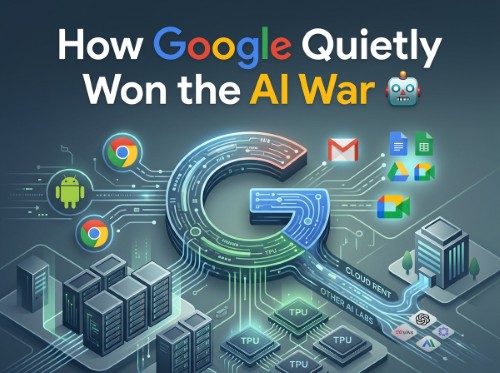
When ChatGPT burst onto the scene in late 2022, the overwhelming consensus was that Google had been caught napping. Headlines proclaimed the end of search engine dominance, casting nimble startups like OpenAI and Anthropic as the executioners of Big Tech incumbents. Fast forward to the present day, and that narrative has completely unravelled.
While public attention remains focused on benchmark battles between rival large language models, Google has quietly executed one of the most effective distribution and infrastructure strategies in corporate history. Far from losing the AI race, Google did not even need to run at the same pace as its rivals. By leveraging its vast, pre-existing software ecosystem and custom silicon hardware, Alphabet has positioned itself as the undisputed tollbooth operator of the artificial intelligence revolution.
In the digital economy, superior technology often loses to superior distribution. OpenAI achieved historic user growth through sheer organic interest, building an impressive base of active users one signup at a time. However, acquiring users manually is an uphill battle compared to owning the hardware and operating systems people use every single day.
Google’s flagship AI model, Gemini, crossed one billion monthly active users without launching a single traditional advertising campaign. This unprecedented expansion was made possible by embedding Gemini directly into the core default infrastructure of the internet:
While standalone AI applications must convince consumers to open a dedicated app or bookmark a new website, Google seamlessly integrated generative AI into existing human habits.
Perhaps the most astonishing aspect of the AI boom is that Google’s primary competitors are actively funding Alphabet’s growth. Training and running frontier AI models requires astronomical amounts of computational power, creating a severe global hardware bottleneck.
Rather than relying solely on third-party graphics processing units (GPUs), Google spent over a decade designing its own custom silicon: Tensor Processing Units (TPUs). These proprietary chips operate between 40% and 50% cheaper than comparable market alternatives, providing Google with an immense structural cost advantage.
Because hardware availability is tightly constrained, leading AI labs have been forced to rent compute capacity directly from Google Cloud:
In essence, Google acts as the ultimate corporate landlord: it designs the hardware, builds the data centre, leases the chips, co-signs the financing agreements, and owns shares in the tenant. Every time a competitor scales its AI infrastructure, Google collects a dividend.
This structural setup creates a stark financial divergence between Alphabet and venture-backed AI pioneers. Alphabet remains one of the most profitable enterprises on Earth, routinely generating tens of billions of dollars in quarterly revenue from its core advertising engine. This relentless cash flow allows Google to self-fund its AI infrastructure buildouts entirely from profits.
In contrast, much of the wider AI industry is taking on immense off-balance-sheet financial commitments. Across top technology firms, long-term infrastructure commitments have escalated dramatically. Financial analysts have raised serious concerns regarding these towering liabilities, warning of potential subprime risks within the data centre funding market if monetisation timelines stall.
While rivals run immense balance-sheet risks to stay competitive, Google’s cloud division continues to post soaring growth, with a significant portion of that revenue coming directly from rival AI laboratories.
For a period, critics argued that despite Google’s reach, competitor models offered superior intelligence and reasoning capabilities. However, that technological gap has narrowed rapidly.
Gemini has demonstrated significant improvements in complex reasoning benchmarks, software coding tasks, and long-context window processing. Crucially, Google has focused on making Gemini exceptionally cheap to run at scale, combining high quality with unmatched cost efficiency.
Developer adoption reflects this shift. Gemini API traffic has surged to tens of billions of tokens per minute, powered by millions of active software developers. For the majority of consumer and enterprise applications, an AI model does not need to be unilaterally superior; it simply needs to be highly competent and effortlessly accessible through existing software distribution channels.
Google’s AI dominance is fundamentally altering the architecture of the open web. The widespread rollout of AI Overviews within Search results has introduced a profound shift in consumer search behaviour:
Despite antitrust scrutiny and landmark legal rulings regarding search dominance, default distribution arrangements remain largely intact. Google still delivers nearly 87% of all search-driven referral traffic across the web, whereas major standalone AI platforms combined account for less than one-third of a single percentage point.
As artificial intelligence moves from text generation toward autonomous software agents—systems that can make purchases, book flights, and manage tasks on a user's behalf—Google is already laying the technical rails for the next decade.
Rather than waiting for fragmented standards to emerge, Google has introduced core open protocols across three critical pillars:
By standardising how AI agents communicate, verify identity, and settle financial transactions, Google is positioning itself as the foundational layer for agent-driven digital commerce.
Insiders have revealed that Google actually developed functional conversational AI prototypes well before ChatGPT was released to the public, but chose not to deploy them immediately due to brand safety and search revenue considerations. In hindsight, this cautious approach allowed venture-backed startups to absorb the initial capital expenditure, bear the reputational risks, and educate global consumers on how to interact with AI tools.
Once the market was primed, Google deployed its full corporate weight. Backed by custom silicon, limitless advertising profits, and pre-installed distribution across billions of smartphones and web browsers, Google did not just catch up—it redefined the parameters of the race.
Coin Bureau - Google Just WON The AI Race. That's The Problem...
"Google’s Gemini just hit 1 billion monthly users by default. No ad blitz, no big campaign, just baked into the apps and devices billions rely on. OpenAI and Anthropic? They’re now paying Google for AI compute power, fueling Google’s dominance while trying to compete.
The video breaks down how Google now controls not just the top AI model, but the infrastructure, the distribution, and the battleground for AI agents. See why smaller creators are losing clicks, and what Google’s total grip could mean for crypto, markets, and anyone using the internet."
~ TIMESTAMPS ~
0:00 – Google Already Won AI?
2:44 – Why OpenAI Pays Google
4:30 – Google's Secret Money Machine
6:46 – Gemini Quietly Caught Up
8:22 – The Internet Is Changing Forever
10:47 – Google's Endgame Revealed
Source 👉 https://www.youtube.com/watch?v=rwziiwywzP8
Disclaimer: This article is provided for informational purposes only, mistakes may be made, and it's not offered or intended to be used as legal, tax, investment, financial, or any other advice.