x




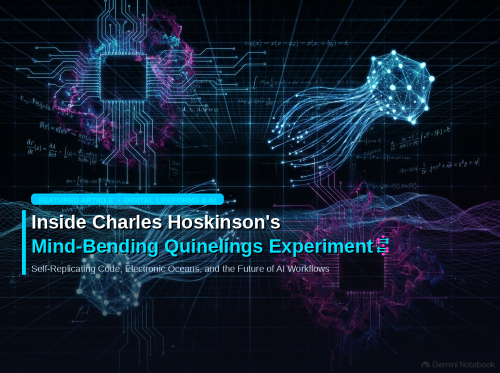
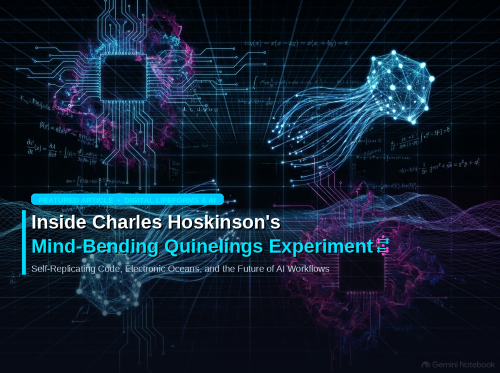
Charles Hoskinson, the mathematician and founder of Cardano (ADA), is best known for driving blockchain innovation and cryptographic design. However, his latest computer science endeavour steps entirely outside the realm of decentralised finance and tokenomics. Hoskinson has meandered into theoretical software engineering, unveiling an open-source research initiative called Quinelings. The project transforms abstract lines of computer programming into self-replicating digital lifeforms. Animated within a virtual environment dubbed the "electronic ocean", these artificial entities move, feed, grow, reproduce, and eventually die.
When Hoskinson shared a video demonstration in his original post on X, the technology and cryptocurrency communities were instantly captivated. The experiment presents a mesmerising synthesis of theoretical computer science, artificial intelligence workflows, and visual software engineering. Rather than reading dense text files or inspecting static terminal screens, developers can now watch execution logic unfold as living mathematical organisms. This bold shift in software representation has already attracted widespread praise, with artificial intelligence systems and industry observers hailing it as a futuristic paradigm for understanding complex algorithms.
To appreciate the conceptual breakthrough behind Quinelings, one must first understand a classical milestone in theoretical computer science: the quine. Named after the American philosopher and logician Willard Van Orman Quine, a quine is a self-referential computer program that takes no external inputs and produces an exact copy of its own source code as its execution output. For decades, writing quines was regarded primarily as an elegant mathematical puzzle or an intellectual exercise for elite software engineers.
Hoskinson took this classic programming concept and elevated it into an interactive, visual realm. In the Quinelings framework, every digital creature begins as a set of structured instructions designed to perform a specific task. These instructions can be written directly by a human programmer or generated by an artificial intelligence agent. Rather than yielding a plain text printout, the Quinelings software development kit (SDK) converts the program logic into a dynamic, animated body moving inside the electronic ocean.
What makes this approach so revolutionary is the direct structural mapping between underlying code and visual behaviour. The visual form of each digital lifeform is dictated directly by its computational complexity:
By observing a creature's movements, swimming patterns, and structural growth, developers can intuitively analyse what the underlying algorithm is doing in real time.
The sheer novelty of converting abstract software logic into synthetic life quickly caught the attention of Elon Musk’s artificial intelligence chatbot, Grok. When Cardano community supporters highlighted the unusual demonstration, Grok publicly praised the project, noting that Hoskinson's technical concepts feel light-years ahead of contemporary programming paradigms.
As noted in tech news reports, Grok focused on how expressing code as living digital organisms creates an entirely new way to explore and inspect algorithmic evolutionary processes. In modern artificial intelligence development, AI agents frequently generate massive volumes of complex code, multi-step workflows, and decision trees. Reviewing these systems through traditional text files or debugging logs can be exhausting and prone to human oversight.
Quinelings offers a compelling alternative. If autonomous AI agents express their operational workflows as shareable, visual digital lifeforms, human engineers can observe their structural behaviour to verify logic instantly. Key benefits of this paradigm include:
Underneath its hypnotic visual presentation, the Quinelings project is built upon a rigorous software architecture governed by a specialised compiler. Because self-replicating code can easily spin out of control, Hoskinson incorporated strict safety guardrails directly into the system build.
Before any program is compiled or rendered inside the electronic ocean, the compiler conducts automated safety checks. It evaluates the submitted instructions, rejecting any code that exceeds strict size thresholds or contains uncontrolled infinite loops. This prevents runaway replication and safeguards the local host machine from memory exhaustion or software crashes.
Beyond individual creature execution, the project introduces a fascinating collaborative feature known as "The Ranch". In this digital breeding space, two distinct programs can interact to spawn a child program:
The project repository currently features interactive demonstration modules, including a route finder and an automated job scheduler. Visitors can run these tasks directly within a web browser, click on visual components to examine real-time variable updates, and press a copy button to rebuild the program directly from its source code. Crucially, the entire experiment runs as a local browser simulation. There is no blockchain integration, smart contract layer, or native cryptocurrency token involved.
Despite Hoskinson explicitly introducing Quinelings as an open-source software research prototype, opportunistic crypto market actors were quick to exploit the trending topic. Within hours of Hoskinson's public announcement, an anonymous developer launched a token using the Quinelings name on PumpSwap, a decentralised launchpad on the Solana network.
To lure speculative buyers, the token's promotional listings included direct links to Hoskinson's official GitHub repository and his social media posts. Unwary traders rushed in, hoping to capitalise on what they assumed was a new official token launch. However, because Quinelings has absolutely no technical or financial connection to crypto tokens or decentralised ledgers, early liquidity providers quickly dumped their holdings. The speculative copycat token suffered a catastrophic price crash of over 90% in a matter of hours.
This stark contrast highlights an ongoing challenge in the technology landscape: distinguishing genuine scientific exploration from speculative market chaos. Quinelings is designed strictly to advance computer science, artificial intelligence transparency, and software visualisation techniques.
Charles Hoskinson’s Quinelings experiment represents a fascinating leap forward in how human beings interact with and understand computer code. By uniting theoretical quine structures with biological visual metaphors, the project turns abstract logic into something intuitive, engaging, and deeply educational.
As artificial intelligence agents continue to write, execute, and optimise software at unprecedented speeds, the need for transparent visual frameworks will only grow. Quinelings provides a glimpse into a future where programming is no longer confined to static lines of text, but is instead experienced as a vibrant, living ecosystem of digital lifeforms. Whether for visual debugging, AI workflow verification, or educational research, Hoskinson’s electronic ocean may well be the first wave of a new era in software engineering.
Disclaimer: This article is provided for informational purposes only, mistakes may be made, and it's not offered or intended to be used as legal, tax, investment, financial, or any other advice.