x




As artificial intelligence shifts from simple chat interfaces to fully autonomous agents, enterprise technology leaders face a daunting dilemma: how do you empower employees with intelligent digital assistants without handing over the keys to the corporate kingdom?
Enter Cloudflare OS, an ambitious open-source AI agent platform designed to give every employee a secure workspace, personal app-building tools, and dedicated AI agents. Originally developed as an internal tool to help thousands of Cloudflare staff automate daily workflows, draft documents, and build micro-apps, this platform has now been rebuilt from the ground up for public deployment.
Here is a deep dive into what Cloudflare OS actually is, how its unique security architecture works, and why it represents a major step forward for enterprise AI infrastructure.
Cloudflare OS is an open-source platform that brings autonomous AI agents directly to the enterprise edge. Rather than treating AI as a siloed search tool or standalone assistant, Cloudflare OS provides a cohesive runtime environment where agents can write code, interact with company data, and construct bespoke applications.
When Cloudflare initially rolled out the prototype to its own workforce, the goal was simple: democratise task automation. Employees across non-engineering departments—from operations to marketing—began using the platform to generate slide decks, streamline repetitive tasks, and construct custom micro-tools.
Recognising the broad potential of this setup, Cloudflare rebuilt the system with a heavy emphasis on security and governance before opening its code to the developer community.
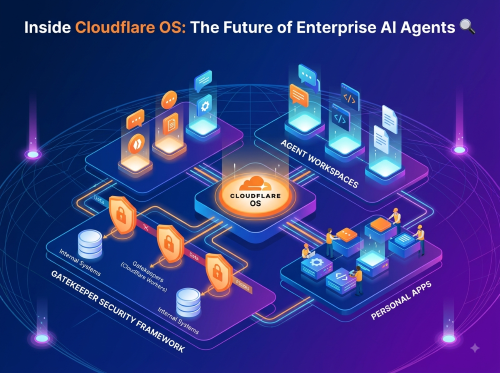
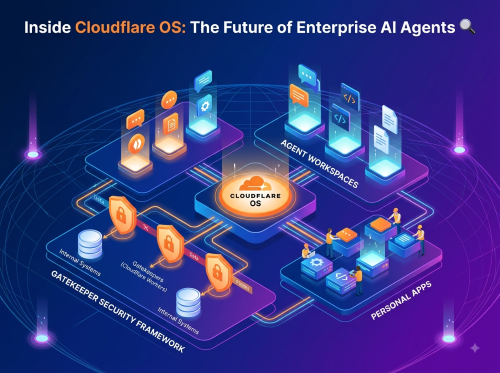
At its technical foundation, Cloudflare OS relies on three distinct layers that work together to balance usability with strict enterprise control:
1. The Isolated Agent Workspace
Every conversation begins within a dedicated workspace grounded in your organisation's curated knowledge and specific skills. When an agent needs to calculate data, process information, or run scripts, it does so within an isolated runtime environment. This sandbox approach ensures that agent-generated code remains contained and cannot breach adjacent systems.
2. The Gatekeeper Security Framework
The standout innovation within Cloudflare OS is its security layer, designed around a zero-trust model. Traditional AI deployments often require giving agents broad, long-lived API keys to interact with company software. Cloudflare OS rejects this approach entirely. Agents start with zero default access. Instead, service-specific Cloudflare Workers known as Gatekeepers mediate every single resource request. Credentials never touch the agent or its code directly, eliminating the risk of key exposure.
3. Personal, Modifiable Applications
Cloudflare OS elevates prompt interaction by turning conversations directly into functional software. Using dynamic workers and object-capability protocols like Cap'n Web, an agent can spin up a lightweight full-stack application or workflow on the fly. These applications run directly as Cloudflare Workers, allowing personal tools to persist and execute tasks even when the user is offline.
While standards like the Model Context Protocol (MCP) help agents understand which tools are available to call, they often fall short when governing which specific data resources an agent should be permitted to view or log.
Cloudflare OS fills this critical governance gap. By routing all interactions through Gatekeepers, the system logs every observation and verifies human permission levels before displaying any output created by an agent. If an employee does not have permission to view a specific database row, their AI agent won't be able to display it either.
By treating security as a fundamental platform service rather than an afterthought left to individual app creators, Cloudflare ensures robust compliance across every user-generated workflow.
By open-sourcing Cloudflare OS, the company provides developers with complete transparency into the code that drives agentic automation. However, it is worth noting that the runtime architecture remains deeply tied to Cloudflare's edge network.
For organisations already heavily invested in edge infrastructure, this setup provides unmatched speed, security, and scalability. For others, it highlights a broader industry trend: open-source software increasingly thrives when paired with high-performance distributed cloud ecosystems.
Ultimately, Cloudflare OS offers a compelling framework for any organisation seeking to deploy autonomous AI agents safely, replacing risky API management with fine-grained, zero-trust governance.
Disclaimer: This article is provided for informational purposes only, mistakes may be made, and it's not offered or intended to be used as legal, tax, investment, financial, or any other advice.