x




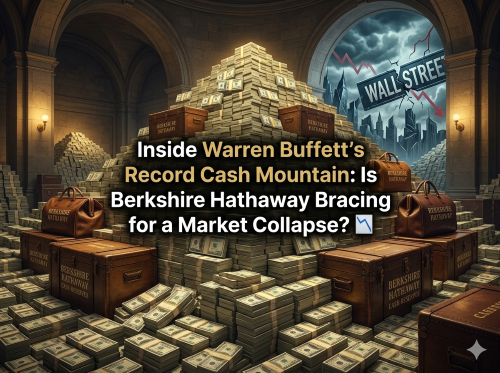
The financial world is buzzing with a single headline: Warren Buffett is sitting on more cash than at any other moment in history. For decades, Berkshire Hathaway’s core philosophy was straightforward—find wonderful businesses, buy them, and hold them effectively forever. In that world, cash was viewed as an idle, almost embarrassing pool of money that simply had not found a proper home yet.
However, a dramatic shift has occurred. Berkshire Hathaway’s cash and government treasury bills have rocketed to an unprecedented $397.4 billion. To put that into perspective, this idle cash hoard is now significantly larger than Berkshire’s entire publicly traded stock portfolio, which stands at roughly $263.1 billion. It is a corporate cash reserve larger than the entire annual economic output of South Africa, and it surpasses the combined cash holdings of tech titans Apple, Amazon, Alphabet, and Microsoft.
By doing absolutely nothing and letting this money sit safely in short-term government debt yielding four to five per cent, Berkshire is pulling in between $15 billion and $20 billion a year in completely risk-free income. This deliberate cash accumulation has left ordinary investors wondering: Is the world's most patient investor bracing for an imminent stock market crash?
This record-breaking cash mountain did not appear overnight. It was built meticulously, share by share, over three and a half years. Every quarter, institutional investors managing large sums must file a Form 13F with the US Securities and Exchange Commission (SEC). When these public receipts are lined up side-by-side, they reveal a relentless pattern.
For 14 consecutive quarters, Buffett has been a net seller of equities. Across this stretch, he has offloaded approximately $195 billion more in stock than he has bought—amounting to roughly $3.7 billion of net selling every single week.
The most striking example of this liquidation is Apple. In late 2023, Berkshire held 915 million shares of Apple, a position worth over $150 billion that made the portfolio look almost like a one-stock show. Then the selling began. Buffett halved the position in a single quarter in mid-2024, and by the end of 2025, the stake was slashed by 75 per cent down to just 228 million shares.
While Buffett cited tax reasons—locking in capital gains before expected corporate tax rate hikes—the broader truth lies in pure valuation discipline. Apple's price-to-earnings (P/E) ratio had ballooned from around 12 to 16 when he initially purchased it to roughly 33 by the time he aggressively sold. The stock had simply become too expensive.
Apple was not an isolated case. Buffett also cut Berkshire's long-held Bank of America stake by roughly half, liquidated credit card giants Visa and Mastercard entirely, and sold off 77 per cent of Berkshire’s Amazon holdings. The smartest money in the room has been quietly heading for the exit.
Despite the alarming headlines screaming about a doomsday prediction, it is vital to separate media sensationalism from reality. Warren Buffett has not actually predicted a market crash. If you look at the transcripts from Berkshire Hathaway's annual meeting, his language is far more nuanced.
Buffett described the modern stock market as a "church with a casino attached," noting that the casino side has become vastly more attractive to the public than in the past. He cautioned that retail investors are in an unprecedented "gambling mood," pointing to the explosive rise of trading one-day options, which he classified as pure gambling rather than investing or even speculating. He has not given a specific date or percentage for a correction; he is simply reacting to a fundamental shift in market psychology.
This caution is backed up by the famous "Buffett Indicator," a metric that divides the total value of the US stock market by the size of the US economy (Gross Domestic Product). Historically, a reading of 100 per cent represented fair value, while anything below 90 per cent signalled strong buying opportunities.
Today, depending on the exact calculation used, the indicator sits between 176 per cent and a staggering 227 per cent. Even during the absolute peak of the dot-com bubble in 2000, the indicator only reached between 140 and 160 per cent. By this metric, the current market is priced more aggressively than the most notorious financial bubble in living memory.
While Buffett warns against relying blindly on any single metric—as the indicator ignores interest rates, intangible tech assets, and the fact that American corporations now earn 40 per cent of their revenue overseas—the overall picture remains unsettling. Berkshire is looking at the most expensive market in a generation and deciding that doing nothing is the smartest play.
Just as Buffett stepped back into a defensive posture, a fascinating contradiction emerged at the heart of Berkshire Hathaway. At the start of 2026, Buffett officially handed the chief executive officer (CEO) role to his long-anointed successor, Greg Abel, while retaining his role as chairman. While Buffett's massive cash pile signals extreme patience, Abel has looked at the very same market and immediately started deploying billions of pounds.
Abel’s first major move was to triple Berkshire's modest $4.3 billion stake in Google's parent company, Alphabet, turning it into a massive $17 billion top-five holding. He followed this by committing another $10 billion directly into Alphabet's massive artificial intelligence (AI) infrastructure fundraising initiative. Acting as an anchor investor, Abel secured this deal at a negotiated private discount to the public market price—a structural move highly reminiscent of Buffett's legendary emergency investments during the 2008 financial crisis, except this time, it was executed during a tech boom.
Abel did not stop with artificial intelligence. He broke from Buffett’s past strategy by re-entering the airline sector, taking a $2.65 billion stake in Delta Air Lines—a sector Buffett famously dumped in 2020 after calling it a bottomless pit. Abel also targeted the housing market, orchestrating a $6.8 billion all-cash acquisition of homebuilder Taylor Morrison at a 24 per cent premium, aiming to merge it with Berkshire's Clayton Homes to build a residential real estate powerhouse.
Buffett has publicly given these aggressive moves his full blessing, praising Abel's speed and efficiency in executing deals independently.
This divergence of strategies leaves regular retail investors in a challenging position. The uncomfortable truth is that everyday investors cannot simply copy Berkshire's new institutional plays. When Greg Abel invests billions, he does so via private, weekend phone calls that secure discounted terms unavailable to the public. Furthermore, because regulatory 13F filings are published up to 45 days after a quarter ends, the public only finds out about these moves after the market has already reacted and prices have adjusted.
The deeper risk lies within the average retirement account. Most modern pensions rely heavily on low-cost S&P 500 index funds under the assumption that they offer a safe, highly diversified basket of 500 distinct companies. In reality, the modern stock market has become incredibly top-heavy. A mere handful of massive technology names are driving the vast majority of index returns.
When the most disciplined value investor alive looks at this highly concentrated, expensive market and chooses to sit on a record mountain of cash, it serves as a powerful reminder to check your own risk tolerance. Buffett's profound silence in the equities market may not be a crystal-ball prediction of a crash, but it stands as the loudest warning of his historic career to practice patience when the rest of the market is in a gambling mood.
Finance Bureau - Buffett Expects a COLLAPSE
"Buffett just built the biggest cash hoard in American corporate history, selling stocks for years and leaving billions idle. Some claim this predicts disaster, but the real story is hidden in the numbers. This breakdown follows the paper trail, exposes market psychology shifts, and explains why Buffett hasn’t bought back in.
Buffett’s successor is making opposite bets, pouring billions into AI, airlines, and housing. Find out what this clash inside Berkshire Hathaway could mean for your money, and why average investors can’t just follow billionaire trades anymore."
~ TIMESTAMPS ~
0:00 Buffett’s $397 Billion Cash Warning
2:12 Why Berkshire Is Selling Stocks Instead of Buying
4:18 The Massive Apple Dump Nobody Saw Coming
6:22 Buffett’s Real Message About Market “Gambling”
8:35 Is the Stock Market More Expensive Than the Dot-Com Bubble?
10:45 Greg Abel’s $10 Billion AI Bet Changes Everything
13:05 What Buffett’s Cash Pile Means for Your Retirement Portfolio
Source 👉 https://www.youtube.com/watch?v=Y8fJNR_xsnI
Disclaimer: This article is provided for informational purposes only, mistakes may be made, and it's not offered or intended to be used as legal, tax, investment, financial, or any other advice.