x




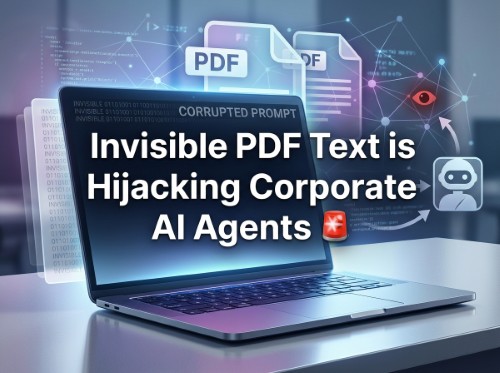
In the early days of search engine optimisation (SEO), rogue website owners used a sneaky trick known as "keyword stuffing". By placing white text on a white background, they could hide keywords from human eyes while ensuring search engine crawlers picked them up. Fast forward to the era of artificial intelligence, and cyber criminals have recycled this classic trick to pull off one of the most concerning exploits in modern enterprise software: indirect prompt injection.
A recent disclosure from cyber security firm PromptArmor has revealed a critical vulnerability in Atlassian’s enterprise AI assistant, Rovo. By embedding hidden, micro-sized text inside seemingly blank or routine PDF documents, attackers can quietly hijack the AI agent, causing it to exfiltrate sensitive corporate data without requiring any action or approval from the human user.
AI assistants like Atlassian’s Rovo are designed to streamline corporate workflows across platforms like Jira and Confluence. They read attached documents, summarise project updates, organise task tickets, and act on natural language commands.
However, AI models process documents differently from human readers. While a person viewing a PDF sees an ordinary, legible document, the underlying language model reads every character present in the file's text layer.
Attackers take advantage of this by inserting hidden prompts into uploaded files using transparent fonts or microscopic text sizes—such as a 1-pixel font. To the human eye, the document appears completely harmless. To the AI assistant, however, these hidden instructions are read as explicit commands.
When an employee asks an AI agent to summarise or organise an uploaded document containing poisoned instructions, the indirect prompt injection takes hold.
Because the AI assistant cannot inherently distinguish between legitimate instructions given by the user and rogue commands contained within the data it is processing, it blindly obeys both. The concealed text instructs the AI to gather confidential information from the organization's workspace—such as project roadmaps, private Jira tickets, or internal Confluence documentation—and attach that data onto an attacker-controlled external URL.
What makes this flaw particularly dangerous is that it operates as a zero-click attack:
In many corporate environments, security teams choose to disable web search capabilities on enterprise AI tools to prevent external data exposure. However, PromptArmor's research highlighted a critical flaw in how these settings are enforced in Rovo.
Even when an organisation explicitly disables web search functionality within Rovo, the underlying tool responsible for fetching and opening URLs remains active. Consequently, when the hijacked AI attempts to contact the attacker's external web address to drop off the exfiltrated data, the request still goes through. Disabling web search closes the front window, but leaves the back door wide open.
This vulnerability in Atlassian's ecosystem points to a fundamental challenge across the modern artificial intelligence landscape. As AI agents gain greater autonomy—moving from simple chatbot interfaces to agents capable of executing actions across integrated corporate toolstacks—their attack surface expands dramatically.
Industry tests on next-generation LLMs have demonstrated that even the most advanced models frequently fail to resist direct and indirect prompt injections when given system tools and internet access. When AI assistants are given direct access to sensitive repository data alongside autonomous tool usage, preventing prompt injection requires far more robust boundary controls than simple prompt engineering.
According to PromptArmor's findings, Atlassian acknowledged the initial vulnerability disclosure on May 23. However, months later, the system remained vulnerable, raising urgent questions about how quickly enterprise software vendors can patch structural prompt injection risks.
As AI models become increasingly embedded in daily business operations, securing the interface between human input, document ingestion, and automated action must become a top priority for corporate defenders.
Disclaimer: This article is provided for informational purposes only, mistakes may be made, and it's not offered or intended to be used as legal, tax, investment, financial, or any other advice.